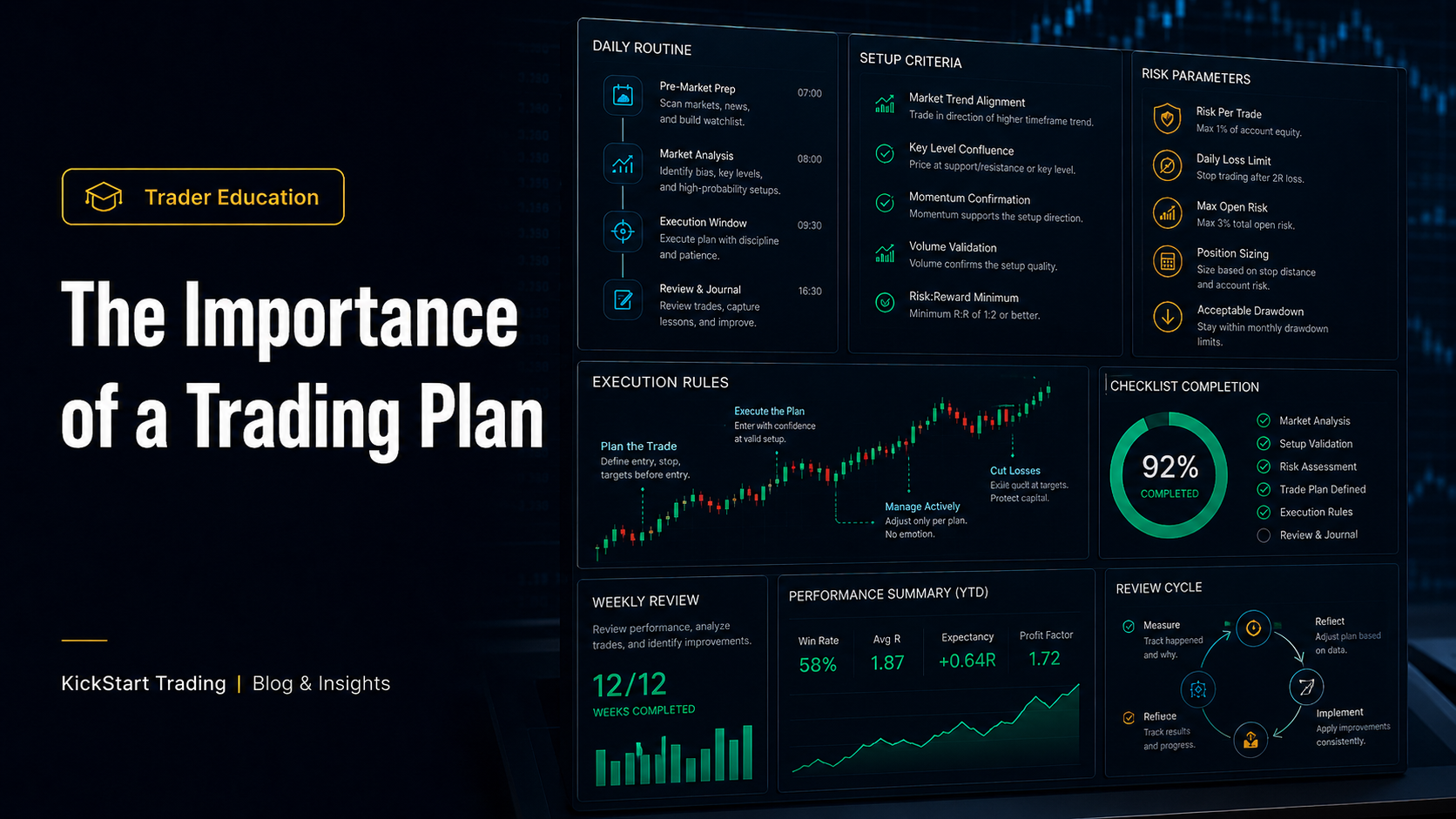
The Importance of a Trading Plan: Why Serious Traders Need a Blueprint
“If you fail to plan, you should plan to fail.”
That was one of the first lessons I was taught when I began my trading journey.
And honestly, it has stayed with me ever since.
When most traders first discover the markets, they usually want to jump straight into the exciting parts: entries, indicators, candlesticks, Fibonacci, account sizes, payouts, and profit targets.
That is understandable.
But trading is not just about finding opportunities.
Trading is about making disciplined decisions under pressure.
And if you do not have a plan before that pressure arrives, the market will usually expose it.
A proper trading plan is not just a document.
It is your blueprint.
It tells you what you are doing, why you are doing it, how you will manage risk, how you will handle emotions, what markets you will trade, what setups you are looking for, and when you should stay out.
Without a plan, trading can become reactive.
And reactive trading is dangerous.
Trading without a plan is too close to gambling
One of my mentors once told me something I never forgot:
“Trading without a plan is a bit too much like gambling for me.”
That hit me.
At the time, I was still early in my own journey. I had gone through the educational material, I was learning theory, and I was beginning to understand how markets moved. But there is a big difference between learning concepts and operating with a real plan.
My mentor was an extremely disciplined person.
He had a routine. He woke up early. He got into the office before most people. He liked the quiet of the morning because it gave him space to think, prepare, and focus.
He also liked to be present during the overlap between the London and New York sessions, because that period often brings increased volume and volatility.
Then, at a specific time each day, he would go to the gym.
Not when it was convenient.
Not only when he felt like it.
It was part of his routine.
He understood that success, in trading and in life, usually requires structure.
That lesson shaped me.
Because if a trader has no plan, no structure, no limits, and no process, then every decision becomes emotional.
And once emotion takes over, the trader is no longer operating like a trader.
They are hoping.
They are reacting.
They are gambling.
A trading plan gives your decisions structure
A trading plan helps remove unnecessary decision-making from the heat of the moment.
That matters because trading is emotionally charged.
When money is involved, everything feels different.
A trade that looked simple during analysis can suddenly feel stressful once price starts moving. A losing trade can trigger frustration. A missed entry can create fear of missing out. A winning trade can create greed. A drawdown period can create panic.
A trading plan gives you something to return to when those emotions appear.
It answers questions before the market pressures you into answering them emotionally.
Questions like:
- What markets am I trading?
- What timeframes am I using?
- What setups am I allowed to take?
- What invalidates my trade idea?
- How much am I risking?
- Where does my stop loss go?
- Where does my take profit go?
- How many trades am I allowed to take in a day?
- When do I stop trading?
- What do I do after a losing streak?
- What do I do after a winning streak?
Without answers to those questions, a trader is forced to improvise.
And improvising under pressure is not a trading plan.
A trading plan should be simple enough to follow
A good trading plan should be clear.
It does not need to be complicated.
In fact, if your plan is too complicated to follow under real market conditions, it probably is not useful.
Your plan should be specific, practical, and easy to understand.
You should be able to explain it to another trader clearly.
More importantly, you should be able to execute it consistently.
Many traders make the mistake of building a plan that sounds impressive but is impossible to follow. They include too many markets, too many indicators, too many setups, too many exceptions, and too many moving parts.
That creates confusion.
A trading plan should reduce confusion, not create more of it.
Simple does not mean basic.
Simple means executable.
Start with the overview
Every trading plan should begin with an overview.
This is where you define what you are doing and why.
Ask yourself:
- Why am I trading?
- What am I trying to achieve?
- What type of trader am I trying to become?
- What does success look like for me?
- What expectations do I have?
- Are those expectations realistic?
This matters because many traders begin with vague goals.
They say things like:
“I want to make money.”
That is not a plan.
It is a desire.
A stronger goal is specific, measurable, and grounded in reality.
For example, a trader might say:
“I want to build a consistent process over the next six months, risk no more than 1% per trade, journal every setup, and work toward becoming eligible for a funded account once I can demonstrate discipline.”
That is much better.
It defines behaviour, risk, time, and process.
Good trading begins with better questions.
Define your trading psychology rules
Most traders know they need technical rules.
Fewer traders define psychological rules.
That is a mistake.
Your psychology will affect your execution every day.
A trading plan should include self-awareness.
Ask:
- When does trading feel fulfilling?
- When does trading become distressing?
- What emotions cause me to make poor decisions?
- Do I chase trades?
- Do I revenge trade?
- Do I hesitate after losses?
- Do I get overconfident after wins?
- Do I struggle to walk away?
- Do I trade better at certain times of day?
This is where a trader begins to understand themselves.
Trading psychology is not just about staying positive.
It is about knowing your own patterns well enough to protect yourself from them.
If you already know that you trade badly after two losses in a row, your plan should include a rule for that.
If you already know that you increase lot size after a win, your plan should address that.
If you already know that you trade poorly when tired, stressed, or distracted, your plan should not ignore it.
A proper plan does not pretend you are emotionless.
It protects the account from the emotional version of you.
For a deeper foundation on this, read Trading Psychology 101: Master Your Mind Before You Trade.
Write a statement for good days and bad days
One useful exercise is to write two short statements:
A statement for good trading days.
And a statement for bad trading days.
On good days, traders can become overconfident. They may feel invincible. They may increase risk, take unnecessary trades, or assume that the market will keep rewarding them.
On bad days, traders can become frustrated. They may revenge trade, abandon the plan, or try to force the market to give back what was lost.
Both situations are dangerous.
A good-day statement might remind you:
“Stick to the plan. Do not increase risk just because the last trade won. Protect the account and keep executing.”
A bad-day statement might remind you:
“Losses are part of trading. Stop when the plan says stop. Do not revenge trade. Review calmly and return when clear.”
These statements may sound simple, but they can be powerful.
Sometimes the trader does not need a new strategy.
They need a reminder written by their calm self before the emotional self takes over.
Define your trading strategy
Your trading plan should clearly define your strategy.
Not vaguely.
Clearly.
You should know what markets you trade, what timeframes you use, what setups you are looking for, and what conditions need to be present before a trade is valid.
Ask:
- What asset or assets am I trading?
- What sessions am I trading?
- What timeframe do I use for analysis?
- What timeframe do I use for entries?
- What indicators, if any, do I use?
- What does a valid setup look like?
- What confirms the idea?
- What invalidates the idea?
- Where does the stop loss go?
- Where is the target?
- What conditions tell me not to trade?
This is where many traders expose the weakness of their process.
If a trader cannot describe their setup clearly, they probably do not have one.
They may have ideas.
They may have patterns they like.
They may have things they have seen work sometimes.
But that is not the same as a defined strategy.
A trading plan forces clarity.
And clarity improves execution.
Avoid trading too many strategies at once
Many traders struggle because they are trying to trade too many things.
One strategy from YouTube.
Another from a Discord group.
A few indicators from social media.
A Fibonacci method.
A breakout method.
A scalping method.
A swing trading method.
Then they wonder why they feel confused.
In the beginning, it is usually better to focus on fewer strategies and master them properly.
That does not mean a trader can never evolve.
Of course they can.
But jumping from one approach to another too quickly makes it almost impossible to know what is working and what is not.
A plan should help you stay focused.
If you are still building your technical foundation, start with core concepts like support and resistance, Japanese candlesticks, and Fibonacci in forex trading.
Trade management belongs in the plan
Entering a trade is only one part of trading.
Managing the trade is just as important.
Your plan should define how you handle open positions.
For example:
- Will you move your stop loss to breakeven?
- If so, when?
- Will you take partial profits?
- Will you trail the stop?
- Will you let the trade either hit stop loss or take profit?
- Will you close trades before major news?
- Will you hold trades overnight?
- Will you manually exit if structure changes?
Many traders enter with a plan but manage emotionally.
They cut winners too early because they are afraid.
They hold losers too long because they are hopeful.
They move stops because they do not want to be wrong.
They close trades randomly because price hesitates.
A trade management plan helps prevent that.
The goal is to make decisions according to structure, not fear.
Risk management is the survival section
Risk management is one of the most important parts of any trading plan.
Without risk management, even a good strategy can fail.
Your plan should define:
- Risk per trade
- Maximum daily loss
- Maximum weekly loss
- Maximum number of trades per day
- Rules after consecutive losses
- Position sizing method
- Stop-loss placement rules
- Drawdown limits
- When to stop trading and review
This is where traders protect themselves from account destruction.
If you are placing small trades followed by huge trades with no logic, you are not trading professionally.
If you are increasing risk after losses, you are not following a risk plan.
If one bad day can destroy weeks of progress, the risk structure is wrong.
Risk management is not the boring part of trading.
It is the part that keeps you in the game.
Read Risk Management: The Skill Most Traders Learn Too Late and Drawdown Explained: What Every Serious Trader Must Understand if you want to build this part properly.
Daily limits matter
Daily limits help protect traders from emotional spirals.
A trading plan should define when the trading day is over.
For example:
- Stop after two full-risk losses
- Stop after hitting a daily loss limit
- Stop after three trades
- Stop after a major rule break
- Stop when emotional or distracted
- Stop when market conditions no longer match the plan
This is especially important for traders pursuing funded accounts.
Funded accounts often include daily loss limits, maximum drawdown rules, and account-specific restrictions. That means one emotional session can create serious damage.
Whether a trader chooses 1-Step Funding, 2-Step Funding, Futures Funding, or Instant Funding, the trader still needs discipline.
Funding does not replace a trading plan.
It makes the need for one even greater.
Journaling turns experience into improvement
A trading journal should be part of the plan.
Trading without journaling makes it harder to improve because you are relying on memory, and memory is often biased.
A good journal helps you review:
- Why you entered
- Whether the setup was valid
- Whether you followed the plan
- Whether risk was correct
- Whether emotion affected the trade
- What you could improve
- What market conditions were present
- Whether the trade matched your strategy
The point is not to punish yourself.
The point is to learn.
Experience alone does not make a trader better.
Reviewed experience does.
A trader who journals honestly can begin to see patterns.
A trader who refuses to review will often repeat the same mistakes.
Your plan should evolve
A trading plan is not carved in stone forever.
Markets change.
Your skill level changes.
Your risk tolerance may change.
Your preferred markets may change.
Your psychology may improve.
Your strategy may become more refined.
That is normal.
But changes should be deliberate.
Do not rewrite your plan every time you take a loss.
Do not abandon a strategy after one bad week.
Do not add a new method just because you saw someone else post a winning trade.
Review your plan at set intervals.
For example, weekly, monthly, or after a defined sample size of trades.
That keeps you flexible without becoming chaotic.
Education helps you build a better plan
Many traders struggle to write a trading plan because they do not yet understand what should go into one.
That is where structured education matters.
A trader needs to understand the building blocks: candlesticks, market structure, support and resistance, Fibonacci, risk management, psychology, journaling, and execution.
Those pieces connect.
A plan becomes much stronger when the trader understands how they work together.
That is why The Ultimate Forex Trading Course™ exists as part of the KickStart ecosystem.
It is not about memorising random setups.
It is about building the foundation needed to make better trading decisions.
If you are not sure where to begin, start with the free trading training and build from there.
Final thoughts
A trading plan is your blueprint for success.
It does not guarantee profitability.
Nothing does.
But it gives you structure.
It gives you rules.
It gives you a way to measure your decisions.
It helps separate trading from gambling.
And it gives you something to return to when emotions start trying to take control.
At KickStart Trading, we believe serious traders need more than motivation. They need education, structure, discipline, risk management, psychology, and a repeatable process.
A dream without a plan is just a wish.
If you want to become a better trader, start by building the blueprint you are willing to follow.