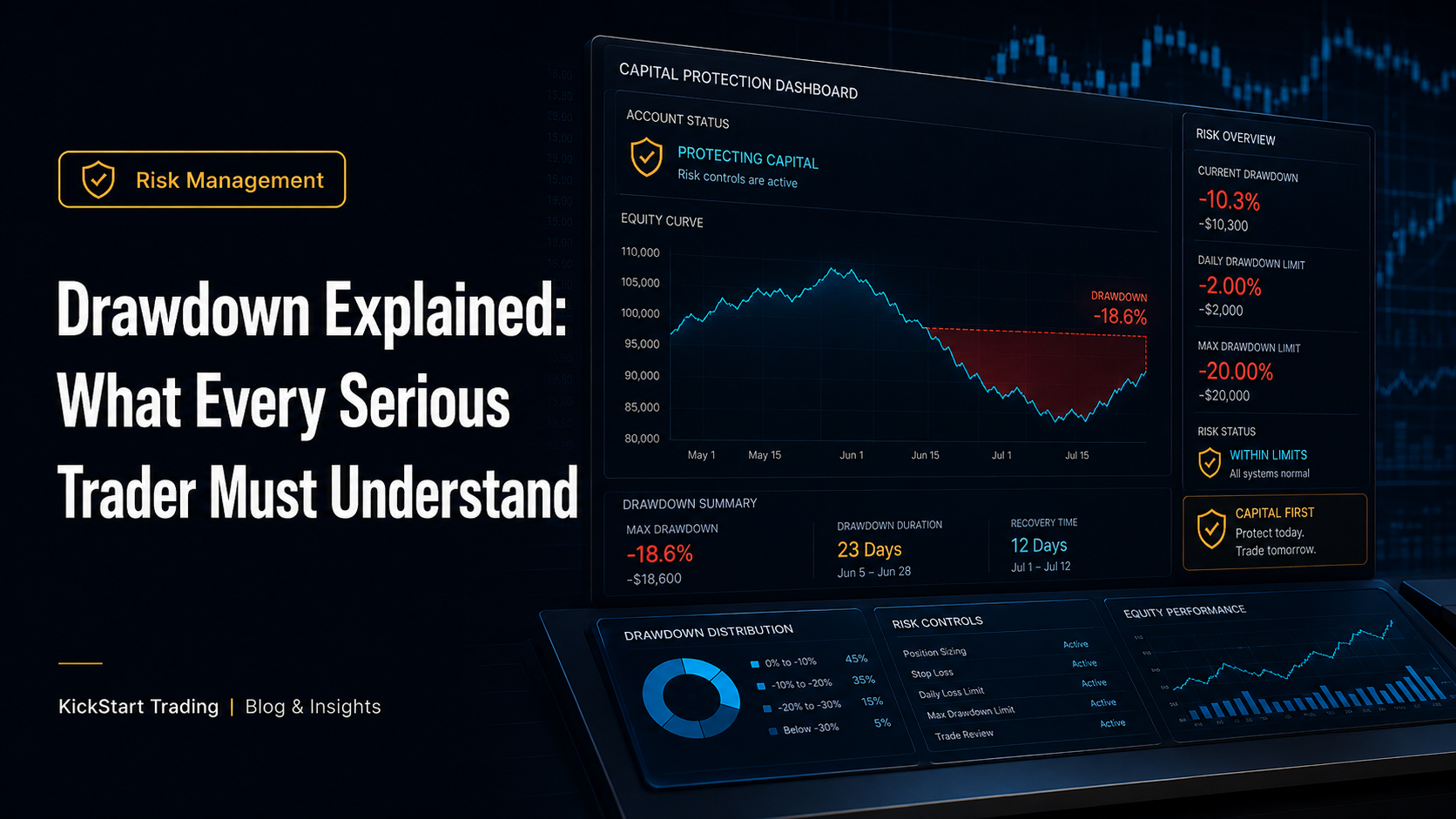
Drawdown Explained: What Every Serious Trader Must Understand
Most traders think about profit first.
How much can I make?
How quickly can I grow the account?
How big should the target be?
How much could this funded account pay out?
Those questions are understandable, but they are not the questions serious traders ask first.
Serious traders think about risk first.
And one of the most important risk concepts every trader must understand is drawdown.
Drawdown is not just a technical term. It is one of the main ways trading performance, account health, emotional discipline, and funded-account survival are measured.
If you do not understand drawdown, you do not fully understand risk.
And if you do not understand risk, you are not ready to trade seriously.
What is drawdown?
Drawdown is the decline from an account’s peak value to a lower value.
In simple terms, it measures how much the account has dropped from its highest point.
For example, if an account grows from $10,000 to $11,000, then falls to $10,400, the drawdown from the peak is $600.
That does not necessarily mean the account is losing overall from its starting balance. It means the account has pulled back from its highest value.
This distinction matters because many traders only think in terms of starting balance, profit, or loss. But drawdown focuses on account decline from a high point, which is extremely important in both personal trading and funded trading.
Why drawdown matters
Drawdown matters because it shows how much stress your account is under.
A trader can have profitable periods and still manage risk poorly. They may grow the account quickly, but if they give most of it back through emotional trading, overleveraging, or poor trade management, that trader is not stable.
Drawdown reveals the quality of risk control.
It shows whether the trader can protect capital, manage losing streaks, and avoid destructive behaviour when the market stops cooperating.
This is why risk management is one of the most important skills a trader can develop.
Profit gets attention.
Risk keeps you alive.
Drawdown is not always failure
Drawdown is part of trading.
Every real trader experiences it.
Even strong strategies go through losing periods. Even disciplined traders take losses. Even good setups fail. Even high-probability methods can produce a sequence of losing trades.
The existence of drawdown does not automatically mean something is wrong.
The question is whether the drawdown is controlled, expected, and within the limits of the trading plan.
There is a major difference between normal drawdown and destructive drawdown.
Normal drawdown is part of the statistical reality of trading.
Destructive drawdown usually comes from poor risk management, emotional decision-making, revenge trading, overtrading, or refusing to accept losses.
Understanding that difference is critical.
Maximum drawdown
Maximum drawdown is the largest permitted decline on an account.
In personal trading, a trader may define this for themselves. For example, they may decide that if the account falls by 10%, they will stop trading, review the strategy, and reduce risk.
In funded trading, maximum drawdown is normally set by the funding provider.
That rule defines how much the account can lose before it violates the account terms.
This is why traders must read rules carefully before choosing a funded account. A trader who does not understand the drawdown rule may accidentally violate an account even if they believe they are trading reasonably.
Before choosing any pathway — whether Instant Funding, 1-Step Funding, 2-Step Funding, or Futures Funding — traders need to understand how drawdown is calculated.
Daily loss limit
A daily loss limit is different from maximum drawdown.
Maximum drawdown usually refers to the total permitted account loss. The daily loss limit refers to how much the trader can lose within a trading day.
This rule exists to stop traders from destroying an account in one emotional session.
It protects the account from revenge trading, overexposure, frustration, and panic.
For funded traders, the daily loss limit is one of the most important rules to respect.
A trader can be technically skilled and still fail an account by losing too much in one day.
This is why discipline matters so much. You do not only need to know how to find trades. You need to know when to stop.
Static drawdown
Static drawdown means the loss limit is fixed rather than continuing to trail as the account grows.
For example, if the account has a static drawdown based on the starting balance, the maximum permitted loss level remains tied to that defined point rather than constantly moving upward with new equity highs.
This can make planning easier for certain traders because the risk boundary is clearer.
Static drawdown can be especially appealing to traders who want a more predictable account structure. It does not remove risk, but it can reduce some of the pressure created by trailing drawdown rules.
That is one reason some traders may prefer a 2-Step Funding pathway if the static drawdown structure suits their approach.
The key is not simply choosing the account with the most exciting profit target.
The key is choosing the rule structure you can trade responsibly.
Trailing drawdown
Trailing drawdown moves as the account reaches new highs.
Depending on the account model, the drawdown limit may trail behind equity or balance until it reaches a certain point or locks at a defined level.
Trailing drawdown can be more psychologically challenging because traders may feel pressure after gaining profit. They may become afraid of giving back progress, or they may overprotect trades too early.
It also means traders need to understand how open profit, closed profit, and account highs affect the drawdown calculation.
A trader who does not understand trailing drawdown can make serious mistakes.
This is why account rules should never be skimmed.
They should be studied.
Drawdown affects psychology
Drawdown is not only a numbers issue.
It is also a psychological issue.
When traders enter drawdown, emotions usually intensify. Fear increases. Confidence drops. Frustration rises. The desire to “make it back” becomes stronger.
This is where many traders lose control.
A trader might start taking lower-quality setups. They might increase risk to recover faster. They might abandon their plan because they feel pressure. They might revenge trade after a losing streak.
That behaviour can turn normal drawdown into account-ending drawdown.
This is why trading psychology and risk management cannot be separated.
Your risk plan protects the account.
Your psychology determines whether you follow it.
Drawdown and position sizing
Position sizing is one of the biggest factors in drawdown control.
If a trader risks too much per trade, even a short losing streak can create serious damage.
For example, a trader risking 5% per trade only needs a few losses to put the account under major pressure.
A trader risking 0.5% or 1% per trade has more room to survive normal variance.
This does not mean every trader must use the same risk percentage. Different strategies, account types, and market conditions may require different approaches.
But the principle is simple: the higher the risk per trade, the less room the account has to absorb losses.
Many traders underestimate this.
They focus on how quickly larger risk could grow the account, but they ignore how quickly it can destroy the account.
Funded accounts make drawdown even more important
Funded accounts make drawdown management critical.
When you trade a funded account, you are not only trying to be profitable. You are also trying to stay within specific rules.
That means the trader must understand:
- Maximum drawdown
- Daily loss limit
- Whether drawdown is static or trailing
- Whether open equity affects the rule
- How profit targets interact with risk
- Whether account scaling changes risk parameters
- What happens after payout
- What behaviour could trigger a violation
This is why choosing a funding route should not be based only on price, discount, or account size.
A trader should compare rules carefully.
That is why we encourage traders to review the full funding pathways and understand which account model actually fits them.
Drawdown should be planned before it happens
The worst time to create a drawdown plan is when you are already emotional.
A serious trader should know in advance what they will do if they lose one trade, three trades, five trades, or hit a defined percentage loss.
For example:
- After two losses in a row, reduce risk
- After three losses in a day, stop trading
- After a weekly drawdown threshold, review the journal
- After a major rule break, step away from the account
- After emotional trading, stop and reset before placing another trade
These rules do not need to be complicated.
They need to be clear.
Clarity reduces emotional negotiation.
Without clear rules, the trader is forced to make decisions while under pressure. That is when discipline usually breaks.
Journaling drawdown
A trading journal should track more than entries and exits.
It should track drawdown behaviour.
A trader should review questions like:
- What caused this drawdown?
- Was it normal strategy variance?
- Did I break rules?
- Did I risk too much?
- Did I trade poor conditions?
- Did I revenge trade?
- Did I stop when I said I would?
- Did my emotions change my execution?
- What needs to change before I trade again?
This kind of review is uncomfortable, but it is valuable.
Drawdown can teach a trader a lot about their process.
It reveals weaknesses that winning streaks often hide.
The goal is not to avoid all drawdown
Trying to avoid all drawdown is unrealistic.
The goal is to control drawdown.
A trader who believes they should never lose will struggle emotionally every time the market proves otherwise.
Losses are part of the business.
Drawdown is part of the business.
Risk is part of the business.
The question is whether those things are managed professionally.
A trader who can lose well has a better chance of winning over time.
That means accepting losses, keeping them controlled, protecting capital, and staying disciplined enough to continue executing the plan.
Education before aggression
Many traders become aggressive too early.
They want bigger accounts, larger trades, faster payouts, and dramatic results before they have built the foundation to handle the pressure.
That is backwards.
Education should come before aggression.
Before chasing the largest account size, a trader should understand candlesticks, market structure, Fibonacci, risk management, trading psychology, and the rules of the funding pathway they are considering.
That is why structured trading education still matters.
It helps traders slow down, build properly, and understand what they are actually doing before money is on the line.
Final thoughts
Drawdown is one of the most important concepts in trading.
It affects risk, psychology, account survival, funded-account rules, and long-term consistency.
Traders who ignore drawdown usually learn about it the hard way.
Traders who respect drawdown give themselves a better chance of surviving long enough to develop.
At KickStart Trading, we believe serious traders should understand risk before chasing reward. That means learning the rules, protecting capital, managing emotions, and choosing funding pathways that fit the trader’s actual level of development.
Profit matters.
But survival comes first.
And drawdown is one of the clearest measures of whether a trader truly understands that.
To your health, wealth, and happiness, always,
Chris