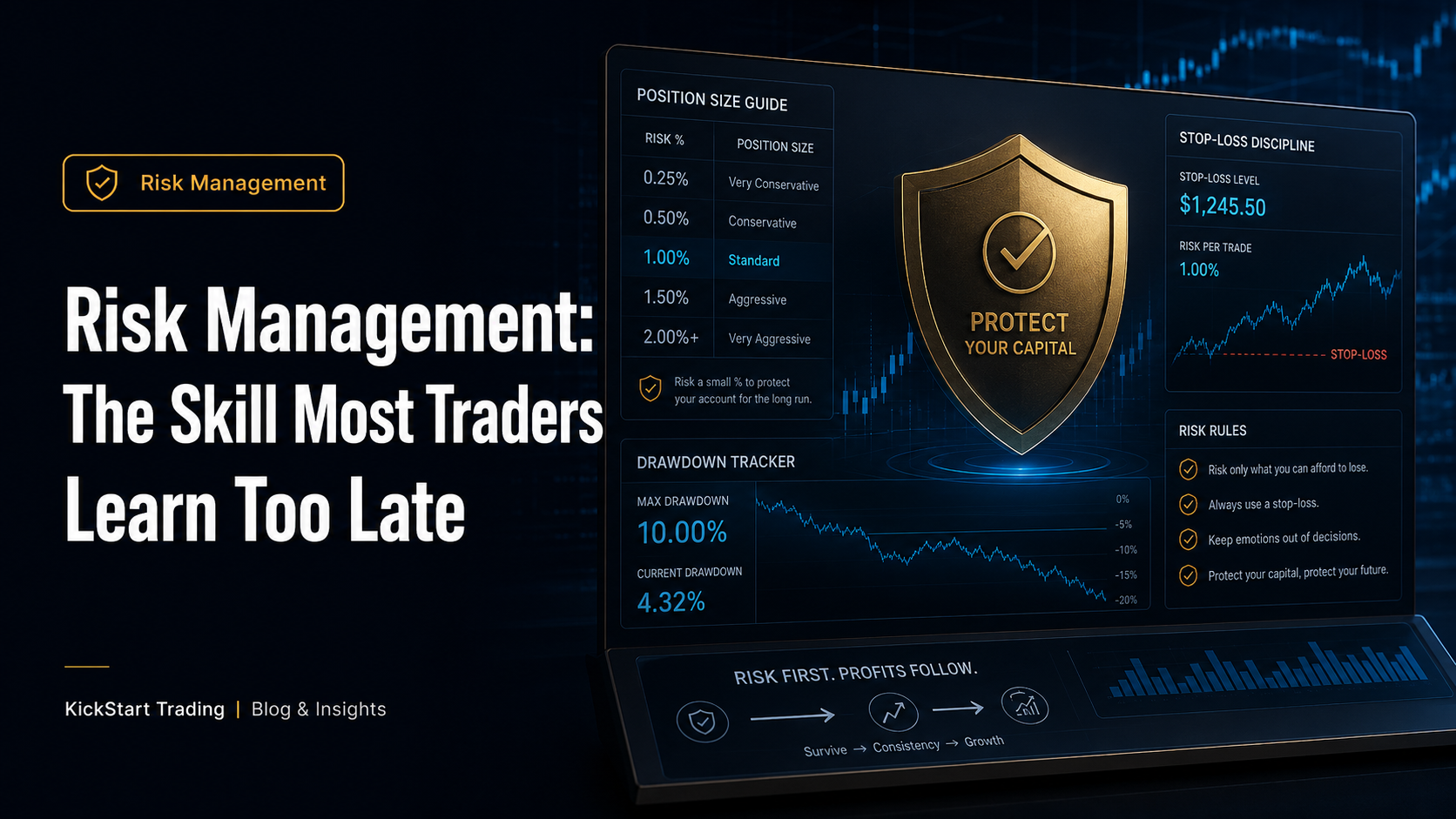
Most traders focus on profits too early.
They want better entries, bigger winners, cleaner setups, and faster results.
But the skill that usually determines whether a trader survives long enough to improve is risk management.
Risk management is not the exciting part of trading.
It is not the part most people post about.
But it is the part that keeps you in the game.
Why risk management matters
Every trader will lose trades.
That is unavoidable.
The question is not whether you will experience losses.
The question is whether your losses are controlled, planned, and survivable.
A trader with poor risk management can destroy an account even with a decent strategy.
A trader with strong risk management can survive losing streaks, protect capital, and keep improving.
That is why risk management must come before profit chasing.
Trading is a probability game
No single trade should be treated like it has to work.
Even a high-quality setup can lose.
Even a good trader can have a losing day.
Even a strong system can go through a drawdown period.
This is why traders need to think in probabilities.
The goal is not to be right every time.
The goal is to manage risk well enough that your edge has room to play out over time.
Common risk management mistakes
Many traders struggle because they:
- Risk too much per trade
- Move stop losses emotionally
- Add to losing positions without a plan
- Overtrade after a loss
- Chase trades after missing an entry
- Trade too large for their experience level
- Ignore daily loss limits
- Treat funded account rules like obstacles instead of safeguards
These mistakes are usually not caused by lack of intelligence.
They are caused by pressure, emotion, impatience, and lack of structure.
Funded trading makes risk management even more important
Funded trading can be a powerful opportunity.
But funded accounts come with rules.
Those rules usually include daily loss limits, overall drawdown limits, trailing drawdown rules, consistency requirements, or other risk controls.
A trader who does not respect risk will struggle inside that environment.
The funding model rewards discipline.
It punishes recklessness.
That is why traders should not rush into funding without first understanding how they will manage risk.
Risk management protects your mindset
Losses hurt more when they are too large.
When a trader risks too much, every trade becomes emotionally heavy.
That emotional pressure can lead to revenge trading, hesitation, panic, or impulsive decision-making.
Proper risk management reduces emotional intensity.
It allows the trader to think more clearly.
It creates space for discipline.
Risk management is not weakness
Some traders think risking less means they are being timid.
That is wrong.
Risk management is not fear.
Risk management is professionalism.
A serious trader understands that capital is ammunition.
You do not waste it carelessly.
You protect it so you can continue operating.
Building a risk management framework
A trader should know:
- How much they are willing to risk per trade
- How much they are willing to lose per day
- When they will stop trading
- What invalidates a trade idea
- Where the stop loss belongs
- Whether the reward justifies the risk
- How funded account rules affect execution
- How they will respond after a loss
These decisions should be made before pressure hits.
That is what structure does.
How KickStart teaches risk
At KickStart Trading, risk management is treated as a core part of trader development.
It is not an afterthought.
Technical analysis may help a trader find opportunities, but risk management determines whether those opportunities can be pursued responsibly.
This is especially important for traders who want to access capital and trade funded accounts.
The goal is not just to pass a challenge.
The goal is to become the kind of trader who can handle responsibility.
Final thought
Risk management is the skill most traders respect only after they have paid the price for ignoring it.
Do not wait for that lesson to become expensive.
Learn to protect capital.
Learn to think in probabilities.
Learn to trade with structure.
Because in the long run, the traders who survive are the traders who respect risk.
Next step
If you want to build a stronger trading foundation, start with the free KickStart training and learn the principles behind structured trader development.