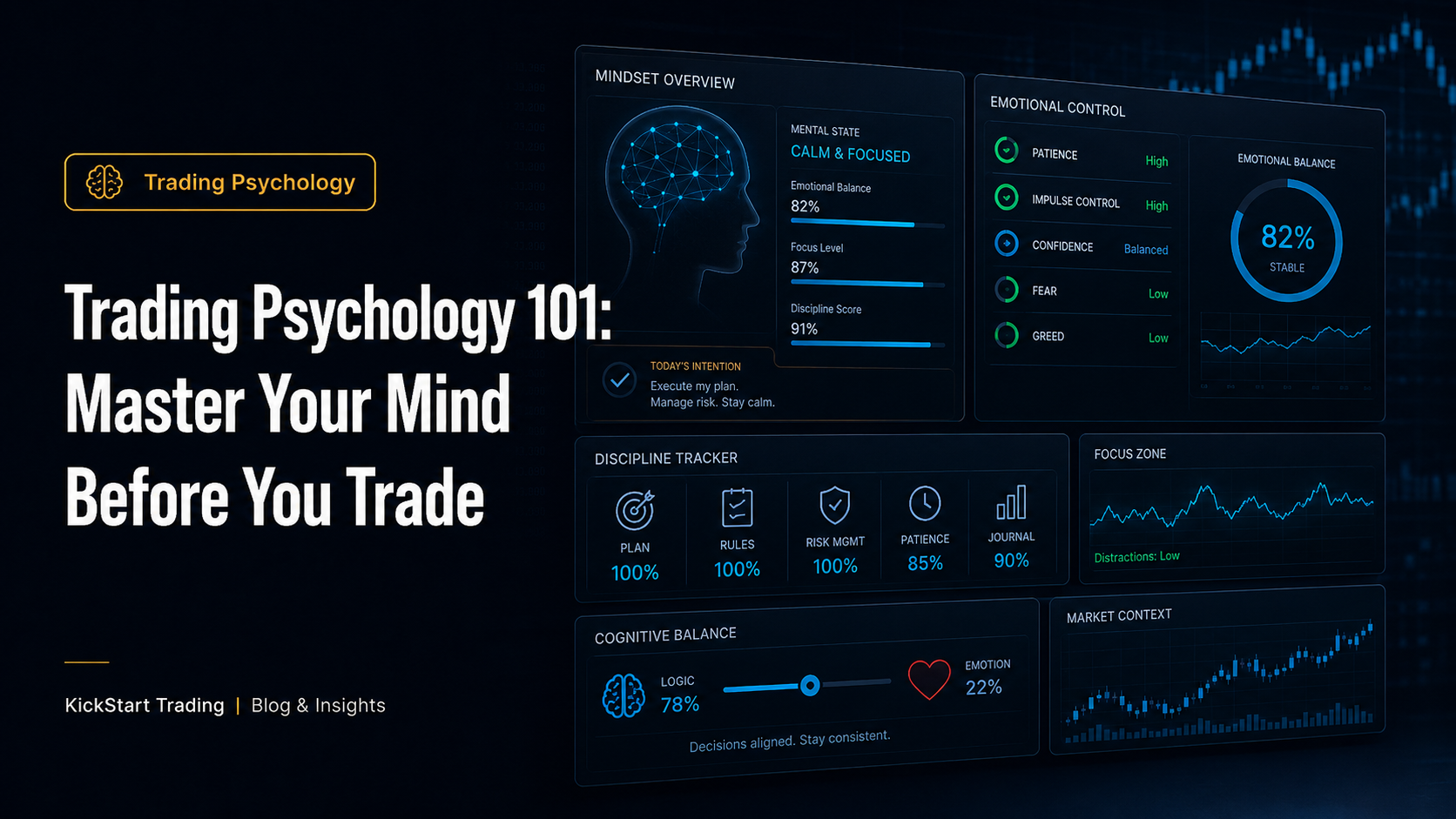
Trading Psychology 101: Master Your Mind Before You Trade
Most new traders think the hardest part of trading is finding the right strategy.
They search for the perfect setup, the perfect indicator, the perfect entry model, the perfect market, or the perfect account size.
But sooner or later, every serious trader discovers the same truth: the strategy is only one part of the game.
The trader executing the strategy matters just as much, if not more.
You can have a strong technical method and still lose money if you cannot follow your own rules. You can understand market structure and still blow an account through impatience. You can know where your stop loss should go and still move it because you do not want to be wrong.
That is why trading psychology matters.
It is not motivational fluff. It is not a nice extra. It is one of the core foundations of long-term trader development.
Why trading psychology matters
Trading forces you to make decisions under uncertainty.
You never know with absolute certainty what the market will do next. You can build a trade idea, identify confluence, manage risk, and follow a process, but the outcome of any single trade is never guaranteed.
That uncertainty creates pressure.
And pressure reveals discipline.
A trader with poor psychology will often do things they already know are wrong. They will enter too early, exit too late, increase lot size emotionally, chase missed trades, revenge trade after a loss, or abandon a plan after one bad session.
The problem is not always knowledge. Many traders know better.
The problem is execution under emotional pressure.
The market does not reward emotional decisions
The market does not care how badly you want to win.
It does not care whether you need money, whether you are behind on your goals, whether you just had a losing trade, or whether you feel like you “deserve” a profitable day.
That can sound harsh, but it is actually freeing.
Once you accept that the market does not owe you anything, you can stop trying to force outcomes and start focusing on the only part you can control: your process.
Good trading psychology is the ability to keep making process-driven decisions even when your emotions are trying to pull you away from the plan.
Common psychological traps traders fall into
Most traders do not fail because of one catastrophic mistake. They fail because of repeated emotional behaviours that compound over time.
Some of the most common are:
- Chasing trades after missing the original entry
- Revenge trading after a loss
- Increasing risk to “make it back”
- Cutting winners too early out of fear
- Letting losers run because they do not want to accept being wrong
- Overtrading when the market is unclear
- Abandoning a strategy after normal drawdown
- Trading without reviewing past mistakes
These behaviours are common because they are human.
Trading exposes impatience, fear, greed, pride, frustration, overconfidence, and insecurity. The goal is not to pretend those emotions do not exist. The goal is to build enough structure that those emotions do not control the account.
Discipline is built before the trade
Many traders think discipline is something they need during a trade.
That is partly true, but real discipline starts before the trade is ever placed.
It starts with having a plan.
A proper trading plan should tell you:
- What market conditions you are looking for
- What setups you are allowed to take
- What invalidates the trade idea
- Where your stop loss goes
- How much you are risking
- What your target or management plan is
- When you should not trade at all
Without a plan, every trade becomes a negotiation with yourself.
And when you are negotiating with yourself in real time, emotion usually wins.
Patience is a trading edge
Patience is one of the most underrated skills in trading.
Many traders lose money not because they cannot spot good trades, but because they cannot wait for them.
They enter early because they are afraid the move will leave without them. They take weak setups because they want action. They trade poor conditions because they feel like doing nothing is wasting time.
But doing nothing is sometimes the correct trade.
Professional trading is not about constant activity. It is about quality decision-making.
Waiting for better conditions, clearer structure, stronger confluence, or a cleaner entry is not laziness. It is discipline.
Confidence must be earned
Confidence in trading should come from process, not from short-term results.
A few winning trades can make a trader feel invincible. A few losing trades can make the same trader feel like they know nothing.
Neither reaction is useful.
Real confidence comes from knowing that you have a tested process, that you manage risk properly, and that you can survive losing trades without falling apart emotionally.
That kind of confidence is built through repetition, review, journaling, and honest self-assessment.
It is not built by hype.
The role of journaling
A trading journal is one of the most powerful tools for improving psychology.
Not just because it records entries and exits, but because it reveals patterns in behaviour.
A good journal helps you see questions like:
- Do I take worse trades after a loss?
- Do I exit early when price hesitates?
- Do I increase risk when I feel confident?
- Do I trade differently after missing a move?
- Do I perform better at certain times of day?
- Do I break rules when I am tired, stressed, or distracted?
The trader who reviews honestly has a major advantage over the trader who simply moves on and repeats the same mistakes.
Funded trading increases psychological pressure
Trading psychology becomes even more important when a trader is preparing for or managing a funded account.
Funded accounts introduce rules: daily loss limits, maximum drawdown, consistency requirements, payout rules, and sometimes time-based or behaviour-based restrictions.
That structure can help traders, but it also adds pressure.
A trader who is emotionally unstable on a personal demo account is unlikely to magically become disciplined under funded-account conditions.
This is why preparation matters.
Before buying or trading a funded account, traders should already understand their process, their risk, their emotional triggers, and their rules.
Funding does not remove the need for discipline. It magnifies it.
How to start improving your trading psychology
Improving trading psychology does not happen overnight, but it can begin immediately.
Start with simple foundations:
- Write down your rules before trading
- Risk an amount that does not create panic
- Journal every trade
- Review emotional mistakes weekly
- Stop trading after major rule breaks
- Avoid increasing risk after losses
- Build a pre-trade checklist
- Learn to walk away from poor conditions
The goal is not perfection.
The goal is awareness, structure, and gradual improvement.
Final thoughts
Trading psychology is not separate from trading. It is part of trading.
Your ability to stay disciplined, patient, and process-driven will shape your results just as much as your ability to read a chart.
At KickStart Trading, we believe trader development has to go beyond setups. A trader needs technical understanding, risk management, education, funding awareness, and the mindset to execute under pressure.
Because the real goal is not just to find trades.
The real goal is to become the kind of trader who can handle them properly.