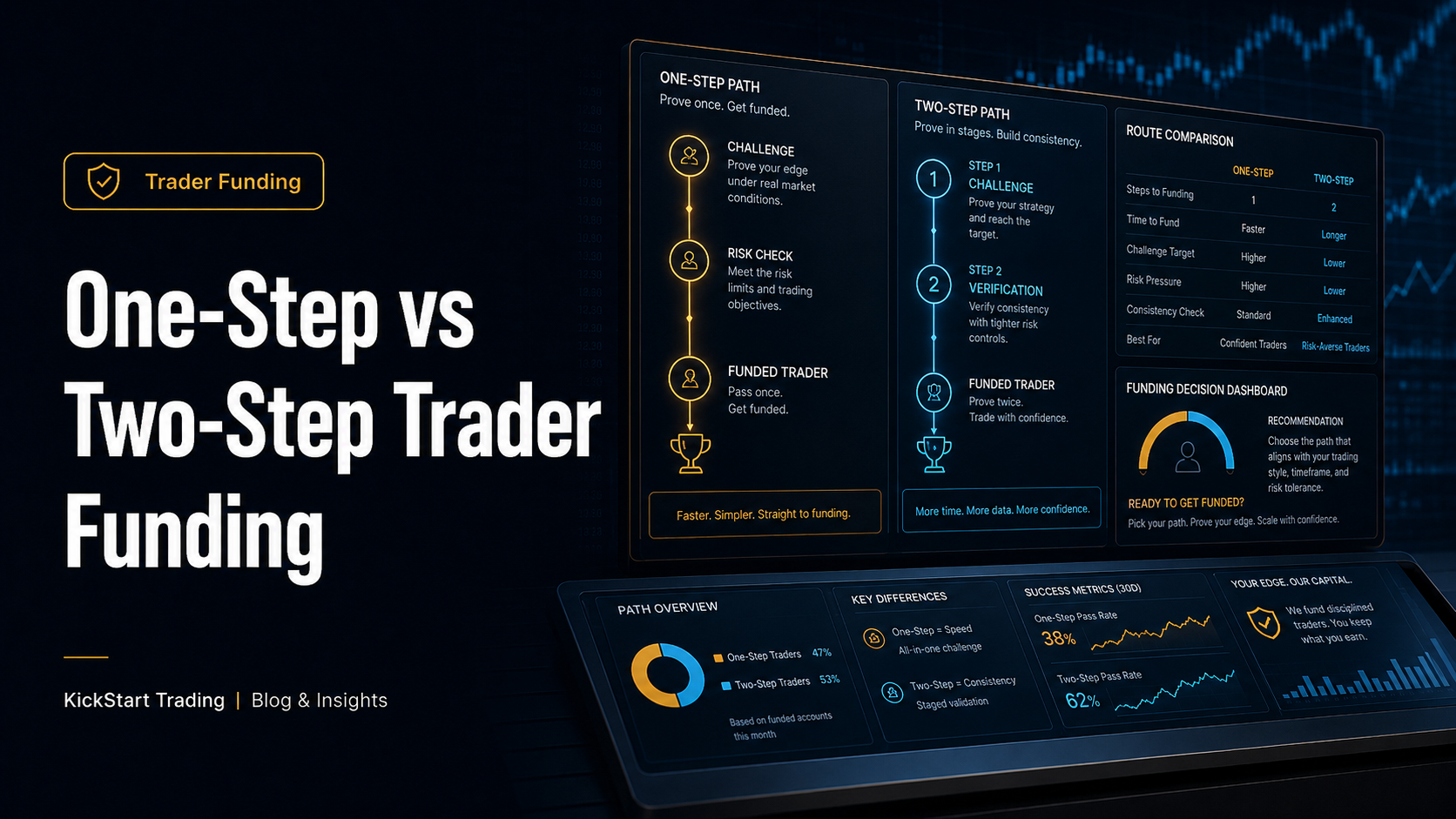
One-Step vs Two-Step Funding: How to Choose the Right Route
Choosing the right funded trading route is one of the most important decisions a trader can make before buying an account.
At first glance, one-step and two-step funding programs can look similar. Both usually require traders to follow rules, manage risk, hit a profit target, and prove they can trade responsibly.
But the experience of each route can be very different.
The right choice depends on your trading style, your discipline, your risk tolerance, and how much pressure you can handle.
What is a one-step funding program?
A one-step funding program is designed to give traders a more direct route toward funding.
Instead of passing multiple evaluation stages, the trader has one main challenge or assessment phase to complete. If they meet the required target and follow the rules, they can move toward funded status faster than they would in a traditional multi-stage model.
This can be attractive for traders who already have a proven strategy and want a simpler route.
The main benefit of a one-step model is speed. There are fewer stages, fewer hurdles, and less time spent proving the same thing repeatedly.
But that does not mean it is easy.
A one-step account still requires discipline, patience, and proper risk management. In some cases, the rules may be slightly tighter because the funding provider is giving traders a more direct path.
That means one-step funding is not a shortcut around trading skill.
It is simply a more direct way to prove that skill.
What is a two-step funding program?
A two-step funding program usually requires traders to pass two separate evaluation phases before becoming funded.
The first phase is often focused on proving that the trader can generate profit. The second phase is usually designed to confirm consistency and risk control.
This route may take longer, but it can also feel more structured.
For newer traders, the two-step model can sometimes be useful because it creates a more gradual pathway. It gives the trader more time to prove their process, adapt to the rules, and demonstrate that their performance was not just one lucky run.
The downside is that it can feel slower.
Some traders lose patience during the second phase, especially after already hitting the first target.
That is where discipline becomes crucial.
Which route is better?
Neither route is automatically better.
A one-step account may be better for a trader who:
- Already has a tested strategy
- Understands risk management
- Can handle pressure
- Wants a faster path to funding
- Does not want to go through multiple evaluation stages
A two-step account may be better for a trader who:
- Wants a more structured evaluation
- Prefers a slower and steadier route
- Needs more time to build confidence
- Is still developing consistency
- Performs better when there is less pressure to move quickly
The mistake many traders make is choosing the route that sounds easiest, rather than the route that actually matches their trading personality.
Speed is not the same as readiness
A faster route is only useful if you are ready for it.
Many traders rush into funding because they want the result. They want the account. They want the payout. They want to call themselves funded.
But funding does not fix poor discipline.
If a trader cannot manage risk on a small account, they will usually struggle even more under funded-account pressure. Larger account sizes can make emotional mistakes more expensive, not less.
Before choosing one-step or two-step funding, ask yourself honestly:
- Do I have a repeatable strategy?
- Do I know exactly where my invalidation point is before entering a trade?
- Can I stop trading after a loss?
- Can I respect a daily loss limit?
- Do I review my trades properly?
- Am I chasing funding, or am I actually prepared for it?
Those questions matter more than the number of phases.
The role of drawdown rules
One of the biggest differences between funding programs is not just whether they are one-step or two-step.
It is how the drawdown rules work.
Some accounts use static drawdown. Others use trailing drawdown. Some rules are based on balance. Others may be based on equity.
This matters because two accounts with the same size can feel completely different depending on how the risk rules are structured.
A trader choosing a funded account should always understand:
- The profit target
- The daily loss limit
- The maximum loss limit
- Whether drawdown is static or trailing
- Whether trades can be held overnight or over the weekend
- Whether news trading is allowed
- Whether consistency rules apply
The route matters.
But the rules matter just as much.
This is why traders should never buy a funded account purely because it looks cheap, fast, or exciting.
They need to understand the structure they are agreeing to trade within.
Why one-step funding appeals to confident traders
One-step funding can appeal to traders who want a cleaner and more direct challenge.
If a trader already knows their system, understands their risk profile, and can execute under pressure, a one-step account can make sense.
The attraction is obvious: fewer stages, less time waiting, and a more direct route to the opportunity.
But confidence must be earned.
A trader who chooses one-step funding simply because they are impatient may struggle. The pressure of knowing there is only one phase can lead to forcing trades, increasing risk, or obsessing over the profit target.
A one-step route works best when the trader is calm enough to treat it like normal trading.
Not a race.
Not a gamble.
Not a desperate attempt to change their life in one week.
Why two-step funding can help developing traders
Two-step funding can be useful because it slows the trader down.
That may sound like a disadvantage, but for many traders it is actually a benefit.
A two-step model gives the trader more time to prove consistency. It encourages them to think beyond one good run. It forces them to repeat the process across more than one phase.
For traders who are still building discipline, that structure can help.
The second phase can be frustrating, but it can also reveal whether the trader is actually stable.
Can they keep following their plan after passing phase one?
Can they avoid becoming careless after early success?
Can they keep risk controlled when the finish line feels close?
Those are important questions.
The psychology of funding routes
The funding route a trader chooses can affect their psychology.
A one-step account may create urgency because the trader feels close to the result immediately.
A two-step account may create impatience because the trader feels they have to prove themselves twice.
Neither pressure is automatically bad.
The issue is how the trader responds.
Some traders become reckless when they feel close to funding. Others become frustrated by a slower process and start forcing trades. Some traders trade well in phase one but collapse emotionally in phase two.
This is why trading psychology matters so much.
The account structure does not remove the trader’s emotional weaknesses.
It exposes them.
Funding should match your trading style
Different traders need different structures.
A scalper may care more about execution rules, spreads, commissions, and daily loss restrictions.
A swing trader may care more about overnight holding, weekend holding, news restrictions, and drawdown calculation.
A trader who takes fewer, higher-conviction setups may prefer a different model from someone who trades more frequently.
That is why the best funding route is not always the one with the lowest price or biggest account size.
The best route is the one that matches how you actually trade.
If your trading style naturally conflicts with the rules, you are setting yourself up for frustration.
How to choose the right route
The best route is the one that matches your current stage as a trader.
If you are experienced, disciplined, and already trading a proven system, a 1-Step Funding route may make sense. It can give you a more direct opportunity to prove yourself and move forward.
If you are still building confidence, still refining your process, or still learning how to manage pressure, a 2-Step Funding route may be the better choice. It gives you a more measured path and forces you to demonstrate consistency over more than one stage.
There is no shame in choosing the slower route if it helps you trade better.
The goal is not to pass quickly.
The goal is to become the kind of trader who can keep the account after passing.
Do not ignore instant funding
One-step and two-step funding are not the only options.
Some traders may also consider Instant Funding, where the trader can access a funded account structure without completing a traditional evaluation first.
Instant funding can be attractive because it removes the challenge phase.
But again, faster does not automatically mean better.
Instant funding still requires discipline. The trader still needs to understand the drawdown rules, daily loss limits, and payout conditions. The absence of an evaluation does not remove the need for skill.
In some ways, it can increase the need for maturity because the trader is immediately operating under live funded-account conditions.
Final thoughts
One-step and two-step funding programs both have a place.
The right choice depends on the trader.
A serious trader does not simply look for the easiest challenge. A serious trader looks for the account structure that gives them the best chance of performing well, following the rules, and building long-term consistency.
At KickStart Trading, we believe funding should be approached with preparation, discipline, and proper education — not hype.
Whether you choose a one-step route, a two-step route, or another funding pathway entirely, the most important thing is to understand the rules, respect the risk, and trade with a process you can actually repeat.
Funding is not just about getting access to capital.
It is about proving that you are ready to manage it.
To your health, wealth, and happiness, always,
Chris