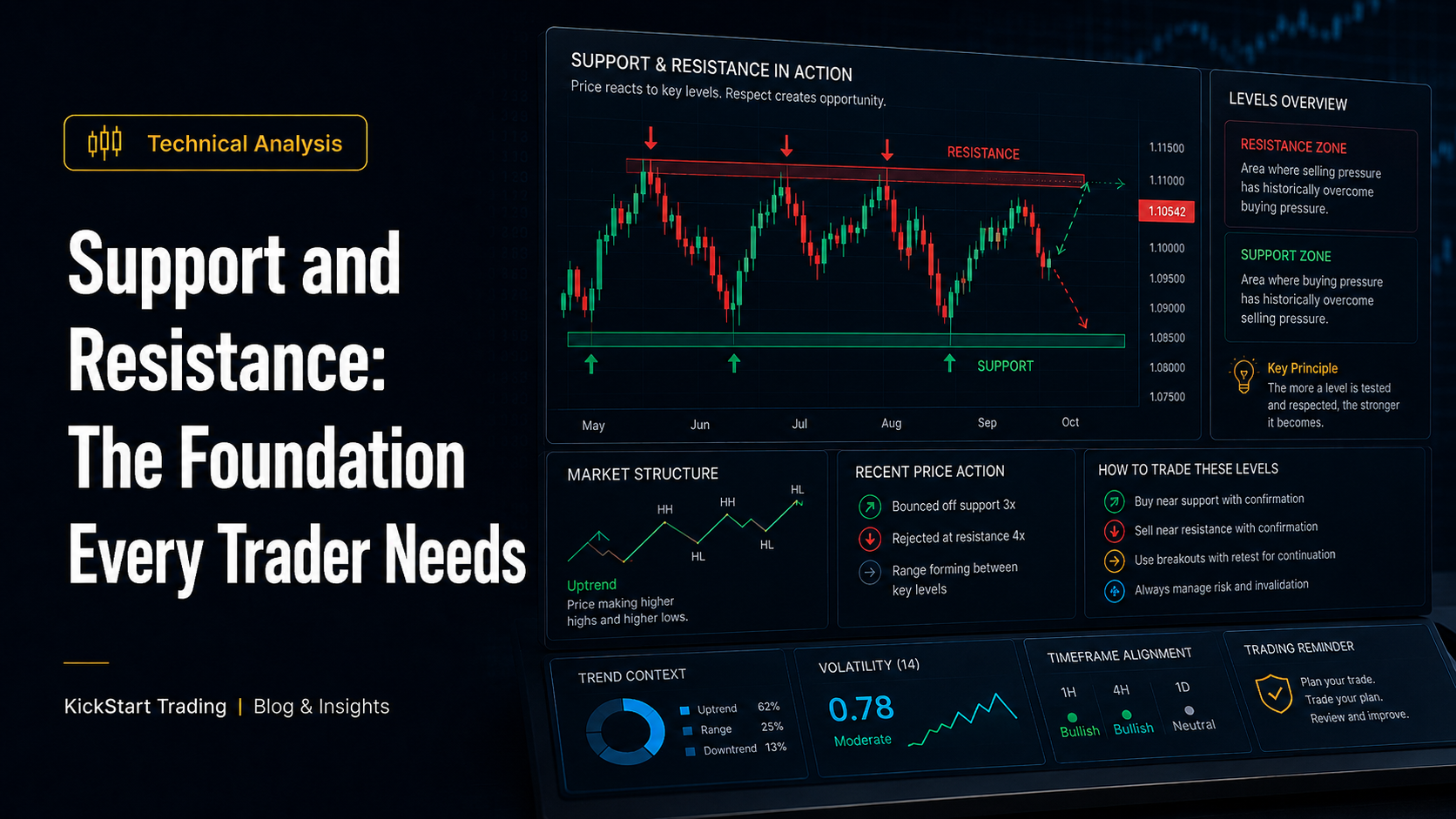
Support and Resistance: The Foundation Every Trader Needs
Support and resistance are among the first technical analysis concepts most traders learn.
They are also among the most misunderstood.
Many traders draw lines on a chart and assume those lines will magically hold. They expect price to reverse perfectly at support, reject perfectly at resistance, and respect every level with precision.
But the market does not work that cleanly.
Support and resistance are not magic walls.
They are areas of interest.
They show where buyers or sellers have previously reacted, where liquidity may be sitting, where traders may make decisions, and where price may respond again under the right conditions.
When understood properly, support and resistance can help traders read the market with more structure.
When misunderstood, they can become just another reason to enter random trades.
What is support?
Support is an area where price has previously found buying interest.
In simple terms, it is a zone where price fell, reacted, and moved higher.
That reaction suggests buyers were willing to step in around that area, or sellers were no longer strong enough to continue pushing price lower.
Support does not mean price must hold forever.
It means the area is worth watching.
If price returns to support, traders may look for signs of reaction, rejection, slowing momentum, bullish candlestick behaviour, or a change in structure.
The level itself is not enough.
The reaction matters.
What is resistance?
Resistance is an area where price has previously found selling interest.
It is a zone where price rose, reacted, and moved lower.
That reaction suggests sellers were willing to step in around that area, or buyers were no longer strong enough to keep pushing price higher.
Just like support, resistance is not a guaranteed reversal point.
It is a decision area.
When price returns to resistance, traders may watch for rejection, failed continuation, bearish candles, exhaustion, or a structural shift.
The key is context.
A resistance level in a strong bullish trend may break easily. A resistance level after an extended move may produce a stronger reaction.
The level matters, but the surrounding market conditions matter more.
Support and resistance are zones, not perfect lines
One of the biggest mistakes traders make is treating support and resistance as exact prices.
They draw a thin horizontal line and expect price to respond perfectly to the pip.
That creates frustration.
Markets are not that precise.
Price may overshoot a level, wick through it, test it multiple times, or react from a nearby area rather than the exact line.
This is why it is usually better to think in terms of zones.
A zone gives the market room to breathe.
It recognises that support and resistance are created by order flow, liquidity, psychology, and participation — not by perfect geometry.
The more realistic your levels are, the less likely you are to panic when price does not behave perfectly.
Why support and resistance matter
Support and resistance help traders structure the chart.
They help answer important questions:
- Where has price reacted before?
- Where might buyers step in?
- Where might sellers defend?
- Where could liquidity be resting?
- Where might price hesitate, reject, or break?
- Where should risk be managed more carefully?
- Where might a trade idea become invalid?
Without key levels, many traders are simply reacting to candles in isolation.
Support and resistance give those candles context.
A bullish candle in the middle of nowhere may not mean much. A bullish rejection candle at a major support zone after a pullback may be more meaningful.
Context changes everything.
The best levels are obvious
A useful rule is this: the best support and resistance levels are usually obvious.
If you need to force a level onto the chart, it may not be important.
Strong levels often stand out because price has clearly reacted there before. They are visible swing highs, swing lows, consolidation boundaries, breakout points, or major areas where price previously changed behaviour.
That does not mean every obvious level will work.
But obvious levels tend to matter because many traders can see them.
And when many traders see the same area, that area can attract orders, stops, entries, exits, and reactions.
Technical analysis is partly about understanding where market participants may be paying attention.
Old resistance can become new support
One of the most important support and resistance concepts is role reversal.
When price breaks above resistance, that old resistance area may later act as support.
When price breaks below support, that old support area may later act as resistance.
This happens because market psychology changes.
For example, traders who sold at resistance and were wrong may look to exit if price retests the area. Buyers who missed the breakout may look for a second chance to enter. Short sellers may have stops or pressure around the same zone.
That combination can create a reaction.
Role reversal is not guaranteed, but it is one of the most useful ways support and resistance can connect with market structure.
Breakouts and retests
Many traders use support and resistance to identify breakouts.
A breakout occurs when price moves beyond a key level.
But not every breakout is worth trading.
Some breakouts fail quickly. Some are liquidity grabs. Some happen in poor conditions. Some occur after price has already moved too far.
That is why many traders prefer waiting for a retest.
Instead of buying the moment resistance breaks, they wait to see whether price comes back to test the old resistance area as new support.
This can provide a cleaner structure and a clearer invalidation point.
The same applies in reverse when support breaks and is retested as resistance.
A breakout gives information.
A retest can provide structure.
False breakouts
False breakouts are extremely common.
A false breakout happens when price breaks beyond a level but fails to continue and moves back inside the previous range or structure.
This can trap traders who entered too aggressively.
False breakouts are one reason patience matters.
If a trader buys every break above resistance without waiting for confirmation, they may get caught repeatedly.
False breakouts also show why trading psychology matters. Traders often enter breakouts because they fear missing the move. That fear can override patience and structure.
A serious trader should ask:
- Did price close beyond the level?
- Was there real momentum?
- Is the breakout happening with context?
- Is there room to target?
- Where is the invalidation point?
- Am I chasing?
A breakout is not automatically an entry.
Support and resistance need market structure
Support and resistance become more powerful when combined with market structure.
Market structure helps traders understand whether price is trending, ranging, reversing, or consolidating.
A support level in an uptrend may be a pullback opportunity.
A support level in a strong downtrend may be a weak floor that eventually breaks.
A resistance level in a downtrend may be a continuation area.
A resistance level in a strong uptrend may be a breakout candidate.
This is why isolated levels are not enough.
The same level can mean different things depending on the structure around it.
Good technical analysis is not just asking, “Where is support?”
It is asking, “What is price doing around support, and does that fit the broader structure?”
Candlesticks help confirm reactions
Candlesticks can help traders read how price is behaving at support and resistance.
A level may become more interesting if price forms rejection wicks, engulfing candles, momentum candles, indecision candles, or clear shifts in candle behaviour near that zone.
But candlesticks should not be used blindly.
A candlestick pattern at a meaningful level is very different from the same pattern in the middle of poor structure.
That is why traders should study Japanese candlesticks in context.
Candles show behaviour.
Support and resistance show location.
Together, they can help traders make better decisions.
Fibonacci and key levels
Support and resistance can also combine well with Fibonacci.
A Fibonacci retracement level that aligns with previous support or resistance may create confluence.
Confluence means multiple reasons are pointing to the same area.
For example, a trader might identify:
- A previous resistance zone
- A breakout and retest area
- A Fibonacci retracement
- A bullish candlestick reaction
- A trend continuation structure
One factor alone may not be enough.
Several factors together can create a more structured trade idea.
This is why Fibonacci should not be used randomly. As explained in why Fibonacci still matters in forex trading, the value comes from disciplined application and context.
Risk management around support and resistance
Support and resistance can help traders define risk.
If a trader is buying near support, the trade idea may become invalid if price clearly breaks below that support area.
If a trader is selling near resistance, the trade idea may become invalid if price clearly breaks above resistance.
This gives the trader a logical place to consider stop placement.
But stops should not be placed randomly.
They should account for the level, market volatility, wick behaviour, and the structure of the setup.
A stop that is too tight may get taken out by normal market noise. A stop that is too wide may create poor risk-to-reward.
This is why risk management has to be part of technical analysis.
A good level does not matter if the risk is managed badly.
Support and resistance in funded accounts
Support and resistance also matter for traders pursuing funded accounts.
When trading under rules such as daily loss limits, maximum drawdown, or account targets, traders need clean decision-making.
Random trades are dangerous.
Chasing levels without confirmation is dangerous.
Oversizing because a level “has to hold” is dangerous.
Funded trading rewards discipline, patience, and risk control. Whether a trader chooses Instant Funding, 1-Step Funding, 2-Step Funding, or Futures Funding, the ability to identify clear levels and manage risk around them can make a major difference.
The goal is not to take every reaction.
The goal is to take better-structured trades.
Common mistakes traders make
Support and resistance are simple concepts, but traders still make serious mistakes with them.
Common mistakes include:
- Drawing too many levels
- Treating levels as exact prices
- Buying support blindly
- Selling resistance blindly
- Ignoring trend direction
- Chasing breakouts
- Failing to wait for confirmation
- Placing stops too close to obvious liquidity
- Risking too much because a level looks strong
- Ignoring higher-timeframe context
Most of these mistakes come from impatience.
The trader sees a level and wants action immediately.
But good trading often requires waiting.
A level is a place to pay attention.
It is not a command to enter.
How to improve your level marking
To improve support and resistance analysis, keep it simple.
Start with higher-timeframe levels. Mark the most obvious swing highs, swing lows, range boundaries, and breakout areas.
Do not cover the chart with lines.
Then drop to the trading timeframe and watch how price behaves around those areas.
Ask:
- Is price approaching with momentum or exhaustion?
- Is this level fresh or has it been tested many times?
- Is the broader trend supporting the trade idea?
- Is there a clean invalidation point?
- Is the potential reward worth the risk?
- Am I reacting to structure or emotion?
Good level marking should make the chart clearer, not more confusing.
If your chart looks like a cage of horizontal lines, simplify it.
Education builds better technical analysis
Support and resistance are foundational, but they are only one part of technical analysis.
To use them properly, traders also need candlestick knowledge, market structure, Fibonacci, risk management, psychology, and a repeatable decision process.
That is why structured trader education matters.
A trader who learns concepts in isolation may know the words, but not the framework.
A trader who understands how the concepts connect can begin to build real skill.
If you are still developing your foundation, start with the free training or explore The Ultimate Forex Trading Course™.
Final thoughts
Support and resistance are not magic lines.
They are important areas where price has reacted before and may react again.
Used properly, they can help traders understand structure, identify decision zones, manage risk, and build more disciplined trade ideas.
Used poorly, they become excuses for random entries.
The difference is context.
At KickStart Trading, we teach traders to treat technical analysis as part of a complete framework: price action, candlesticks, Fibonacci, structure, risk management, and psychology all working together.
Because the goal is not simply to draw better lines.
The goal is to make better trading decisions.
To your health, wealth, and happiness always,
Chris