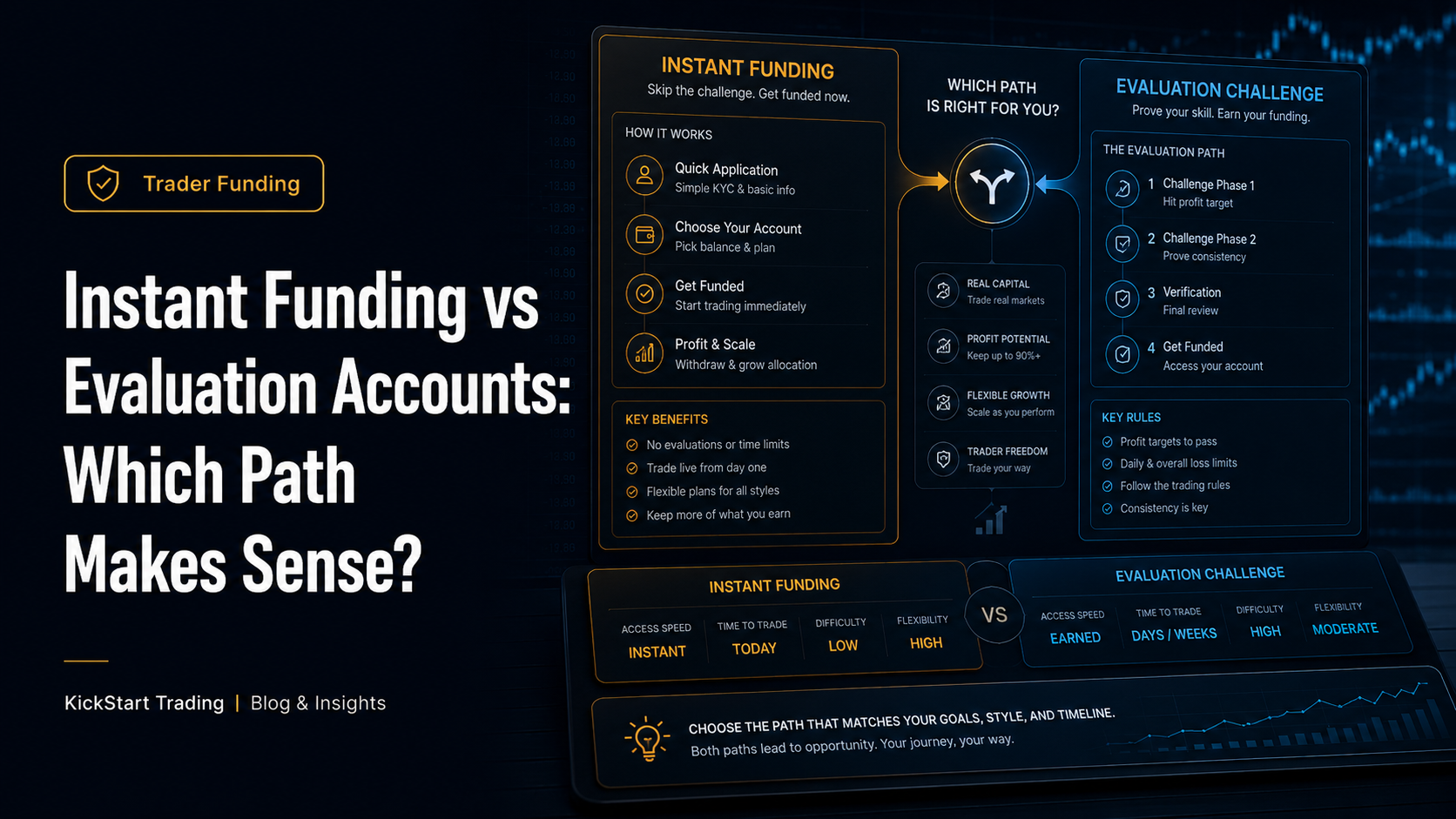
Instant Funding vs Evaluation Accounts: Which Path Makes Sense?
One of the biggest mistakes traders make when looking at funded trading is assuming every funding route is basically the same.
It is not.
Instant funding, 1-step evaluations, 2-step evaluations, and futures funding all serve different purposes. Each route has its own advantages, drawbacks, rules, cost structure, and psychological pressure.
The right choice depends on where you are as a trader.
Not where you wish you were.
Not where you want to look impressive.
Where you actually are right now.
At KickStart Trading, we believe funding should be approached with structure. A funded account can be a powerful opportunity, but only when the trader understands the rules, manages risk properly, and chooses a path that fits their experience and trading style.
This guide will help you compare the main funding routes and decide which one makes the most sense for you.
What is instant funding?
Instant Funding is designed for traders who want direct access to funded capital without first completing an evaluation challenge.
Instead of passing a staged assessment, you purchase an instant funded account and begin trading under the provider’s funded-account rules.
That can be attractive because there is no challenge phase to complete first. You are not trying to prove yourself through a separate evaluation. You are moving directly into live funded-account conditions.
But that does not mean instant funding is easier.
In many ways, instant funding demands more maturity because you are immediately operating under real funded-account pressure. There is less room for emotional decision-making, poor risk control, or experimenting with an untested process.
Instant funding is best suited to traders who already trust their strategy, understand their risk, and have enough discipline to trade with structure from day one.
Who instant funding is best for
Instant funding may make sense if:
- You already have a proven trading process
- You understand drawdown and daily loss limits
- You are comfortable following strict rules
- You do not need a challenge phase to validate your strategy
- You want quicker access to funded-account conditions
- You are experienced enough to avoid gambling with the account
The key word is experienced.
Instant funding can be powerful, but it should not be treated as a shortcut for traders who have not yet built discipline.
If you are still learning the basics of market structure, risk management, or emotional control, jumping straight into instant funding may create unnecessary pressure.
What is a 1-step evaluation?
A 1-Step Funding account gives traders a cleaner evaluation path: one target, one challenge structure, and a direct route toward funded trading.
Instead of moving through multiple assessment phases, the trader focuses on completing one evaluation stage according to the rules.
This can be appealing for traders who want structure, but do not want an unnecessarily long or complicated process.
The 1-step model gives you a challenge to complete before funded status. That means you still need to prove consistency, but the pathway is more direct than a traditional two-phase model.
For many traders, this is the sweet spot.
It offers structure without dragging the process out too far.
Who 1-step funding is best for
A 1-step evaluation may make sense if:
- You want a clear target
- You prefer a simpler evaluation structure
- You want to prove your trading before moving into funded conditions
- You are confident enough to trade under rules, but still want a validation phase
- You want a more direct route than a two-step model
- You are focused on discipline, consistency, and rule-following
The 1-step route is especially useful for traders who have some experience but want a structured bridge between education and funded trading.
It gives you a defined challenge without making the process feel overly complex.
What is a 2-step evaluation?
A 2-Step Funding account follows a more traditional evaluation model.
Instead of completing one challenge phase, the trader moves through two stages before reaching funded status.
This route usually appeals to traders who prefer a measured progression. It gives them more of a staged validation process and can often have a lower upfront cost compared with some alternatives.
The 2-step model can also be psychologically helpful for traders who want to build confidence gradually. You prove yourself in stages rather than trying to complete everything in one direct push.
At KickStart, the 2-step pathway is also particularly worth paying attention to because of its static drawdown structure.
Static drawdown can be a major advantage for certain traders because the maximum loss level does not keep trailing in the same way some other models do. For traders who value clearer risk boundaries, that can make the account easier to plan around.
Who 2-step funding is best for
A 2-step evaluation may make sense if:
- You prefer a more traditional challenge model
- You want staged validation
- You like a more measured path toward funded status
- You want lower upfront cost compared with some other routes
- You value static drawdown rules
- You are patient enough to complete the process properly
The 2-step route is not necessarily “slower” in a negative sense. For many traders, the extra structure is useful.
It can help prevent rushing, overleveraging, or trying to force the market to meet a target too quickly.
What about futures funding?
Futures Funding is different again.
Instead of focusing on forex or CFD-style accounts, futures funding is built around exchange-traded futures markets such as CME, COMEX, NYMEX, and CBOT.
This route is designed for traders who want transparent futures-market exposure, clear payout phases, and a structured progression model.
Futures trading can appeal to traders who like centralized exchange products, defined sessions, and market-specific instruments. It is not automatically better or worse than forex funding. It is simply a different environment.
The key is whether your strategy, experience, and preferred market fit that structure.
Who futures funding is best for
Futures funding may make sense if:
- You already trade or want to trade futures markets
- You understand futures contracts and market sessions
- You want exposure to exchange-traded products
- You like structured payout phases
- You prefer rules designed specifically around futures trading
- You are comfortable with the pace and volatility of futures markets
For the right trader, futures funding can be an excellent pathway. But it should not be chosen simply because it sounds more professional.
Choose it because the market, rules, and structure fit how you trade.
The wrong way to choose a funded account
Many traders choose funding accounts based on emotion.
They pick the biggest account size they can afford. They choose the fastest-sounding route. They look for the highest profit split. They chase discounts. They compare prices without comparing rules.
That is the wrong approach.
A funded account should be chosen based on fit.
Ask better questions:
- Do I understand the rules?
- Can I trade within the drawdown limits?
- Does my strategy fit the account type?
- Am I emotionally ready for the pressure?
- Is the account size sensible for my current level?
- Do I need validation first, or am I genuinely ready for instant access?
- Would a static drawdown model suit me better?
- Do I trade forex, futures, or both?
The goal is not to buy the most impressive account.
The goal is to choose the account you are most likely to manage properly.
Account size matters more than traders think
A larger funded account can look exciting, but it can also create unnecessary pressure.
If the account size is too large for your current discipline, you may start thinking about the money instead of the process. That can lead to forced trades, oversized positions, and emotional decision-making.
Smaller accounts can sometimes be better for development because they allow traders to focus on rule-following and consistency.
There is nothing wrong with scaling gradually.
In fact, for many traders, that is the more professional path.
Funding does not replace education
This point matters.
Funding is not a substitute for learning how to trade.
A funded account gives you access to opportunity, but it does not automatically give you technical skill, discipline, risk management, or emotional control.
If you do not yet understand candlesticks, market structure, Fibonacci, risk management, journaling, or trading psychology, it may be wiser to start with education before buying a challenge.
That is why KickStart is built as an ecosystem, not just a funding page.
You can explore trader education, watch the free training, or compare funding pathways when you are ready.
The right path depends on your stage of development.
So which funding route makes sense?
Here is a simple way to think about it.
Choose Instant Funding if you already trust your process and want direct funded-account access without completing an evaluation first.
Choose 1-Step Funding if you want one clear target, one clean evaluation structure, and a more direct route toward funded trading.
Choose 2-Step Funding if you prefer staged validation, a more traditional pathway, and the appeal of static drawdown.
Choose Futures Funding if you want a futures-specific pathway with exchange-traded market exposure and structured payout phases.
There is no single perfect answer for everyone.
The right answer is the route that fits your current ability, psychology, risk tolerance, and trading style.
Final thoughts
Funded trading can be a serious opportunity, but only when approached seriously.
Do not choose a funded account because you are impatient. Do not choose one because the account size looks impressive. Do not choose one because you are trying to solve a discipline problem with more capital.
Choose the path that fits your development.
At KickStart Trading, our goal is to help traders learn, connect, grow, and get funded in a more structured way. That means understanding the difference between each funding route, respecting the rules, and building the skills needed to trade properly.
The best funding pathway is not always the biggest, fastest, or flashiest.
It is the one you can actually manage with discipline.
To your health, wealth, and happiness, always,
Chris