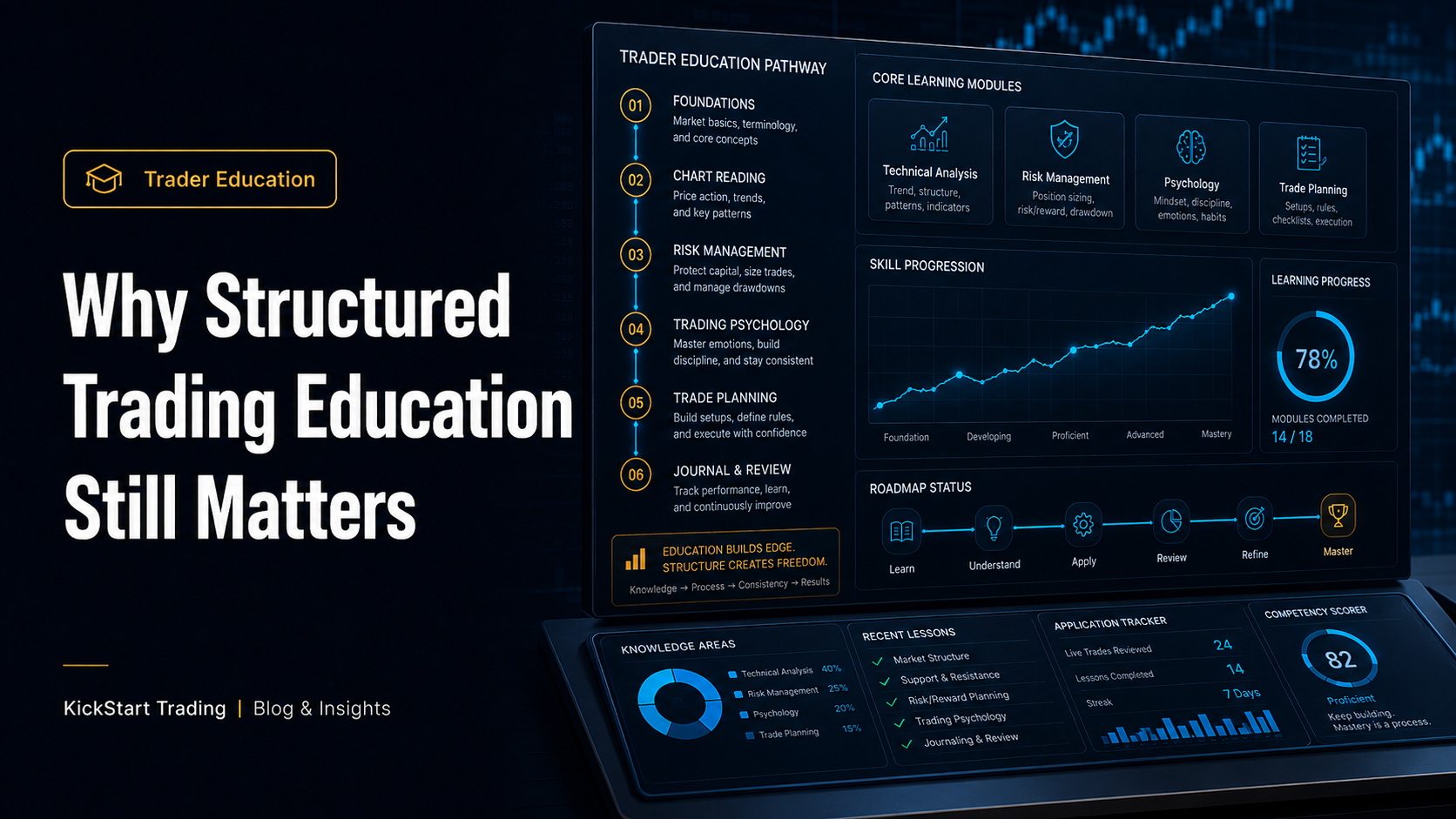
Why Structured Trading Education Still Matters
There has never been more trading content available than there is today.
YouTube videos, social media clips, Discord groups, free indicators, signal channels, AI tools, market breakdowns, trading podcasts, short-form tutorials, and endless opinions are everywhere.
A trader can open a phone and find thousands of people talking about trading within seconds.
But more information has not necessarily created better traders.
In many cases, it has created more confusion.
That is why structured trading education still matters.
Not because every trader needs to sit through theory forever. Not because education should replace live market experience. And not because a course automatically makes someone profitable.
Structured education matters because trading is already difficult enough without trying to build your entire foundation from scattered, disconnected pieces of content.
Information is not the same as education
Most traders do not lack information.
They lack structure.
They have watched videos on support and resistance, candlesticks, Fibonacci, market structure, psychology, liquidity, risk management, funded accounts, and entries.
But those concepts often sit in their mind as separate fragments.
They know a little bit about everything, but they do not have a coherent framework that tells them what matters first, how the pieces connect, or when to use each concept.
That is a major problem.
Trading requires decision-making under uncertainty. If your knowledge is scattered, your decisions will usually be scattered too.
Structured education helps organise the chaos.
It gives traders a sequence.
It helps them understand what to learn first, what to ignore for now, how one concept supports another, and how to build a repeatable process instead of chasing random ideas.
Most traders skip the foundations
Many traders want to jump straight to entries.
They want to know where to buy, where to sell, what indicator to use, what pair to trade, or what strategy will get them funded quickly.
That desire is understandable.
But it is also dangerous.
Entries are only one small part of trading.
Before a trader focuses on entries, they need to understand the foundation underneath them:
- How price moves
- What candlesticks are showing
- Where structure is forming
- How trend and range conditions differ
- How risk should be controlled
- How position sizing affects account survival
- How drawdown works
- Why psychology matters
- When not to trade
Without those foundations, entries become guesses dressed up as strategy.
This is why KickStart Trading puts so much emphasis on education, psychology, and risk management before pushing traders toward bigger accounts or aggressive targets.
A trader who does not understand the basics is not underfunded.
They are underprepared.
Candlesticks are a perfect example
Japanese candlesticks are one of the first things many traders see, but one of the most commonly misunderstood.
New traders often memorise candlestick names without understanding what the candles are actually communicating.
They learn “hammer,” “engulfing,” “doji,” or “pin bar,” but they do not understand context.
A candlestick pattern means very little without understanding where it forms, what came before it, what market structure looks like, and whether the candle is appearing at a meaningful level.
That is why our article on Japanese candlesticks is not just about memorising patterns. It is about helping traders begin to read price more intelligently.
Candlesticks are not magic signals.
They are market language.
Structured education teaches traders how to read that language in context.
Fibonacci is another example
Fibonacci is powerful when used properly, but confusing when used randomly.
Some traders draw Fibonacci tools everywhere. Others dismiss Fibonacci entirely because they have only seen it used badly.
The truth sits somewhere more practical.
Fibonacci can help traders understand retracement, projection, confluence, and potential reaction areas. But it needs rules. It needs context. It needs a method.
That is why we teach Fibonacci as part of a structured trading framework, not as a standalone trick.
In our article on why Fibonacci still matters in forex trading, we explain why Fibonacci remains relevant when it is used with discipline, market structure, and proper risk control.
The tool itself is not the edge.
The structured use of the tool is what matters.
Risk management is not optional
A trader can have good analysis and still fail because of poor risk management.
This is one of the hardest truths in trading.
Many traders spend months trying to improve their entries while ignoring the thing that is actually destroying their accounts: risk.
They risk too much. They revenge trade. They increase size after losses. They use inconsistent lot sizes. They ignore daily loss limits. They treat drawdown like an inconvenience instead of a warning sign.
That behaviour eventually catches up with them.
This is why risk management has to be part of a trader’s education from the beginning.
Risk management is not the boring part of trading.
It is the survival part.
A trader who cannot manage risk cannot stay in the game long enough to develop skill.
Funded trading makes education even more important
Funded trading has created incredible opportunities for retail traders.
A trader no longer needs to personally have a large amount of capital to access meaningful account sizes. Through the right pathway, traders can pursue funded accounts, profit splits, scaling opportunities, and structured trading objectives.
But this has also created a problem.
Some traders now think funding is the shortcut.
They believe that once they have access to a funded account, everything changes.
But funding does not fix poor trading.
It exposes it.
If a trader has no structure, no risk discipline, no tested approach, and no emotional control, a funded account can disappear very quickly.
That is why traders should understand the difference between Instant Funding, 1-Step Funding, 2-Step Funding, and Futures Funding before choosing a route.
Funding should match the trader’s current stage of development.
Education helps traders understand that stage honestly.
A course is not a magic button
A serious trading course should never promise instant success.
That is not how trading works.
The purpose of structured education is not to remove effort. It is to focus effort in the right direction.
A good course should help traders:
- Learn concepts in the right order
- Avoid unnecessary noise
- Build a repeatable process
- Understand risk before chasing profit
- Develop psychological awareness
- Review charts more intelligently
- Connect technical analysis with real decision-making
- Stop treating every new idea as a strategy
That is the purpose behind The Ultimate Forex Trading Course™.
It is designed to help traders build a foundation: candlesticks, market structure, Fibonacci, technical analysis, risk management, psychology, and trading discipline.
Not hype.
Foundation.
Why self-taught traders often struggle
There is nothing wrong with being self-taught.
Many great traders learned through personal study, chart time, trial and error, journaling, and experience.
But self-teaching becomes dangerous when it has no structure.
A self-taught trader may spend months studying advanced concepts while still misunderstanding basic risk. They may learn five different strategies without mastering one. They may keep changing methods because they do not understand whether the problem is the strategy, the market conditions, or their own execution.
That creates a cycle.
Learn something new.
Try it.
Lose money.
Blame the strategy.
Move to something else.
Repeat.
Structured education helps break that cycle by giving the trader a framework for evaluating progress.
Instead of constantly asking, “What should I learn next?” the trader starts asking better questions:
- Am I following my rules?
- Do I understand why I am entering?
- Is this setup actually valid?
- Am I risking appropriately?
- Did I review my previous trades honestly?
- Is the market suitable for my approach today?
Those are the questions that create development.
Education should lead to independence
The best trading education does not create dependency.
It should not make traders feel like they always need someone else to tell them what to do.
Good education should move traders toward independence.
That means helping them understand why a setup exists, why risk matters, why patience matters, why context matters, and why emotional control matters.
A trader should not just be told “buy here” or “sell there.”
They should learn how to think.
That is one of the reasons KickStart Trading is built around education, funding, community, and trader development together.
The goal is not to create signal followers.
The goal is to help traders develop skill, confidence, structure, and discipline over time.
Community supports education
Trading can be lonely.
A trader can spend hours in front of charts, making decisions alone, dealing with losses alone, and trying to figure out whether their process is improving.
That isolation can make bad habits worse.
Community does not replace education, but it can support it.
A good trading community gives traders a place to discuss ideas, ask questions, stay accountable, and remain connected to people who are pursuing similar goals.
That is why the KickStart ecosystem includes a trading community alongside education and funding.
Traders need structure, but they also need environment.
The right environment can help reinforce the right habits.
Free training is a smart starting point
Not every trader is ready to buy a course, join a community, or purchase a funded account immediately.
That is fine.
The first step should be understanding the framework and seeing whether the approach makes sense.
That is why we offer a free training for traders who want to begin with a clearer picture of what proper development should look like.
A serious trader does not need to rush.
They need to start properly.
Final thoughts
Structured trading education still matters because trading is not just about finding entries.
It is about building a complete foundation.
Technical analysis matters. Candlesticks matter. Fibonacci can matter. Risk management matters. Psychology matters. Journaling matters. Funding awareness matters. Community matters.
But they matter most when they are connected.
That is what structure provides.
At KickStart Trading, our belief is simple: traders deserve more than hype, signals, and scattered information. They deserve a clear path to learn, grow, connect, and pursue funding with discipline.
Because the goal is not just to trade more.
The goal is to trade better.
I’d like to help you do just that!
To your health, wealth, and happiness, always,
Chris