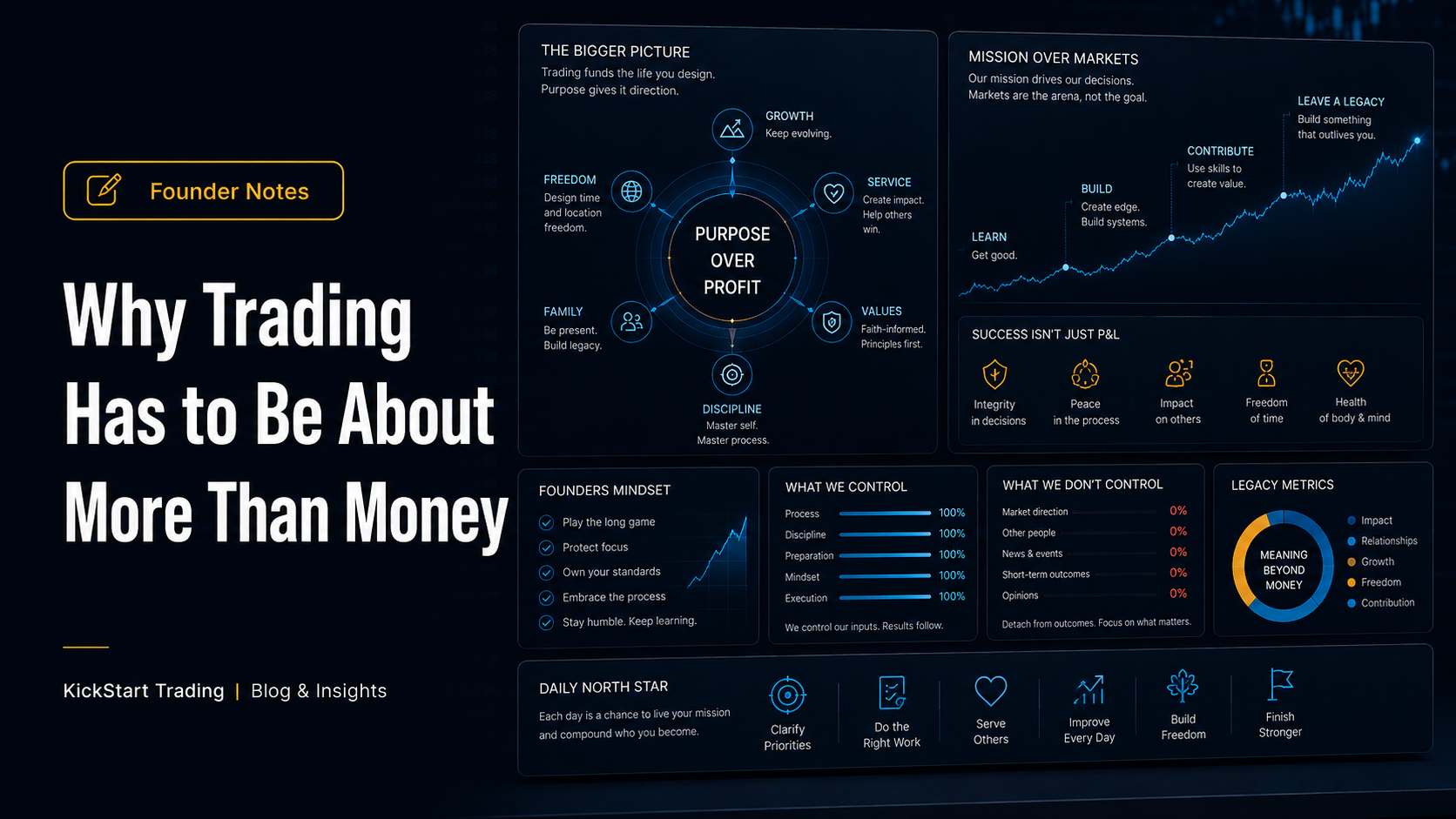
Why Trading Has to Be About More Than Money
I have coached traders for many years, and I have never liked the idea that trading is “for everyone.”
That might sound strange coming from someone who teaches trading, but it is the truth.
There are plenty of people in this industry who will tell you whatever you want to hear. They will tell you anyone can become a successful trader. They will tell you trading is simple. They will tell you all you need is the right setup, the right indicator, the right account, or the right strategy.
I do not believe that.
Trading is not easy.
Trading is difficult, emotional, repetitive, humbling, and sometimes brutally frustrating.
That does not mean people should avoid it.
It means people should respect it.
And if you are going to stay in this game long enough to become good, trading has to become about more than just money.
Money is not enough to keep most traders going
Most people are attracted to trading because of money.
That is normal.
The idea of making money from the markets is exciting. The idea of working from a laptop, building a skill, growing capital, getting funded, earning payouts, or creating more freedom is powerful.
There is nothing wrong with wanting those things.
But money alone is usually not enough.
Because trading will test you.
It will test your patience.
It will test your confidence.
It will test your discipline.
It will test your ability to follow rules when you do not feel like following them.
It will test whether you can take a loss without losing your mind.
If your only reason for trading is fast money, then the first serious losing streak may be enough to break you.
The traders who last tend to have something deeper.
They love the challenge.
They love the process.
They love the feeling of reading the market correctly.
They love improving.
They love the craft.
They love the game.
You have to love the process
Trading is not exciting every second.
In fact, a lot of trading is boring.
Waiting for a setup can be boring.
Reviewing charts can be boring.
Journaling trades can be boring.
Sitting on your hands when there is no valid opportunity can be boring.
But that is part of the job.
A trader who only loves the winning moments will struggle with the quiet moments.
A trader who only loves the money will struggle with the discipline required to earn it.
A serious trader has to develop respect for the process itself.
That means learning, reviewing, testing, waiting, planning, managing risk, and showing up again even after difficult days.
If you can learn to love the process, you have a much better chance of surviving the emotional ups and downs of trading.
The markets are emotional because people are emotional
Markets may look technical on the surface.
Charts, candles, algorithms, indicators, price levels, liquidity, volume, order flow — all of it can seem mechanical.
But behind the market are people.
People placing orders.
People managing risk.
People panicking.
People getting greedy.
People closing positions.
People chasing moves.
People defending levels.
People reacting to news.
Even where algorithms and automated systems are involved, those systems were still created, configured, and adjusted by people.
That is why emotion is everywhere in the market.
Fear.
Greed.
Hope.
Frustration.
Euphoria.
Regret.
Impatience.
The trader’s job is not to pretend emotion does not exist.
The trader’s job is to recognise emotion and stop it from controlling execution.
That is why trading psychology is not a side topic.
It is central.
Different personalities can succeed
Over the years, I have coached many different types of traders.
Some were naturally calm.
Some were intense.
Some were analytical.
Some were emotional.
Some were patient.
Some were impulsive.
Some were confident.
Some doubted themselves constantly.
I have seen emotionally steady people fail.
I have seen emotional people succeed.
I have seen naturally talented people quit.
I have seen slower-developing traders become excellent because they refused to stop improving.
There is no single perfect trader personality.
But the traders who develop usually have a few things in common.
They care enough to keep going.
They are willing to review.
They are willing to face uncomfortable truths.
They are willing to work on themselves.
And deep down, they love the challenge of trying to beat the market.
That love matters.
Because trading will give you plenty of reasons to quit.
One of the best signs: you keep showing up
A trader’s long-term potential is not only shown by how they behave when they are winning.
It is shown by whether they keep showing up after things go wrong.
Anyone can feel motivated after a good trade.
Anyone can feel excited after a strong week.
Anyone can talk about discipline when the account is in profit.
But what happens after a loss?
What happens after a drawdown?
What happens after a mistake?
What happens after you break your own rule and have to face yourself honestly?
This is where trading becomes personal.
The trader who genuinely loves the process will review, reset, and return.
The trader who only wanted easy money may disappear.
That does not mean you should push through burnout blindly. Sometimes taking a break is the right move.
But there is a difference between stepping back to reset and quitting because the market did not give you what you wanted quickly enough.
Good-day and bad-day statements
One exercise I have used with traders is writing two statements:
A statement for good days.
And a statement for bad days.
The good-day statement exists because winning can be dangerous.
Winning can make a trader overconfident. It can make them careless. It can make them think they are better than the rules. It can tempt them to increase risk, force trades, or assume the next setup will work just because the last one did.
A good-day statement might say:
“Stay patient. Stick to the plan. Do not improvise just because today went well. Review, rest, and repeat the process tomorrow.”
The bad-day statement exists because losing can be even more dangerous.
Losing can make a trader angry. It can make them chase. It can make them revenge trade. It can make them abandon structure and try to force the market to give something back.
A bad-day statement might say:
“Losses are part of trading. Accept the loss, learn from it, and do not chase. If I am emotional, the day is over. Review, rest, and come back with discipline.”
These statements are simple, but they matter.
They remind the trader who they want to be before emotion takes control.
They also reinforce one of the most important lessons in trading:
You need a plan for your behaviour, not just your entries.
For a deeper breakdown of that, read The Importance of a Trading Plan.
The best loser often wins
A lot of people think trading is about being right.
It is not.
Trading is about managing outcomes.
You can be wrong and still trade well.
You can be right and still trade badly.
A trader who takes a valid setup, manages risk properly, follows the plan, and accepts a loss has done their job.
A trader who wins after breaking every rule has not.
This is one of the most difficult lessons for newer traders to accept.
Winning trades can reinforce bad behaviour.
Losing trades can happen even when you did everything correctly.
That is why your relationship with losses matters so much.
You are going to lose.
There is no strategy that wins 100% of the time.
There is no trader who avoids every bad day.
The goal is not to avoid losing.
The goal is to lose properly.
Control the loss.
Learn from the loss.
Protect the account.
Do not let one loss become five.
Do not let one bad trade become a destroyed account.
The trader who learns how to lose with discipline has a much better chance of staying in the game.
Trading requires emotional honesty
Many traders do not fail because they lack information.
They fail because they are not honest with themselves.
They know they are overtrading.
They know they are risking too much.
They know they are chasing.
They know they are entering late.
They know they are moving stops.
They know they are revenge trading.
They know they are ignoring the plan.
But knowing is not enough.
You have to face it.
That is why journaling matters.
A journal does not just record trades. It reveals behaviour.
It shows whether you followed your rules. It shows whether emotions affected execution. It shows whether your losses came from normal strategy variance or poor discipline.
That kind of honesty is uncomfortable.
But it is necessary.
Trading has a way of showing you who you are under pressure.
That can be painful, but it can also be transformative.
Funded trading increases the pressure
Funded trading can be a powerful opportunity.
A trader can access larger account sizes, pursue profit splits, and work toward payouts without needing the same amount of personal capital.
That is exciting.
But funded trading also adds pressure.
Rules matter.
Drawdown matters.
Daily limits matter.
Consistency matters.
Account selection matters.
If a trader does not have emotional control, a funded account can disappear quickly.
This is why the route matters.
Some traders may be ready for Instant Funding.
Others may be better suited to a 1-Step Funding evaluation.
Some may prefer a 2-Step Funding pathway with staged validation and static drawdown.
Others may want Futures Funding.
The right choice depends on the trader.
But no funding pathway removes the need for discipline.
Funding gives opportunity.
It does not give emotional control.
Love the game, but respect the risk
There is a thrill in trading.
There is a real satisfaction in reading the market correctly, building a trade idea, managing risk, and seeing the plan play out.
That feeling can be addictive in a good way when it is grounded in discipline.
But it can become dangerous when it turns into gambling.
Loving trading does not mean chasing every move.
Loving trading does not mean risking recklessly.
Loving trading does not mean sitting in front of charts all day forcing action.
A serious trader can love the game and still respect the risk.
That balance matters.
The best traders are not reckless thrill-seekers.
They are disciplined competitors.
They enjoy the challenge, but they do not forget that capital protection comes first.
Trading is competition with yourself
It is easy to think trading is you against the market.
In one sense, it is.
But in a deeper sense, trading is you against yourself.
Your impatience.
Your ego.
Your fear.
Your greed.
Your need to be right.
Your desire to make back losses quickly.
Your temptation to abandon the plan.
The market is the arena, but the real battle is internal.
That is why traders who focus only on strategies often stay stuck.
They keep looking outside themselves for the answer.
New strategy.
New indicator.
New account.
New mentor.
New market.
But sometimes the real work is internal.
Can you follow rules?
Can you accept losses?
Can you stay patient?
Can you keep showing up?
Can you review honestly?
Can you still love the process when the market humbles you?
Education gives the process structure
Loving trading is important, but passion alone is not enough.
A trader still needs education.
They need to understand candlesticks, structure, support and resistance, Fibonacci, risk management, drawdown, psychology, journaling, and account rules.
Passion without structure can become chaos.
Structure without passion can become lifeless.
The goal is both.
A trader should care deeply enough to keep improving, but also be disciplined enough to build properly.
That is why The Ultimate Forex Trading Course™ exists inside the KickStart ecosystem.
Education gives traders a foundation.
The free training is also there for traders who want to begin with a clearer starting point before choosing their next step.
Final thoughts
Trading has to be about more than money.
Money may be what attracts you at first, but it is rarely enough to sustain you through the full journey.
You have to respect the craft.
You have to enjoy the challenge.
You have to be willing to lose, learn, review, and come back better.
You have to build a plan and follow it.
You have to manage risk.
You have to control emotion.
You have to love the process enough to keep showing up when the easy excitement fades.
At KickStart Trading, we believe serious traders need more than hype. They need education, psychology, risk management, funding awareness, community, and structure.
The money matters.
Of course it does.
But if trading is only about money, the market will test that very quickly.
The traders who last are usually the ones who love the game enough to master themselves.