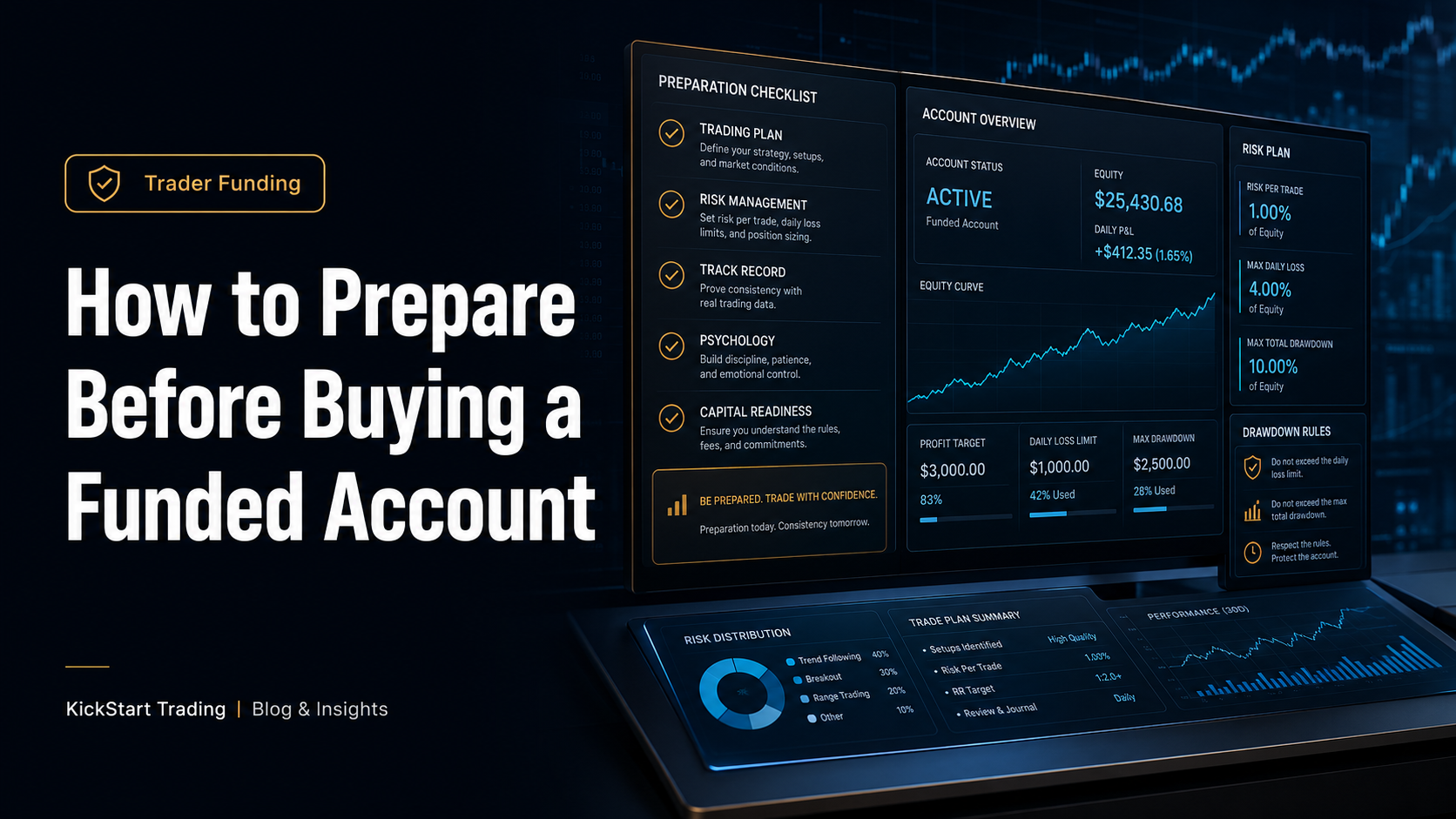
How to Prepare Before Buying a Funded Account
Buying a funded account can feel exciting.
For many traders, it represents opportunity.
Access to more capital.
A chance to prove yourself.
A way to trade at a meaningful size without needing to personally deposit tens of thousands of pounds or dollars.
But excitement can also be dangerous.
Too many traders buy funded accounts before they are ready. They focus on the account size, the profit target, the discount code, or the potential payout, but they do not stop to ask whether they are actually prepared to trade the account properly.
That is a serious mistake.
A funded account is not just something you buy.
It is something you need to be ready to manage.
Funding does not fix poor preparation
One of the biggest mistakes traders make is believing that a funded account will solve their trading problems.
It will not.
If a trader is undisciplined on a demo account, they are unlikely to become disciplined just because the account size is larger.
If a trader overtrades a small live account, they will probably overtrade a funded account.
If a trader revenge trades after losses, a funding challenge may actually make that problem worse because the pressure is higher.
Funding gives traders access to an opportunity.
It does not replace skill, discipline, risk management, or emotional control.
This is why preparation matters.
Before buying any funded account, a trader should know exactly how they plan to trade, how much they will risk, what rules they must follow, and what they will do when things go wrong.
Understand the rules before you buy
Before buying a funded account, you need to understand the rules.
Not skim them.
Not assume they are all the same.
Actually understand them.
Every funding model has its own structure. Some accounts use static drawdown. Others use trailing drawdown. Some have strict daily loss limits. Some have consistency rules. Some allow weekend holding. Others do not. Some allow news trading. Others restrict it.
A trader should know the answers to questions like:
- What is the profit target?
- What is the maximum drawdown?
- Is the drawdown static or trailing?
- Is drawdown based on balance or equity?
- What is the daily loss limit?
- Are there minimum trading days?
- Are there consistency rules?
- Can trades be held overnight?
- Can trades be held over the weekend?
- Is news trading allowed?
- What happens after passing?
- What are the payout rules?
These details matter.
A trader can have a good strategy and still fail an account by misunderstanding the rules.
That is why reading the rules carefully is part of preparation.
Know which funding route fits you
Not every trader should choose the same funding route.
Some traders may be better suited to 1-Step Funding. Others may prefer 2-Step Funding. Some may consider Instant Funding. Others may be more interested in Futures Funding.
The right route depends on the trader.
A trader with a tested strategy, strong discipline, and confidence under pressure may prefer a faster route.
A trader who is still building consistency may benefit from a more structured pathway.
A trader who struggles with trailing drawdown may need to think carefully before choosing an account where the drawdown moves aggressively.
A trader who holds trades over multiple sessions needs to check whether overnight or weekend holding is allowed.
The point is simple.
Do not choose a funded account only because it looks attractive.
Choose the account that fits the way you actually trade.
Have a trading strategy before buying
A funded account is not the place to start figuring out your strategy.
Before buying, you should already know:
- What markets you trade
- What timeframes you use
- What setups you look for
- How you define an entry
- Where your stop loss goes
- How you choose targets
- When you avoid trading
- How many trades you normally take
- What invalidates your trade idea
This does not mean your strategy must be perfect.
No strategy is perfect.
But you should have a clear process.
If you are still randomly jumping between indicators, YouTube strategies, signal groups, and social media trade ideas, you are probably not ready for a funded account.
You need structure before pressure.
This is why structured trading education matters. A trader needs a foundation before they can perform consistently under funded-account rules.
Build a risk plan first
Risk management is not something to figure out after buying the account.
It needs to be planned before the first trade.
A trader should know:
- How much they will risk per trade
- How many trades they can lose before stopping
- What their daily stop limit is
- What their weekly drawdown threshold is
- Whether they will reduce risk after losses
- Whether they will increase risk after profits
- How they will protect the account near drawdown limits
Many traders fail funded accounts because they risk too much too early.
They want to hit the profit target quickly, so they increase position size, take lower-quality setups, and put themselves under unnecessary pressure.
That is not professional trading.
A serious trader protects the account first.
Profit matters, but survival comes first.
Respect daily loss limits
Daily loss limits are one of the biggest reasons traders fail funded accounts.
A daily loss limit is designed to prevent one bad day from destroying the account.
That rule exists for a reason.
Every trader has bad days. Every trader can misread the market. Every trader can take losses. The problem begins when a trader refuses to stop.
One loss becomes two.
Two losses become frustration.
Frustration becomes revenge trading.
Revenge trading becomes a rule violation.
Before buying a funded account, decide exactly when you will stop trading for the day.
Do not leave that decision to emotion.
If your rule is to stop after two losing trades, stop after two losing trades.
If your rule is to stop after a certain percentage loss, stop there.
The discipline to stop is one of the most important skills in funded trading.
Prepare for drawdown emotionally
Most traders think they are ready for drawdown until they are in it.
Drawdown changes how traders feel.
Confidence drops. Fear increases. The desire to recover becomes stronger. The trader starts questioning their strategy, their ability, and sometimes their entire future.
This is where preparation matters.
Before buying a funded account, you should know what you will do when drawdown happens.
Will you reduce risk?
Will you stop trading for the day?
Will you review your trades?
Will you take a break?
Will you go back to demo until you regain composure?
Drawdown should not surprise you.
It is part of trading.
The goal is not to avoid all drawdown. The goal is to control it.
If you have not already read it, our article on drawdown explains why this concept is so important for serious traders.
Do not buy when emotional
One of the worst times to buy a funded account is immediately after a loss, a blown account, or a frustrating trading period.
That is when traders are most likely to make impulsive decisions.
They want a fresh start.
They want to win the money back.
They want to prove something.
They want to feel like they are moving forward again.
But buying a funded account from an emotional state can lead to poor decisions. The trader may choose too large an account, ignore the rules, underestimate the pressure, or start trading aggressively from day one.
A funded account should be bought from a place of preparation, not desperation.
If you are emotional, step back first.
Review your recent trades.
Check whether your process is stable.
Make sure you are buying because you are ready, not because you are reacting.
Start with the right account size
Many traders choose account sizes based on ambition rather than readiness.
They see a large account and imagine the potential payout.
But bigger accounts can create bigger psychological pressure.
A trader who is not used to managing size may become emotional when the numbers on the screen become larger. Even if the risk percentage is the same, the money value can feel different.
That emotional pressure can affect execution.
Before choosing an account size, ask yourself:
- Have I traded this size before?
- Can I handle the monetary value of normal losses?
- Will this account size make me more disciplined or more emotional?
- Am I choosing this size because it fits my plan, or because I want a bigger payout?
There is nothing wrong with ambition.
But ambition without self-awareness can be expensive.
Test your plan before buying
Before buying a funded account, test your plan.
That can mean demo trading, backtesting, forward testing, journaling, or reviewing historical setups.
The goal is to prove that your approach has structure.
A trader should know whether their strategy can realistically operate within the rules of the account.
For example, if the strategy regularly goes through losing streaks, the trader needs to know whether the drawdown rules can handle that.
If the strategy requires holding trades through major news events, the trader needs to check whether news restrictions would interfere.
If the strategy needs wider stops, the trader needs to understand how that affects position sizing.
Testing helps remove guesswork.
It does not guarantee success, but it gives the trader a better foundation.
Prepare your trading environment
Preparation is not only about strategy.
It is also about environment.
Before buying a funded account, make sure you have:
- A reliable internet connection
- A clean trading workspace
- Your trading platform set up correctly
- A clear watchlist
- A journal ready
- A written trading plan
- A risk calculator or position sizing process
- Time blocked out for trading and review
- No unnecessary distractions during sessions
Small things matter.
A trader who is disorganised before entering a challenge will usually become more disorganised under pressure.
Structure reduces friction.
The more prepared your environment is, the easier it is to execute your plan.
Know your reason for buying
Before buying a funded account, ask yourself why you are doing it.
Are you trying to build a serious trading career?
Are you trying to test your skill?
Are you trying to access capital responsibly?
Or are you trying to make fast money?
The answer matters.
A trader who sees funding as a professional opportunity will usually approach it differently from a trader who sees it as a lottery ticket.
At KickStart Trading, we believe funded trading should be approached seriously.
That means education first, process first, risk first, and discipline before aggression.
Funding can be powerful, but only when the trader respects the responsibility that comes with it.
Final checklist before buying
Before buying a funded account, make sure you can honestly say:
- I understand the rules
- I know the drawdown structure
- I have a written trading plan
- I have a risk management plan
- I know when I will stop trading
- I understand my strategy
- I have tested my process
- I know which account size fits me
- I am not buying emotionally
- I am prepared to treat the account professionally
If you cannot say those things yet, it may be better to wait.
Waiting is not failure.
Rushing into an account before you are ready is what usually causes failure.
Ready to reset before choosing a funded account?
If you are thinking about buying a funded account, start by making sure your process is ready.
KickStart Education is built to help traders develop more structure around risk, discipline, trade planning, and funded-account readiness.
For the July 4th Trading Reset Promo, use FREEDOM50 for 50% off eligible education options.
You can also review the funded account routes when you feel ready:
Trading involves risk. Education, coaching, and funded-account access do not guarantee profits, payouts, or funded success.
Final thoughts
Buying a funded account can be a powerful step for a trader.
But it should be a prepared step.
The traders who give themselves the best chance are not always the ones who rush fastest. They are the ones who understand the rules, respect risk, control their emotions, and trade with a clear process.
Funding is not just about access to capital.
It is about proving that you are ready to manage capital responsibly.
Before buying, slow down.
Prepare properly.
Choose the route that fits you.
And make sure you are trading from discipline, not desperation.
To your health, wealth, and happiness, always,
Chris