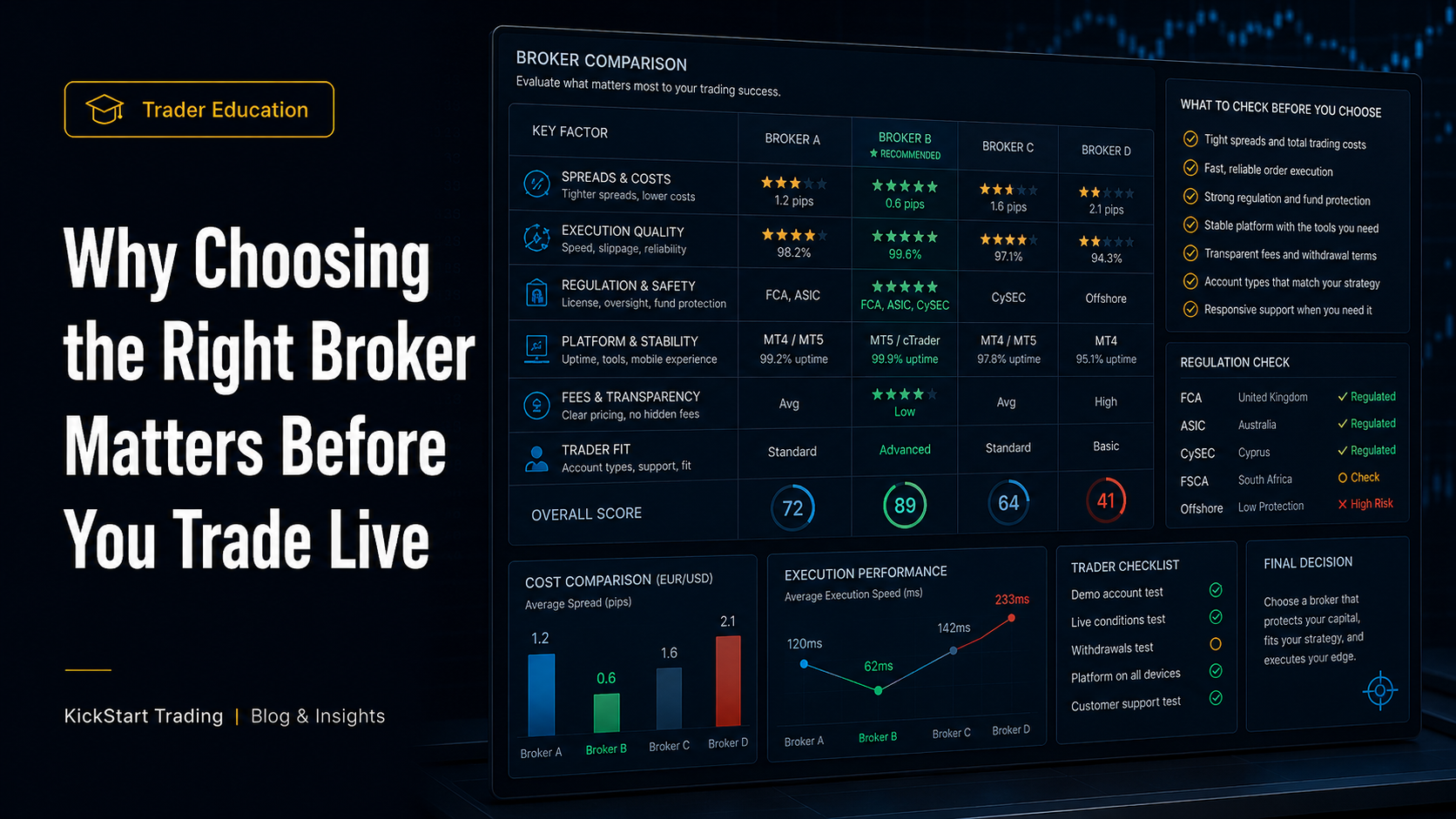
Why Choosing the Right Broker Matters Before You Trade Live
Many traders spend months studying entries, indicators, candlesticks, Fibonacci, market structure, risk management, and funded account rules.
But when it comes time to trade live, they often rush one of the most important decisions:
Choosing a broker.
That is a mistake.
Your broker is not just a place where you open an account.
Your broker affects your trading environment, execution experience, platform access, spreads, commissions, deposits, withdrawals, available markets, and sometimes even whether you are allowed to open an account at all.
A strong strategy can still be damaged by poor execution, unsuitable account conditions, platform issues, or a broker that simply does not fit the trader’s needs.
Before trading live, every serious trader should understand why broker choice matters.
A broker is part of your trading infrastructure
Trading is not only about analysis.
It is also about infrastructure.
A trader needs a charting process, a risk plan, a trading journal, a platform, a stable internet connection, and a broker that can support the type of trading they want to do.
If any part of that infrastructure is weak, the trader can suffer.
This is especially important for traders who want to move from education into live market conditions.
A demo account can help build familiarity, but live trading introduces real execution, real spreads, real emotions, real deposits, and real consequences.
That is why broker choice should be treated as a serious decision.
Regulation and trust matter
One of the first things traders should review is whether a broker operates under a proper regulatory framework.
Regulation does not remove trading risk. It does not guarantee profit. It does not mean every trader will have a perfect experience.
But it does matter.
Regulation can affect how a broker handles client funds, compliance, dispute processes, reporting, operational standards, and client protections.
A trader should never choose a broker purely because of a flashy promotion, a social media post, or a random recommendation.
Before opening a live account, traders should review the broker’s website, terms, legal documents, jurisdiction, restrictions, and account conditions.
If you are trusting a broker with your money, you should understand who you are dealing with.
Execution can affect your results
Execution refers to how trades are processed.
This includes order filling, slippage, spreads, commissions, platform response, and the overall trading environment.
Execution matters because small differences can add up.
A trader who scalps may be more sensitive to spread and slippage than a trader who holds longer-term positions. A trader using tight stops may need a more precise execution environment than someone trading larger swing structures.
This is why traders should not only ask, “Can I trade this market?”
They should also ask:
- What are the spreads like?
- Are there commissions?
- How does execution feel during active sessions?
- Are my preferred platforms available?
- Are my preferred markets available?
- Are deposits and withdrawals practical for me?
- Are there restrictions based on my country of residence?
The broker needs to fit the trader’s actual style.
Platform access matters
A broker’s platform offering can make a big difference.
Some traders prefer MetaTrader. Some prefer cTrader. Some use web platforms. Some need mobile access. Some want clean execution for forex and CFDs. Some care deeply about charting layout and order management.
The platform is where trading decisions become real orders.
If the platform feels clunky, unstable, confusing, or unsuitable for your process, that can create unnecessary friction.
A good trading process should be as clean as possible.
You want your attention on the market, your risk, and your plan — not fighting the platform.
Market access should match your trading plan
Not every trader needs access to every market.
Some traders focus only on forex.
Some focus on gold.
Some want indices, commodities, or crypto CFDs depending on availability and restrictions.
Some eventually explore futures funding or exchange-traded futures products through a separate pathway.
The point is simple: your broker should support the markets you actually trade.
If your strategy is built around specific instruments, trading sessions, volatility profiles, or spread expectations, broker choice becomes even more important.
A trader should not open an account first and figure out the details later.
The broker should be selected around the trading plan.
Costs matter more than many traders realise
Spreads, commissions, swaps, conversion fees, withdrawal fees, inactivity fees, and other charges can affect performance.
Some costs are obvious.
Others are less obvious until the trader starts using the account.
For short-term traders, spread and commission can be especially important because each trade has a cost before it has any chance of becoming profitable.
For longer-term traders, overnight financing or swap charges may matter more.
This does not mean the cheapest broker is always the best broker.
It means traders should understand the cost structure before trading live.
A broker should be assessed on overall fit, not just one headline number.
Deposits and withdrawals matter
A live trading account is only useful if deposits and withdrawals are practical.
Traders should review available funding methods, processing times, currency options, minimum deposit requirements, withdrawal rules, and any verification steps.
This is not the exciting part of trading, but it matters.
A trader does not want to discover avoidable funding or withdrawal issues after opening an account.
Before trading live, check the practical details.
Good trading infrastructure includes smooth account management.
Country restrictions matter
Broker availability depends on jurisdiction, regulation, and residency.
A broker may be available to traders in some countries but not others.
This is important because some brokers are not available to residents of certain jurisdictions.
For example, Focus Markets is only available to non-US residents.
That means US residents should not attempt to open an account through Focus Markets and should instead review broker options available in their own jurisdiction.
Always check eligibility before applying.
Why KickStart Trading partners with Focus Markets
KickStart Trading partners with Focus Markets because many traders need a live broker option that can support their trading journey after they have developed a proper foundation.
For eligible non-US residents, Focus Markets may be worth reviewing as a live broker option.
You can review Focus Markets here:
Open or review a Focus Markets account
Focus Markets is not suitable for everyone, and traders should always review the broker’s own terms, conditions, legal documents, risk disclosures, available jurisdictions, and account requirements before opening any live trading account.
Broker choice should come after education
A broker is important, but it is not a shortcut.
Opening a live account does not automatically make someone ready to trade live.
Before trading live, traders should understand:
- Candlesticks
- Market structure
- Support and resistance
- Fibonacci
- Risk management
- Drawdown
- Trading psychology
- Trade journaling
- Position sizing
- Account rules
- When not to trade
This is why structured trader education matters.
If a trader has not built a foundation yet, it may be wiser to start with education before putting real money at risk.
You can also begin with the free trading training if you want a clearer starting point.
Live trading increases emotional pressure
Demo trading and live trading are different.
The chart may look the same, but the emotional pressure changes when real money is involved.
A trader may suddenly hesitate, exit early, move stops, increase risk, revenge trade, or make decisions they would never make on demo.
This is why trading psychology matters before going live.
A broker gives access to the market.
It does not give emotional discipline.
That part has to be built.
Broker choice and funded trading are different decisions
It is also important to understand the difference between live broker trading and funded trading.
A broker account usually involves trading your own deposited capital.
A funded account involves trading under a funding provider’s rules, targets, drawdown limits, payout terms, and account conditions.
Both can have a place in a trader’s journey, but they are not the same thing.
Some traders may choose to trade live with a broker. Others may pursue Instant Funding, 1-Step Funding, 2-Step Funding, or Futures Funding.
Some traders may use both over time.
The right path depends on your experience, capital, risk tolerance, psychology, and trading plan.
Do not rush the live account decision
Opening a live account can feel exciting.
But serious traders do not rush serious decisions.
Before choosing a broker, slow down and review:
- Whether the broker accepts residents of your country
- Regulation and legal documents
- Available platforms
- Market access
- Spreads and commissions
- Funding methods
- Withdrawal rules
- Account types
- Risk disclosures
- Customer support
- Whether the broker fits your trading style
This is basic due diligence.
It is not optional.
Final thoughts
Choosing the right broker matters because your broker becomes part of your trading infrastructure.
A trader needs more than a strategy. They need structure, education, risk control, emotional discipline, and a trading environment that supports their process.
For eligible non-US residents, Focus Markets is one broker option KickStart Trading can point traders toward.
You can review Focus Markets here:
Open or review a Focus Markets account
Disclosure: KickStart Trading has a partnership relationship with Focus Markets and may receive compensation if eligible traders open and fund an account through the link above. Always conduct your own due diligence and review the broker’s terms before opening any live trading account.
But regardless of which broker you choose, the principle remains the same:
Do your due diligence.
Understand the risks.
Build your foundation first.
And never treat live trading as something to rush into unprepared.
To your health, wealth, and happiness always,
Chris