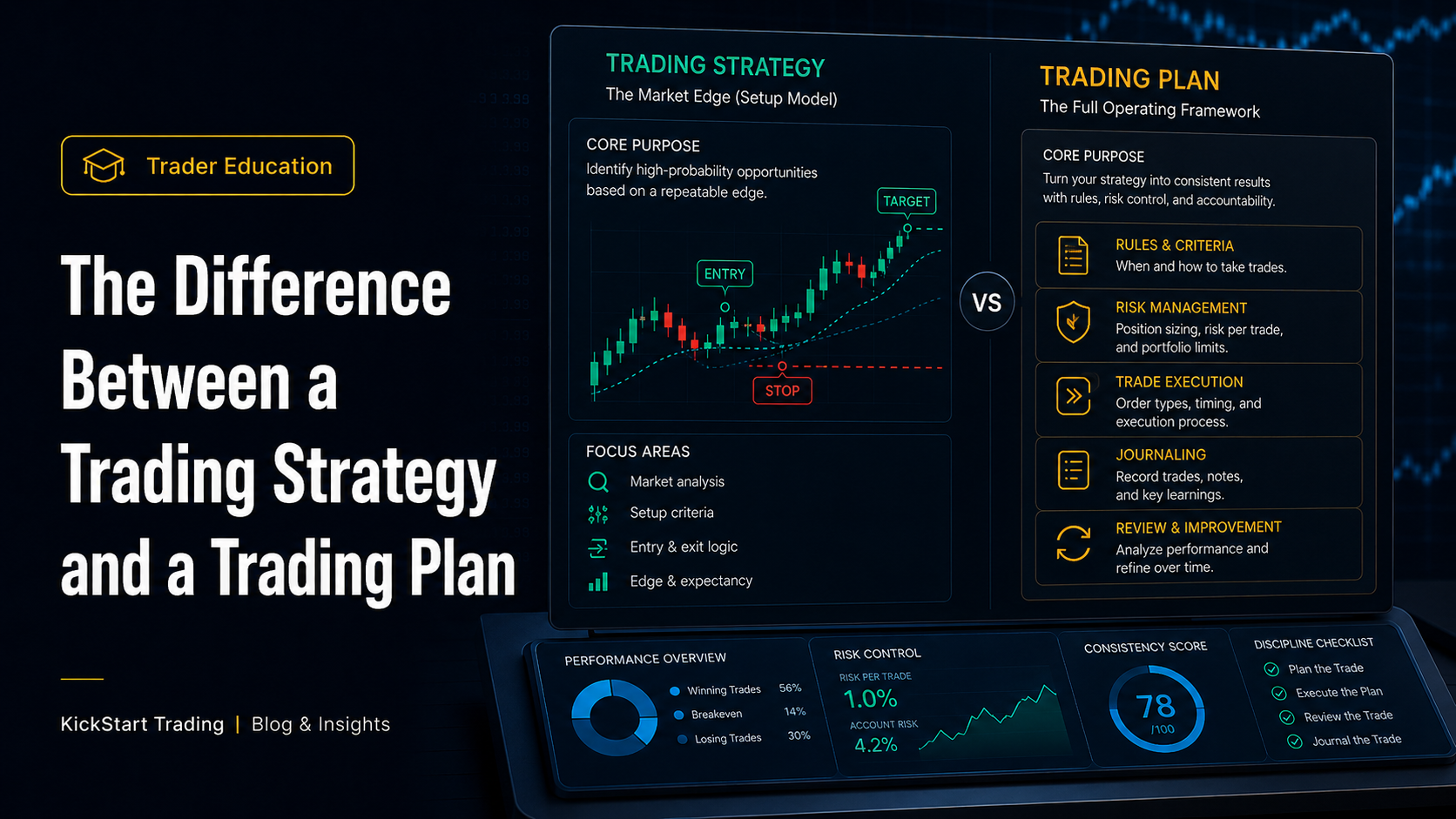
The Difference Between a Trading Strategy and a Trading Plan
Many traders confuse a trading strategy with a trading plan.
They are not the same thing.
A trading strategy tells you what you are looking for in the market.
A trading plan tells you how you will behave around that strategy.
That difference matters.
A trader can have a good strategy and still lose money if they do not have a proper plan. They can know where to enter, where to place a stop, and where to target, but still fail because they overtrade, risk too much, revenge trade, ignore market conditions, or abandon the rules under pressure.
A strategy helps you identify opportunity.
A plan helps you manage yourself.
Serious traders need both.
What is a trading strategy?
A trading strategy is the method a trader uses to find and execute trade opportunities.
It defines the type of setup the trader is looking for.
That may include:
- Market structure
- Trend direction
- Support and resistance
- Fibonacci retracement or extension levels
- Candlestick confirmation
- Breakouts or pullbacks
- Momentum
- Confluence
- Entry criteria
- Stop placement
- Target selection
A strategy gives the trader a reason to enter the market.
Without a strategy, the trader is usually just reacting to price movement.
That creates inconsistency.
A trading strategy should help answer the question:
Why am I taking this trade?
What is a trading plan?
A trading plan is broader than a strategy.
It is the written framework that defines how the trader will operate.
It includes the strategy, but it also includes everything around the strategy.
A trading plan may include:
- Markets traded
- Trading sessions
- Risk per trade
- Daily loss limit
- Maximum number of trades
- Setup rules
- Entry rules
- Exit rules
- News rules
- Journaling process
- Review routine
- Emotional rules
- Rules for when not to trade
A trading plan helps answer the question:
How will I behave as a trader?
That is why the plan matters so much.
Most traders do not fail only because they cannot find setups.
They fail because they cannot consistently behave properly around those setups.
A strategy is not enough
A strategy alone is not enough.
A trader may know the technical setup perfectly and still make poor decisions.
For example, they may:
- Enter before confirmation
- Move the stop loss
- Increase risk after a loss
- Take the same setup in poor market conditions
- Trade during high-impact news without planning
- Continue trading after reaching a daily stop
- Take trades outside the strategy
- Close winners too early from fear
- Hold losers too long from hope
These mistakes are not always strategy problems.
They are plan and discipline problems.
This is why many traders keep searching for a better strategy when what they actually need is better structure.
A trading plan creates boundaries
Trading creates constant temptation.
There is always another chart.
Another setup.
Another move.
Another opportunity.
Without boundaries, traders can easily become reactive.
A trading plan creates those boundaries.
It tells the trader what they are allowed to do and what they are not allowed to do.
That may sound restrictive, but it is actually protective.
The plan protects the trader from emotion.
It prevents one bad decision from becoming a bad day.
It prevents one bad day from becoming a bad week.
It gives the trader something to return to when pressure rises.
A plan does not remove uncertainty from the market.
But it reduces uncertainty in the trader’s behaviour.
The strategy defines opportunity
The strategy defines what the trader considers a valid opportunity.
For example, a trader might only take trades when price pulls back into a key level during a clear trend.
Another trader might focus on breakouts from consolidation.
Another might trade Fibonacci-based retracements and extensions.
Another might specialise in gold during specific market sessions.
There are many possible strategies.
The key is that the strategy must be clear enough to repeat.
If the trader cannot define the setup, they cannot measure it.
If they cannot measure it, they cannot improve it.
A vague strategy creates vague results.
The plan defines execution
The trading plan defines how the strategy will be executed.
It turns the idea into a process.
For example:
- Which markets will be traded?
- Which timeframes will be used?
- What confirms the setup?
- How much will be risked?
- Where will the stop go?
- Where will the target go?
- When will the trade be skipped?
- What happens after a loss?
- What happens after a win?
- When does the trading day end?
These are practical questions.
They matter because trading is not just analysis.
Trading is execution under pressure.
A plan gives the trader a system for that execution.
Why traders confuse the two
Traders often confuse strategy and plan because most trading education focuses heavily on entries.
Where to buy.
Where to sell.
Which indicator to use.
Which pattern to look for.
Which level to mark.
Entries matter, but they are only one part of the process.
A trader can enter well and still manage the trade poorly.
They can identify the correct area and still risk too much.
They can be right about direction and still lose because the stop was wrong.
They can win a trade and still reinforce bad behaviour.
This is why a strategy must sit inside a larger trading plan.
The entry is not the whole business.
It is only one decision within the business.
A trading plan helps with consistency
Consistency is one of the hardest things in trading.
Not because traders cannot have good days.
Many traders have good days.
The problem is repeating good behaviour over time.
A trading plan helps because it creates a standard.
The trader can compare their behaviour against the plan.
Did I follow my rules?
Did I take only valid setups?
Did I risk the correct amount?
Did I stop when I said I would stop?
Did I journal properly?
Did I avoid emotional trades?
Without a plan, the trader has no stable benchmark.
Every session becomes subjective.
That makes improvement harder.
A strategy should be tested
A trading strategy should be tested before serious money is risked.
That testing might include backtesting, forward testing, demo trading, small live trades, or structured review of historical examples.
The goal is to understand how the strategy behaves.
A trader should know:
- What conditions suit the strategy
- What conditions hurt the strategy
- Typical win rate
- Typical losing streaks
- Average risk-to-reward
- Best session times
- Common failure patterns
- Psychological challenges
Testing does not guarantee future results.
But it helps the trader understand what they are working with.
Trading an untested strategy with real money or a funded account adds unnecessary risk.
A plan should be reviewed
A trading plan should not be written once and ignored.
It should be reviewed regularly.
The trader should ask:
- Am I following the plan?
- Are the rules clear enough?
- Are my risk limits realistic?
- Am I overtrading?
- Am I respecting daily stops?
- Do certain market conditions keep causing mistakes?
- Does the strategy still fit my personality?
- Does my journal reveal repeated problems?
A plan can evolve.
But changes should be deliberate, not emotional.
Changing the plan after one losing trade is usually reaction.
Improving the plan after a structured review is development.
The emotional side of a trading plan
A trading plan is not only technical.
It should include emotional rules.
For example:
- Stop trading after revenge trading thoughts appear
- Stop after two full-risk losses
- Do not increase risk after a loss
- Do not trade when angry, rushed, or desperate
- Do not trade to recover
- Take a break after a mistake-based trade
- Review before continuing
These rules matter because emotional mistakes can damage an account faster than technical mistakes.
A trader may understand the market well and still fail because they cannot manage themselves.
A trading plan should protect the trader from emotional escalation.
Funded accounts require both
Funded accounts make the difference between strategy and plan even more important.
A trader needs a strategy to generate valid trades.
But they also need a plan to respect funded-account rules.
That includes:
- Daily loss limits
- Maximum drawdown
- Profit targets
- Consistency rules
- News rules
- Holding rules
- Account-size pressure
- Payout requirements
A trader may have a strategy that works in general, but if the plan does not fit the funded-account structure, the account can still fail.
This is why preparation matters before buying a funded account.
If you are considering funding, read our guide on why most traders fail funded accounts and make sure your plan is built before you enter the challenge.
A strategy answers “what”
A simple way to understand the difference is this:
The strategy answers “what.”
What market setup am I looking for?
What confirms the trade?
What price action matters?
What structure supports the idea?
What invalidates the trade?
What target makes sense?
The strategy is about identifying opportunity.
It gives the trader a technical reason to act.
A plan answers “how”
The plan answers “how.”
How much will I risk?
How many trades will I take?
How will I respond to a loss?
How will I protect the account?
How will I manage emotion?
How will I review performance?
How will I know when to stop?
The plan is about behaviour.
It gives the trader a professional operating framework.
Signs you only have a strategy
You may only have a strategy, not a full plan, if:
- You know your entry setup but not your daily stop
- You know your target but not your post-loss rule
- You know your favourite market but not your maximum weekly risk
- You know when to enter but not when to walk away
- You keep changing risk based on emotion
- You do not journal consistently
- You cannot explain what makes you stop trading for the day
- You do not have rules for news, volatility, or poor conditions
This is common.
It is also fixable.
The next step is not necessarily to find a new strategy.
The next step may be to build a better plan around the strategy you already have.
What a complete trading plan should include
A complete trading plan should include at least:
- Your trading goals
- Markets you trade
- Sessions you trade
- Timeframes you use
- Strategy rules
- Entry criteria
- Stop-loss rules
- Target rules
- Risk per trade
- Daily loss stop
- Maximum number of trades
- News rules
- Journaling process
- Review schedule
- Emotional rules
- Rules for when not to trade
This does not need to be complicated.
In fact, simple plans are often easier to follow.
The key is clarity.
If the plan is vague, the trader will negotiate with it under pressure.
Simplicity helps execution
A trading plan should be clear enough to use.
Some traders create plans that are too complicated.
They include too many setups, too many conditions, too many indicators, and too many exceptions.
That can create confusion.
A good plan should help the trader act with clarity.
It should reduce hesitation.
It should reduce impulsive decisions.
It should make review easier.
The goal is not to create a perfect document.
The goal is to create a usable operating system.
The plan must match the trader
A trading plan should fit the trader’s personality, schedule, risk tolerance, experience, and market preference.
A trader who works during the day may need a different plan from a full-time trader.
A trader who is emotional under high volatility may need stricter risk rules.
A trader who trades gold may need to account for faster movement and sharper volatility.
A trader who uses funded accounts must account for rule restrictions.
Copying someone else’s plan blindly rarely works.
You can learn from others.
But the plan must become your own.
Final thoughts
A trading strategy and a trading plan are connected, but they are not the same thing.
The strategy tells you what to trade.
The plan tells you how to behave.
A trader who has a strategy without a plan may still make emotional, inconsistent, and risky decisions.
A trader with both has a stronger foundation.
They know what they are looking for.
They know how much they are risking.
They know when to trade.
They know when to stop.
They know how to review.
They know how to protect the account.
That is the difference between simply finding setups and operating like a serious trader.
If you want better trading results, do not only ask whether your strategy is good.
Ask whether your plan is strong enough to help you execute it properly.
To your health, wealth, and happiness, always,
Chris