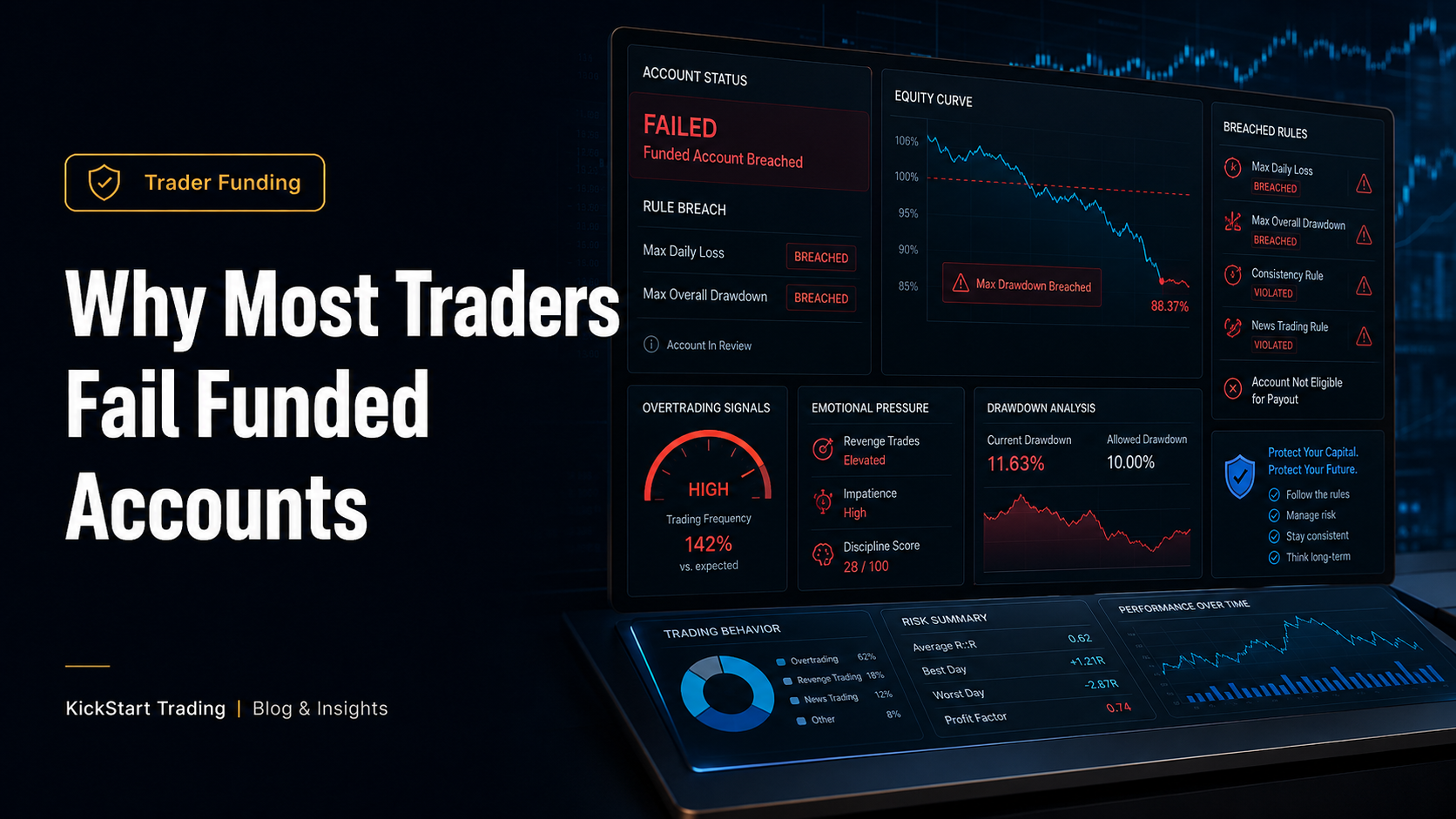
Why Most Traders Fail Funded Accounts
Most traders do not fail funded accounts because they lack ambition.
They fail because ambition is not enough.
A trader can want success badly. They can study charts, watch videos, buy courses, follow mentors, and believe deeply in their potential.
But a funded account does not reward potential.
It rewards execution.
It rewards discipline.
It rewards risk control.
It rewards the ability to follow rules when money, pressure, and emotion are involved.
That is why so many traders fail funded accounts. Not because they are incapable, but because they approach the opportunity without the structure required to manage it properly.
Funded accounts expose weaknesses quickly
A funded account can be a powerful opportunity.
It can give a trader access to more capital than they may personally have available. It can create a pathway toward payouts, scaling, and professional development.
But it also exposes weaknesses quickly.
If a trader overtrades, the account will expose it.
If a trader revenge trades, the account will expose it.
If a trader risks too much, the account will expose it.
If a trader cannot follow rules, the account will expose it.
If a trader becomes emotional after losses, the account will expose it.
A funded account does not magically turn a struggling trader into a disciplined one.
It usually magnifies whatever is already there.
They focus on passing, not surviving
One of the biggest mistakes traders make is focusing only on passing.
They look at the profit target and think:
How quickly can I hit this?
That mindset can be dangerous.
The goal is not just to pass the evaluation.
The goal is to become the kind of trader who can keep the account after passing.
A trader who passes by overleveraging, taking oversized trades, or getting lucky may still be in trouble once funded.
Passing is not the finish line.
It is the start of a new level of responsibility.
Serious traders think beyond the challenge phase.
They ask:
Can I trade this account responsibly over time?
That is a better question.
Poor risk management
Poor risk management is one of the main reasons traders fail funded accounts.
Many traders risk too much per trade.
They may risk 3%, 5%, or even more because they want to reach the profit target quickly.
The problem is that high risk leaves very little room for normal losses.
Every strategy has losing trades.
Every trader experiences losing streaks.
If the risk per trade is too high, a few losses can quickly push the account near the daily loss limit or maximum drawdown.
That creates pressure.
Pressure leads to emotional decisions.
Emotional decisions lead to mistakes.
A funded account should be approached with capital protection first.
Profit comes second.
Ignoring daily loss limits
Daily loss limits are one of the most important rules in funded trading.
They are also one of the most commonly ignored.
Many traders understand the rule but still trade too close to it.
They treat the official daily loss limit as the level where they should stop.
That is dangerous.
The official daily loss limit should be treated as the emergency wall, not the normal stopping point.
A serious trader should usually have a personal daily stop before the official limit.
If the account allows a 5% daily loss, the trader may choose to stop at 2% or 2.5%.
That creates a buffer.
It protects the account from emotional decision-making.
If you are not willing to stop before the account forces you to stop, you are probably giving the rule too much control over your behaviour.
Misunderstanding drawdown
Drawdown is another major reason traders fail funded accounts.
Some traders do not fully understand the difference between static drawdown and trailing drawdown.
Some do not know whether the drawdown is based on balance or equity.
Some do not understand how open trades affect the account.
Some assume that because they are in profit, they are safe.
That can be a dangerous assumption.
Drawdown rules can completely change how an account behaves.
A trader might think they have more room than they actually do.
They might give back too much profit.
They might hold trades through volatility without understanding the risk.
They might violate a rule without realising how close they were to the limit.
Before trading any funded account, the trader needs to understand the drawdown structure properly.
Not vaguely.
Properly.
Trading too large
Many funded-account failures happen because the trader chooses a position size that is too large for the rules.
The trader may be excited by the account size.
They may think a larger account means they can trade larger positions.
Technically, that may be true.
But responsible position sizing must still be based on risk.
A larger account does not justify reckless exposure.
The question should not be:
How much can I trade?
The question should be:
How much can I risk while still protecting the account?
That is a very different mindset.
A trader who sizes properly can survive normal losses.
A trader who sizes emotionally may fail quickly.
Revenge trading after losses
Revenge trading is one of the fastest ways to lose a funded account.
It usually starts with one loss.
The trader becomes frustrated.
They want to recover.
They take another trade.
Then another.
Then another.
The trades become less planned and more emotional.
At that point, the trader is no longer executing a strategy.
They are trying to repair how they feel.
That is dangerous on any account.
On a funded account, it can be fatal.
Daily loss limits and maximum drawdown rules do not care why the trader became emotional.
A rule breach is still a rule breach.
The trader must learn to stop after losses before the account is in danger.
Overtrading
Overtrading is another common reason traders fail.
The trader takes too many trades because they feel pressure to make progress.
They may think more trades means more opportunity.
But more trades also means more chances to make mistakes.
More exposure.
More commissions.
More emotional decisions.
More chances to violate rules.
A serious trader does not need to be in the market constantly.
They need to take the right trades at the right time under the right conditions.
If the setup is not there, the professional decision is to wait.
For many traders, patience is the missing edge.
Chasing the profit target
Funded accounts usually have defined profit targets.
That target can become psychologically dangerous.
Instead of trading the market properly, the trader starts trading the target.
They think:
I only need one more good trade.
I am almost there.
I can pass today.
I just need to push a little harder.
That mindset can lead to oversized positions, poor entries, rushed decisions, and emotional exits.
The profit target should be the result of good trading.
It should not become the reason for bad trading.
A trader who chases the target may pass sometimes.
But long term, the behaviour is risky.
The better approach is to trade the plan and let the target come from process.
Buying the wrong account
Some traders fail because they choose the wrong account structure.
They pick the biggest account they can afford.
Or the cheapest discounted account.
Or the fastest route.
Or the account that looks most exciting.
But they do not ask whether the rules fit their trading style.
A scalper, swing trader, gold trader, futures trader, and news trader may all need different conditions.
Some traders are better suited to 1-Step Funding.
Some may benefit from the structure of 2-Step Funding.
Some may prefer Instant Funding, but only if they are ready for immediate pressure.
Some may be better suited to Futures Funding.
The route matters.
The rules matter.
The account size matters.
A trader should choose deliberately, not emotionally.
Not reading the rules properly
This one sounds obvious, but it happens constantly.
Traders buy accounts without fully reading the rules.
They do not check news restrictions.
They do not check weekend holding rules.
They do not check daily reset times.
They do not check drawdown calculations.
They do not check consistency rules.
They do not check payout requirements.
Then they become surprised when a rule affects them.
That is not professional.
A funded account is a rule-based opportunity.
If the trader does not know the rules, they are already taking unnecessary risk.
Before placing the first trade, the trader should understand exactly what can cause failure.
Strategy hopping
Some traders fail funded accounts because they do not have a stable strategy.
They enter the account with one method, lose a few trades, then switch to another.
Then another.
Then another.
This creates inconsistency.
The trader never gives one method enough time to produce meaningful data.
They react to short-term outcomes instead of building a process.
A funded account is not the place to experiment wildly.
The trader should already know what they are trading, why they are trading it, how they manage risk, and what conditions suit the strategy.
Testing belongs before the account.
Execution belongs during the account.
Lack of journaling
Many traders fail because they do not review their behaviour.
They take trades, win or lose, then move on.
No screenshots.
No notes.
No emotional tracking.
No mistake review.
No performance data.
Without a trading journal, the trader may keep repeating the same errors without seeing the pattern.
A journal helps identify:
- Which setups perform best
- Which times of day create mistakes
- Whether losses are strategy-based or behaviour-based
- Whether risk rules are being followed
- Whether emotions are affecting decisions
- Whether the trader is improving
Funded trading requires feedback.
A journal provides it.
Financial pressure
Financial pressure can damage trading decisions.
If a trader buys a funded account because they desperately need a payout, they may trade from fear and urgency.
That pressure can lead to forcing trades, increasing risk, holding losers, closing winners too early, and breaking rules.
A funded account should not be treated like an emergency solution.
It is a professional opportunity.
That opportunity needs calm execution.
If a trader feels desperate, they may need to reduce risk, choose a smaller account, slow down, or focus on preparation before entering.
Trading from desperation is rarely clean.
Unrealistic expectations
Many traders enter funded accounts expecting fast results.
They believe they can pass quickly, get paid quickly, scale quickly, and change their financial situation quickly.
It can happen.
But it should not be the expectation.
Trading is difficult.
Funded trading adds rules and pressure.
A serious trader needs realistic expectations.
They should expect losing trades.
They should expect slow periods.
They should expect emotional challenges.
They should expect to work.
The trader who expects a straight line to success is often unprepared for normal setbacks.
Treating funding like a lottery ticket
Some traders approach funded accounts like lottery tickets.
They buy an account, take aggressive trades, hope for a big win, and accept that they may lose it.
That is not trading professionally.
That is gambling behaviour.
A funded account should be treated as capital to protect.
Even during an evaluation phase, the trader should behave as though the capital matters.
Because the habits built during the challenge will usually carry into the funded stage.
If the trader passes through reckless behaviour, they may struggle to keep the account later.
Lack of emotional reset
A trader can fail not only because of one bad trade, but because of how that trade affects the next day.
One bad session becomes a bad week.
The trader carries frustration forward.
They open the chart angry.
They feel behind.
They want to recover.
They force trades.
This is why emotional reset matters.
After a difficult day, the trader should review, step away, and return with structure.
The next session should not be controlled by the previous session’s emotion.
A trader who cannot reset is vulnerable to repeated mistakes.
Not knowing when to stop
Knowing when to stop is one of the most important skills in trading.
Stop after a personal daily loss limit.
Stop after breaking a rule.
Stop after emotional frustration appears.
Stop after a mistake-based trade.
Stop when market conditions are unclear.
Stop when there is no valid setup.
Stop when you are trading to recover.
Many traders fail because they keep going when the best decision is to walk away.
Stopping is not weakness.
Stopping is risk management.
The trader matters more than the account
Traders often spend too much time comparing account features and not enough time evaluating themselves.
They ask:
Which account is best?
Which firm is cheapest?
Which challenge is easiest?
Which payout is highest?
Those questions matter, but they are incomplete.
The better question is:
Am I ready to trade this account properly?
The account does not create discipline.
The trader brings discipline to the account.
If the trader is not ready, even the best account structure will not solve the problem.
How to improve your chances
A trader can improve their chances by approaching funded accounts with structure.
Before buying, they should:
- Understand the rules
- Choose the right account size
- Know the drawdown structure
- Build a risk plan
- Define risk per trade
- Set a personal daily stop
- Prepare for losing streaks
- Journal every trade
- Avoid revenge trading
- Stop after emotional mistakes
- Trade a tested strategy
- Choose the right funding route
This does not guarantee success.
Nothing in trading does.
But it gives the trader a much better foundation than rushing in emotionally.
The KickStart approach
At KickStart Trading, we believe funded trading should be approached responsibly.
Funding is not just about buying an account.
It is about preparing the trader.
That means education, risk management, psychology, tools, and community all matter.
A trader should understand the opportunity before trying to take advantage of it.
They should know the rules before risking the account.
They should build discipline before chasing payouts.
That is the difference between treating funding like a gamble and treating it like a professional pathway.
Final thoughts
Most traders fail funded accounts because they are underprepared.
They risk too much.
They chase the target.
They ignore drawdown.
They break daily loss limits.
They revenge trade.
They overtrade.
They choose the wrong account.
They do not understand the rules.
They treat the account like a shortcut.
But funded trading is not a shortcut around discipline.
It is a test of discipline.
The trader who respects risk, follows rules, prepares properly, and controls emotion has a better chance of surviving long enough to improve.
The goal is not just to pass.
The goal is to become the kind of trader who can keep the account, protect the capital, and build from there.
To your health, wealth, and happiness, always,
Chris