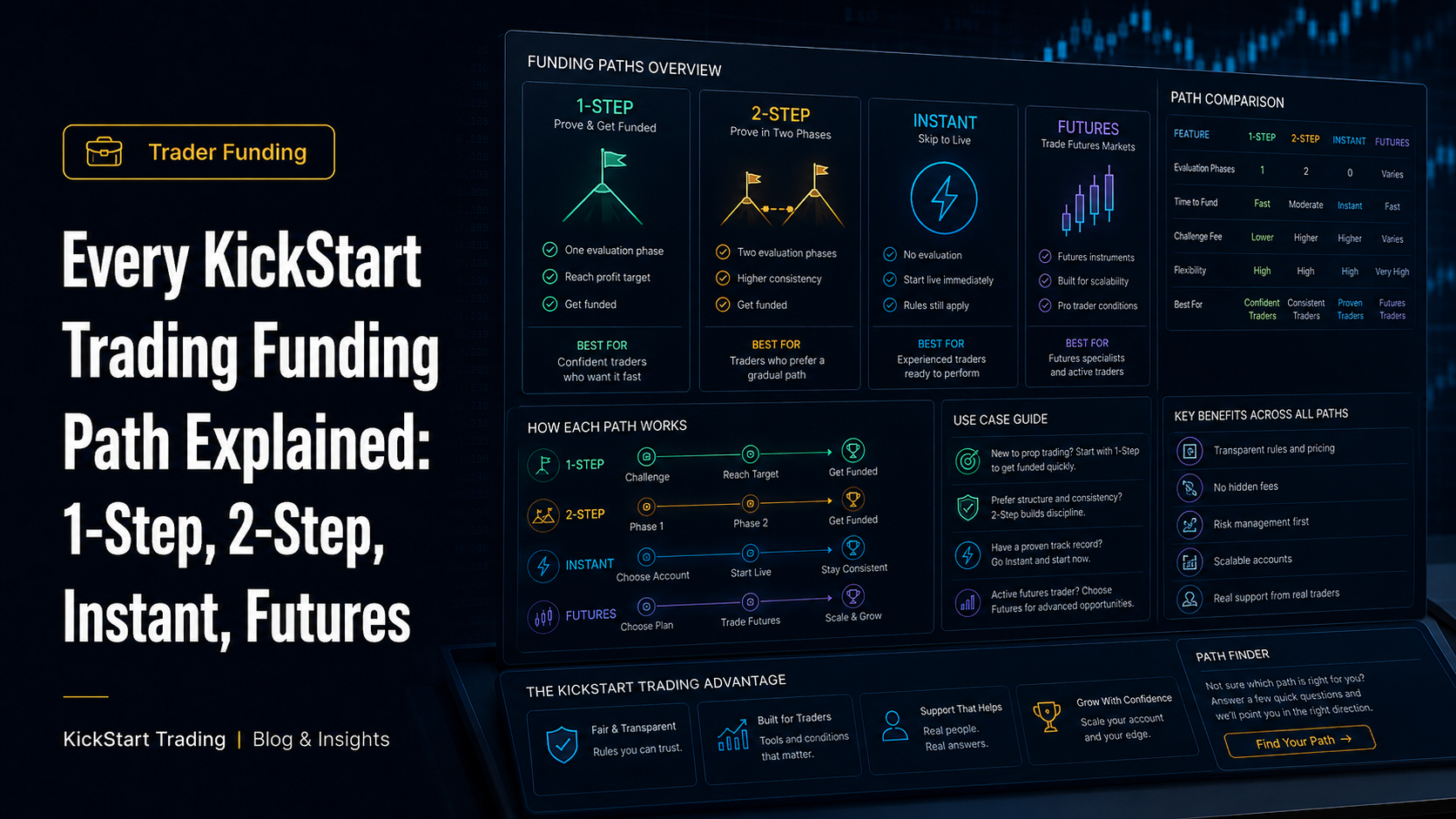
Every KickStart Trading Funding Path Explained: 1-Step, 2-Step, Instant, Futures and More
Not every trader needs the same funding route.
Some traders want a direct path.
Some traders prefer a more structured evaluation.
Some want access to capital without going through a traditional challenge.
Some are focused on forex.
Others are more suited to futures.
That is why KickStart Trading is building a funding ecosystem rather than forcing every trader into one account model.
The goal is simple.
Help traders choose the route that actually fits their trading style, experience level, risk tolerance, and stage of development.
Funding should not be approached blindly.
The right account structure can support a trader’s process.
The wrong one can create unnecessary pressure before the first trade is even placed.
Funding is not one-size-fits-all
Many traders make the mistake of choosing a funded account based only on account size, price, or discount.
They see a large account and imagine the potential payout.
They see a reduced price and rush to buy.
They see a fast route and assume it must be the best option.
But serious traders need to think deeper than that.
A funded account is not just a product.
It is a rule structure.
It has profit targets, loss limits, drawdown rules, time expectations, trading restrictions, and psychological pressure.
If the structure does not match the trader, the account can become harder to manage than it needs to be.
That is why understanding the different funding routes matters.
1-Step Funding
1-Step Funding is designed for traders who want a more direct route.
Instead of passing multiple evaluation phases, the trader has one main challenge or assessment to complete. If they meet the target and follow the rules, they can move toward funded status more quickly than they would in a traditional two-stage model.
This route can appeal to traders who already have a clear strategy and want fewer stages between them and the opportunity.
The benefit is speed and simplicity.
But one-step does not mean easy.
A trader still needs discipline, patience, risk control, and emotional stability. The account still has rules. The trader still has to prove they can manage risk.
A one-step model can be powerful for traders who are ready.
It can be dangerous for traders who are simply impatient.
Who 1-Step Funding may suit
1-Step Funding may suit traders who:
- Already have a tested trading strategy
- Understand risk management
- Can handle pressure
- Want a more direct evaluation route
- Prefer fewer phases
- Can stop trading after losses
- Do not need a long evaluation process to build confidence
This route is best approached by traders who already know how they trade.
If a trader is still jumping between strategies, forcing trades, or struggling to follow basic rules, a faster route may simply expose those weaknesses more quickly.
Speed is useful only when the trader is prepared.
2-Step Funding
2-Step Funding gives traders a more structured route.
Instead of proving themselves in one phase, traders usually complete two stages before moving toward funded status.
The first phase often focuses on achieving a profit target while following the account rules. The second phase typically confirms that the trader can repeat the process and maintain discipline.
This route may take longer, but that can be a benefit.
For many traders, a two-step model creates a more measured environment. It slows the process down and forces the trader to demonstrate consistency over more than one stage.
That structure can be useful for traders who want time to settle into the rules.
Who 2-Step Funding may suit
2-Step Funding may suit traders who:
- Prefer structure
- Want a more gradual evaluation
- Are still building consistency
- Perform better with a slower process
- Want more time to prove their strategy
- Are not in a rush to pass quickly
- Value rule familiarity and repetition
Some traders see two-step funding as slower.
That is true.
But slower is not always worse.
If the slower route helps the trader stay disciplined, control risk, and avoid emotional mistakes, it may be the better choice.
The goal is not simply to pass.
The goal is to become the kind of trader who can keep the account after passing.
Instant Funding
Instant Funding is different from traditional evaluation models.
Instead of completing a challenge first, the trader can access a funded account structure more directly.
This can be attractive for traders who do not want to go through a standard evaluation phase.
But instant funding still requires maturity.
The absence of a challenge does not remove risk. It does not remove drawdown rules. It does not remove daily loss limits. It does not remove the need for discipline.
In some ways, instant funding can require even more emotional control because the trader is operating under funded-account conditions from the beginning.
There is less of a warm-up period.
The trader has to be ready immediately.
Who Instant Funding may suit
Instant Funding may suit traders who:
- Already understand their strategy
- Do not want a traditional challenge phase
- Can trade conservatively from day one
- Understand funded-account rules
- Are comfortable with immediate pressure
- Have strong risk control
- Do not need an evaluation phase to prove discipline to themselves
Instant Funding is not a shortcut around preparation.
It is a different type of funding route.
A trader who is unprepared can still damage or lose the account quickly.
That is why anyone considering instant funding should read the rules carefully and trade with a clear plan from the start.
Futures Funding
Futures Funding is designed for traders who prefer futures markets rather than traditional forex or CFD-style products.
Futures traders often think differently about markets, sessions, contracts, volatility, and execution.
That means the funding structure also needs to make sense for that type of trader.
A futures-focused trader may care about things like:
- Contract sizing
- Session timing
- Market volatility
- News and economic releases
- Platform rules
- Daily loss limits
- Maximum drawdown
- Scaling opportunities
- Execution conditions
Futures Funding can be a strong route for traders who are already comfortable with futures markets and understand how those instruments move.
But, like every funding path, it requires discipline.
The market does not become easier just because the account is funded.
Who Futures Funding may suit
Futures Funding may suit traders who:
- Prefer futures markets
- Understand contract sizing
- Trade around specific sessions
- Are comfortable with faster market movement
- Have experience with futures platforms
- Know how to manage intraday risk
- Want a funding route built around futures rather than forex
A forex trader should not jump into futures funding simply because it looks exciting.
Different markets require different understanding.
The trader needs to know the instrument they are trading.
That includes how it moves, how risk is calculated, and how the account rules apply.
Equities and future pathways
KickStart Trading is also building toward a broader trader development ecosystem.
That means future pathways may include additional routes such as equities-focused opportunities or other market-specific structures.
The principle will remain the same.
The funding route should fit the trader.
A trader should not be forced into one model if their style, market, or experience level requires something different.
The long-term goal is to help traders learn, connect, grow, and access funding opportunities in a way that feels structured rather than random.
Funding should be part of a wider trader development journey.
Not a one-off gamble.
The account size question
Account size matters, but it should not be the only factor.
Many traders immediately look for the biggest account they can afford.
That is understandable.
Larger accounts can create larger potential payouts.
But larger accounts can also create more emotional pressure.
A trader who is used to small position sizes may become nervous when normal losses represent larger monetary amounts. Even if the percentage risk is the same, the psychological impact can feel different.
Before choosing account size, ask:
- Have I traded this size before?
- Can I handle normal losses at this size?
- Will this account make me more disciplined or more emotional?
- Does this account fit my actual strategy?
- Am I choosing this size for the right reason?
Ambition is good.
But ambition needs structure.
Risk rules matter more than hype
Every funding route has rules.
Those rules matter more than marketing language.
Before choosing any account, traders should understand:
- Profit target
- Daily loss limit
- Maximum drawdown
- Static or trailing drawdown
- Balance-based or equity-based calculations
- Minimum or maximum trading days
- Consistency rules
- News trading rules
- Weekend holding rules
- Payout process
- Scaling plan
- What causes a violation
These details can change the entire experience.
Two accounts with the same size can feel completely different depending on the rule structure.
This is why traders should never rush.
Read the rules.
Understand the structure.
Choose deliberately.
Matching the route to the trader
The best funding route depends on the trader.
A disciplined, experienced trader may prefer the directness of 1-Step Funding.
A developing trader may prefer the structure of 2-Step Funding.
A trader who wants funded-account access without a traditional challenge may consider Instant Funding.
A futures trader may prefer a route built around futures markets.
There is no universal answer.
There is only the right fit.
That fit depends on the trader’s experience, strategy, market, risk profile, emotional control, and goals.
Education still comes first
Funding is exciting, but education still comes first.
A trader who does not understand price action, risk management, market structure, drawdown, trading psychology, and discipline is not magically fixed by buying a funded account.
In fact, funding often increases pressure.
That pressure reveals weaknesses.
This is why structured trading education matters.
The trader needs a foundation before trying to perform under funded-account rules.
At KickStart Trading, we believe education, community, coaching, tools, and funding belong together because serious traders need more than one piece of the puzzle.
They need structure.
Common mistakes traders make when choosing a funding route
Many traders make avoidable mistakes before buying a funded account.
They choose the biggest account instead of the most suitable account.
They ignore drawdown rules.
They underestimate daily loss limits.
They assume all funding models are the same.
They buy emotionally after a bad trading period.
They rush because there is a discount.
They do not test whether their strategy fits the rules.
They focus on passing but not on keeping the account.
These mistakes are common.
They are also preventable.
A serious trader slows down enough to choose properly.
How to choose your route
Before choosing a funding route, ask yourself:
- What market do I trade best?
- What timeframes do I use?
- How many trades do I normally take?
- Do I hold overnight or over the weekend?
- Can I respect a daily loss limit?
- Do I understand drawdown?
- Do I perform better under pressure or structure?
- Am I ready for funding, or just excited by it?
- Which account rules fit my actual trading style?
The answers to those questions should guide the decision.
Not hype.
Not impatience.
Not the size of the discount.
The KickStart approach
KickStart Trading exists to help traders build with structure.
That means education before aggression.
Risk before reward.
Process before profits.
Discipline before scale.
Funding can be a powerful part of the journey, but only when approached properly.
The goal is not simply to sell traders the biggest account possible.
The goal is to help traders understand which path makes sense and how to approach it responsibly.
A funded account should be treated like an opportunity to manage capital professionally.
Not a lottery ticket.
Video explanation
This article is designed to pair with a full video breakdown of KickStart Trading’s funding pathways.
Once the video is available, it can be embedded here so traders can watch the full explanation and then use this article as a written reference.
The video will cover:
- 1-Step Funding
- 2-Step Funding
- Instant Funding
- Futures Funding
- How to choose the right route
- What traders should understand before buying
- Why education and risk management still come first
This gives traders a simple way to understand the full ecosystem before choosing a path.
Final thoughts
KickStart Trading offers multiple funding pathways because traders are not all the same.
Different traders need different routes.
Some need speed.
Some need structure.
Some need direct access.
Some need market-specific funding.
But every trader needs discipline, preparation, and risk awareness.
The funding path matters.
But the trader matters more.
Before choosing an account, understand the rules, understand yourself, and choose the route that gives you the best chance to trade responsibly.
Funding is not just about access to capital.
It is about proving you are ready to manage it.
To your health, wealth, and happiness, always,
Chris