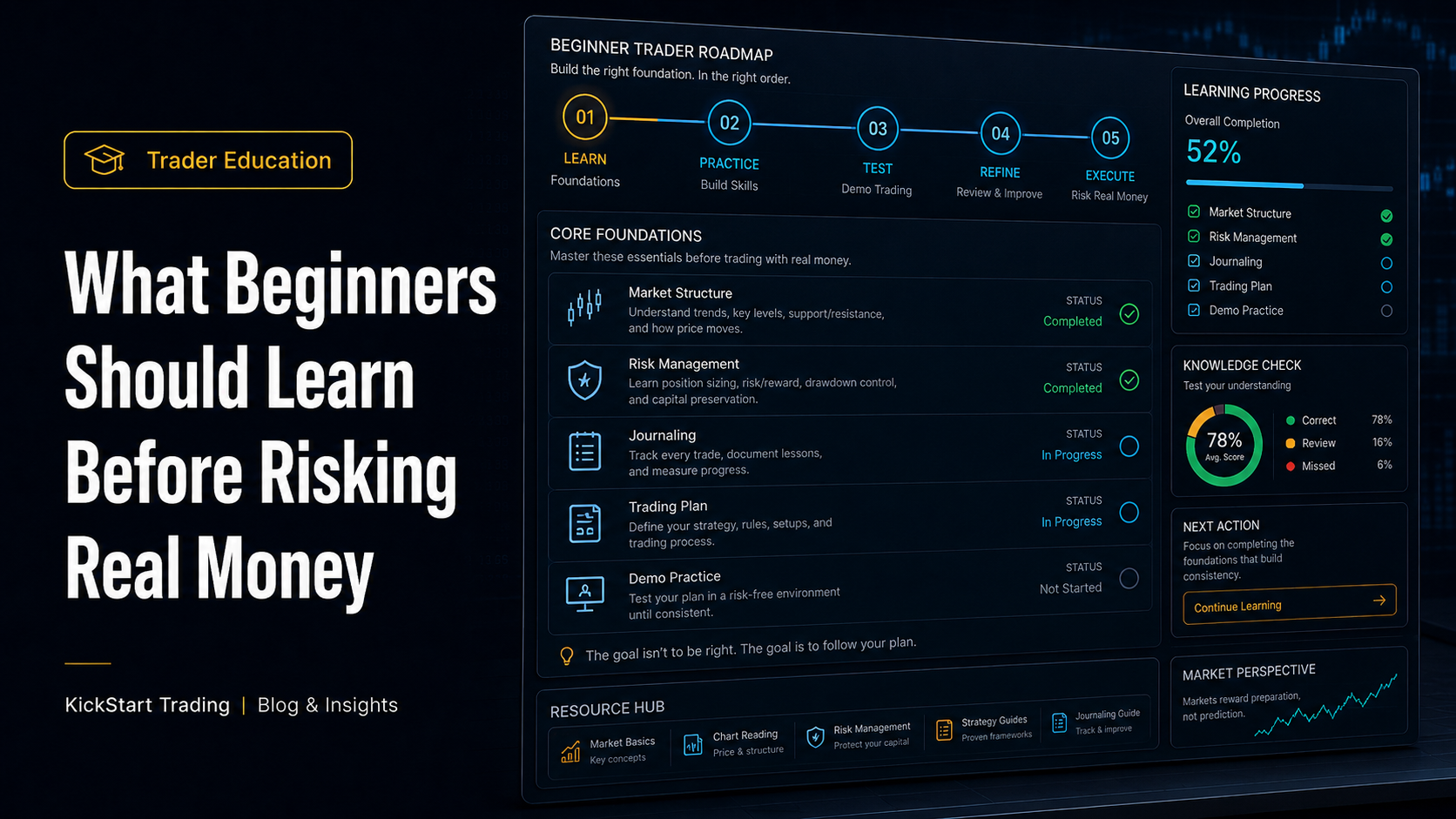
What Beginners Should Learn Before Risking Real Money
Many beginner traders want to get to the exciting part immediately.
They want to place trades.
They want to make money.
They want to catch the move.
They want to prove they can do it.
That is understandable.
But trading with real money before building a proper foundation is one of the fastest ways to create bad habits, emotional damage, and unnecessary losses.
The market is not forgiving just because a trader is new.
That is why beginners should learn certain core skills before risking real money.
Not because they need to know everything.
No trader knows everything.
But because they need enough structure to avoid walking into the market completely unprepared.
Trading is not just buying and selling
At the surface level, trading looks simple.
Buy low.
Sell high.
Enter here.
Exit there.
Make more than you lose.
But real trading is much deeper than that.
A trader must understand market structure, risk, timing, psychology, probability, discipline, and review.
They must learn how to make decisions under uncertainty.
They must learn how to accept losses without losing control.
They must learn how to protect capital when the market does not behave as expected.
This is why trading should not be treated casually.
It is a skill.
And like any serious skill, it needs to be learned properly.
Start with risk management
The first thing a beginner should learn is risk management.
Not indicators.
Not shortcuts.
Not secret setups.
Risk.
A trader can have a strong strategy and still fail if they manage risk poorly. They can find good entries and still lose money if they risk too much, move stops, overtrade, or refuse to accept losses.
Before risking real money, a beginner should understand:
- How much they are willing to risk per trade
- How position sizing works
- Why stop losses matter
- How drawdown affects the account
- Why daily loss limits exist
- Why protecting capital comes before chasing profit
Risk management is not the boring part of trading.
It is the foundation that allows the trader to survive long enough to improve.
Learn what a stop loss really means
A stop loss is not just a random line on the chart.
It should represent the point where the trade idea is no longer valid.
Many beginners place stops based on how much they want to lose, rather than where the market proves them wrong.
That is a problem.
A proper stop should connect to the trade idea.
If a trader buys because price is holding support, the stop should usually be placed where that support has clearly failed.
If a trader sells because price is rejecting resistance, the stop should reflect the point where that idea is invalid.
The stop loss answers the question:
Where am I wrong?
A beginner who does not understand that question is not ready to risk real money.
Understand position sizing
Position sizing is one of the most important practical skills in trading.
It determines how large or small the trade should be based on account size, stop distance, and risk tolerance.
Many beginners make the mistake of choosing lot size first.
They think:
I will trade this size.
Then they place a stop afterwards.
That is backwards.
The better process is:
- Decide how much you are willing to risk.
- Identify the logical stop location.
- Calculate the position size that matches that risk.
This keeps the trade controlled.
Without position sizing, the trader may accidentally risk far more than intended.
That can turn one normal loss into serious account damage.
Learn basic technical analysis
A beginner does not need to master every technical analysis concept before trading real money.
But they do need a basic understanding of how to read a chart.
That includes:
- Candlesticks
- Support and resistance
- Trend direction
- Higher highs and lower lows
- Pullbacks
- Breaks of structure
- Market conditions
- Entry timing
- Basic confluence
The goal is not to make the chart complicated.
The goal is to understand what price is doing.
A beginner should learn to read the market clearly before adding too many tools.
Most new traders do the opposite.
They add indicators, templates, alerts, signal groups, and random strategies before they can even explain basic price action.
That creates confusion.
Learn candlesticks properly
Japanese candlesticks are one of the first things many traders see, but many never learn them properly.
A candlestick shows information about price movement.
It shows where price opened, where it closed, how high it went, and how low it went during that period.
That information can help traders understand pressure, rejection, momentum, indecision, and potential turning points.
But candlesticks should not be used in isolation.
A reversal candle at a random location means far less than a reversal candle at a major support or resistance level.
Beginners should learn candlesticks in context.
The candle matters.
The location matters more.
Learn support and resistance
Support and resistance are foundational trading concepts.
Support is an area where buyers have previously stepped in.
Resistance is an area where sellers have previously stepped in.
These levels help traders understand where price may react.
They are not magic lines.
They are areas of interest.
Beginners should learn how to identify support and resistance without filling the chart with too many levels.
A useful chart should be clear.
If every price is marked as important, no price is important.
Support and resistance help the trader build context.
They should not replace risk management or confirmation.
Understand trend structure
Beginners should learn how to tell whether the market is trending, ranging, reversing, or unclear.
A market moving upward will often create higher highs and higher lows.
A market moving downward will often create lower highs and lower lows.
A ranging market may move sideways between support and resistance.
Understanding trend structure helps traders avoid fighting the market unnecessarily.
A beginner who cannot identify basic trend direction may enter trades against the dominant movement without realising it.
That does not mean countertrend trades never work.
But beginners should usually learn to read trend structure before trying to trade against it.
Learn the difference between a setup and a trade
Not every setup should become a trade.
A trader may see something that looks interesting, but that does not mean it is worth risking money.
Before taking a trade, the trader needs a complete plan:
- Entry reason
- Stop location
- Position size
- Target
- Risk-to-reward profile
- Market context
- News awareness
- Emotional state
A setup is only one part of the decision.
A trade requires risk.
That means it requires more scrutiny.
Beginners often trade every interesting chart pattern they see.
Serious traders are more selective.
Understand risk-to-reward
Risk-to-reward compares how much a trader is risking with how much they are targeting.
For example, if a trader risks $100 to potentially make $200, the trade has a 1:2 risk-to-reward ratio.
This concept is important because a trader does not need to win every trade to be profitable.
But beginners should not use risk-to-reward mechanically.
A 1:3 trade is not automatically good.
A 1:1 trade is not automatically bad.
The target must be realistic.
The stop must be logical.
The setup must make sense.
Risk-to-reward is useful, but it must be combined with proper analysis and execution.
Learn trading psychology early
Trading psychology should not be treated as an advanced topic.
Beginners need it from the start.
The market triggers emotion quickly.
Fear.
Greed.
Frustration.
Impatience.
Overconfidence.
Regret.
A beginner who does not understand these emotions may start breaking rules without realising why.
They may move stops because they are afraid of losing.
They may enter late because of fear of missing out.
They may revenge trade after a loss.
They may overtrade after a win.
Learning psychology early helps traders recognise emotional patterns before those patterns become destructive habits.
Learn to lose properly
One of the most important things a beginner can learn is how to lose.
That may sound strange, but it is essential.
Losses are part of trading.
A trader who cannot accept losses will struggle.
They may move stops, double down, revenge trade, or abandon a good strategy after a normal losing streak.
A proper loss is not failure.
A proper loss is a trade that followed the plan and was controlled within the risk rules.
The beginner needs to understand that losing trades are part of the process.
The goal is not to avoid all losses.
The goal is to keep losses controlled and learn from them.
Learn how to journal
A trading journal is one of the best tools for improvement.
It helps the trader see patterns in their behaviour, strategy, and execution.
A beginner should journal:
- Entry reason
- Stop loss
- Target
- Risk amount
- Trade outcome
- Emotional state
- Mistakes made
- Lessons learned
- Screenshots before and after the trade
Without a journal, traders rely on memory.
Memory is unreliable, especially when emotion is involved.
A journal creates evidence.
It shows what is actually happening.
That makes improvement easier.
Learn before chasing signals
Many beginners are attracted to signals.
They want someone to tell them when to buy and sell.
That may seem easier, but it does not build skill.
A trader who depends entirely on signals may not understand why a trade is being taken, where risk should be managed, or when conditions have changed.
Signals can create dependency.
Education creates independence.
At KickStart Trading, we believe traders should learn the process behind trading decisions, not simply chase instructions from someone else.
A beginner should focus on building understanding.
That is what creates long-term development.
Practice before going live
Before risking real money, beginners should practise.
That can include demo trading, backtesting, forward testing, replay tools, journaling, and studying historical examples.
Practice helps traders understand how their strategy behaves.
It also helps them experience decision-making without immediately adding financial pressure.
Demo trading is not exactly the same as live trading because the emotional pressure is different.
But that does not make it useless.
It is a training environment.
A beginner who cannot follow a plan on demo will usually struggle even more with real money.
Know when not to trade
Beginners often think trading skill means finding more trades.
But sometimes skill means knowing when to stay out.
Poor market conditions can make trading more difficult.
That may include:
- Choppy price action
- Low liquidity
- Major news uncertainty
- Unclear trend direction
- Overextended moves
- Emotional fatigue
- Lack of a valid setup
Not trading can be a professional decision.
A beginner should learn that patience is part of trading.
The market does not need to be traded every day.
Build a simple pre-trade checklist
Before risking real money, beginners should use a checklist.
It does not need to be complicated.
It might ask:
- Does this setup match my strategy?
- Is the market condition clear?
- Do I know my stop loss?
- Do I know my target?
- Is my position size correct?
- Is there major news nearby?
- Am I calm enough to trade?
- Am I risking an amount I can accept losing?
- Would I still take this trade if I was not emotional?
A checklist slows the trader down.
That is valuable.
Many bad trades happen because the trader acts too quickly.
Start small when going live
When a beginner is ready to trade real money, they should start small.
The goal of early live trading is not to get rich.
The goal is to learn how real money affects behaviour.
Even small amounts can change emotions.
A trader may feel more fear, excitement, hesitation, or pressure when real money is involved.
Starting small allows the trader to observe those reactions without taking unnecessary risk.
Live trading should be treated as the next stage of development.
Not a final destination.
Education before aggression
Many beginner traders become aggressive too early.
They increase risk before they understand risk.
They trade real money before they have a plan.
They buy funded accounts before they understand drawdown.
They chase profit before they learn process.
That is backwards.
Education should come before aggression.
A trader who builds properly may move slower at first, but they are building something stronger.
The goal is not to rush into the market.
The goal is to become capable of trading responsibly.
Final thoughts
Before risking real money, beginners should build a foundation.
They should understand risk management, position sizing, stop losses, technical analysis, psychology, journaling, and process.
They do not need to know everything.
But they need enough structure to avoid trading blindly.
The market is not a place to gamble with confusion.
It is a place that rewards preparation, discipline, patience, and risk control over time.
At KickStart Trading, we believe serious traders are built through education before aggression.
Learn first.
Practise properly.
Respect risk.
Then, when the time comes, trade with a plan.
To your health, wealth, and happiness, always,
Chris