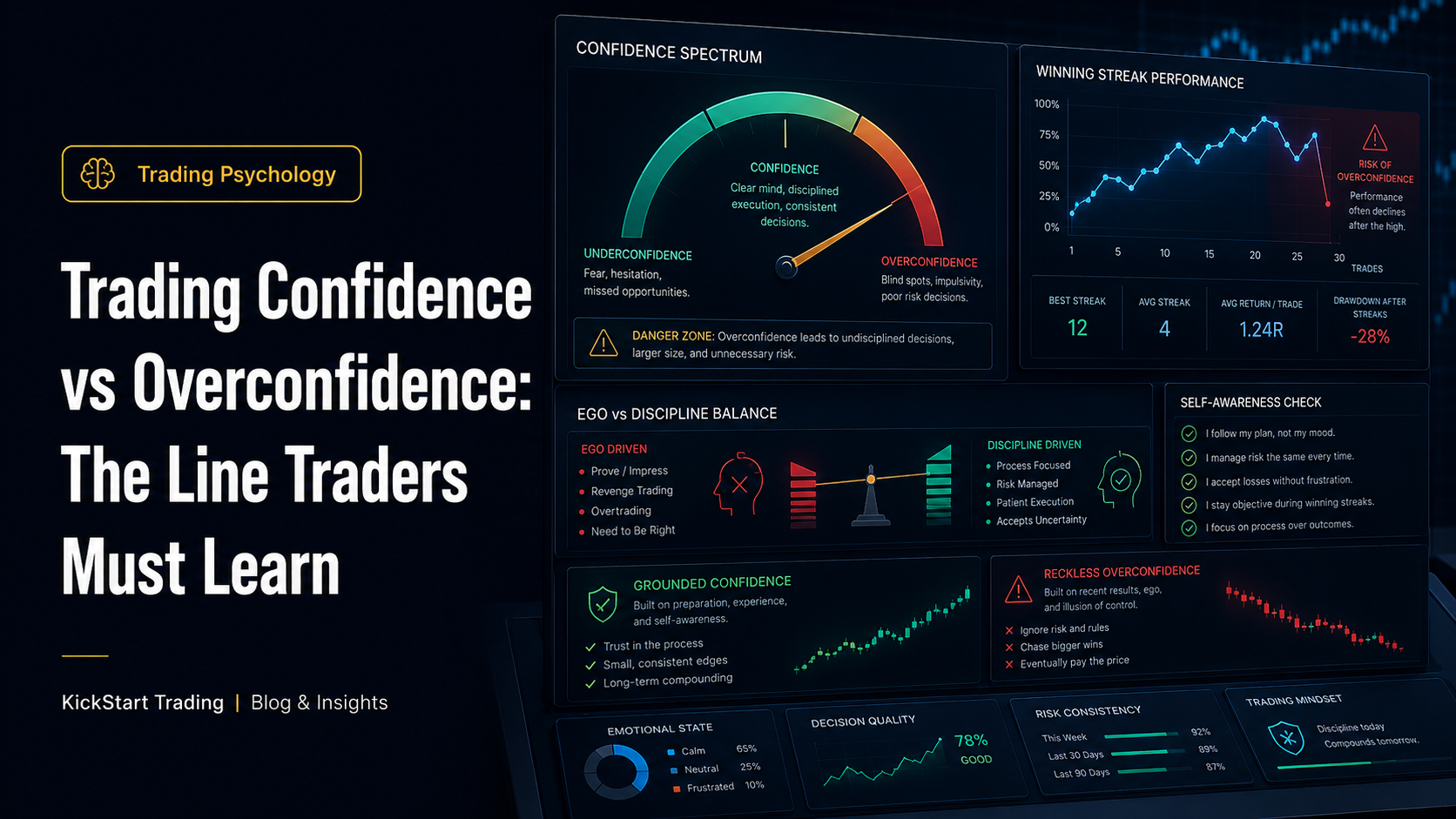
Trading Confidence vs Overconfidence: The Line Traders Must Learn
Confidence is important in trading.
A trader needs enough confidence to execute.
They need confidence to follow their plan, take valid setups, accept controlled losses, and stay patient when the market is not offering opportunity.
Without confidence, a trader may hesitate, second-guess every decision, close trades too early, skip valid setups, or constantly change strategy.
But there is another side to this.
Too much confidence can become dangerous.
Confidence helps a trader execute.
Overconfidence makes a trader careless.
The line between the two matters.
Confidence is built from process
Real trading confidence does not come from hype.
It does not come from one winning trade.
It does not come from a good week.
It does not come from watching motivational videos or imagining future payouts.
Real confidence is built from process.
It comes from preparation, practice, journaling, review, risk management, and repeated execution of a clear plan.
A confident trader does not believe they will win every trade.
They believe they can follow their process whether the trade wins or loses.
That is a very different kind of confidence.
Overconfidence comes from outcome obsession
Overconfidence often appears after a trader experiences a good result.
A winning trade.
A winning day.
A winning week.
A passed challenge.
A strong payout.
The trader starts to feel unusually sharp.
They may begin to think they understand the market better than they actually do.
They may start ignoring rules because recent outcomes made them feel invincible.
That is dangerous.
A good result does not automatically mean the process was good.
Sometimes a trader wins because they made a good decision.
Sometimes they win because the market bailed them out.
If the trader cannot tell the difference, overconfidence can build quickly.
Confidence respects risk
A confident trader respects risk.
They know that any single trade can lose.
They know that even a strong setup can fail.
They know that normal losing streaks are part of trading.
They know that protecting the account matters more than proving a point.
That respect keeps them grounded.
A confident trader may believe in their strategy, but they still use a stop loss.
They may trust their analysis, but they still calculate position size properly.
They may feel ready, but they still follow the rules.
Real confidence does not remove risk controls.
It depends on them.
Overconfidence ignores risk
Overconfidence often shows up as risk expansion.
The trader starts increasing lot size without a clear reason.
They take more trades than usual.
They hold trades longer than planned.
They move stops.
They ignore daily loss limits.
They convince themselves that a setup is better than it really is.
They may say:
I have got this.
I can make this back.
This one is obvious.
I know where the market is going.
Those thoughts can be warning signs.
The market does not reward confidence alone.
It rewards disciplined execution under uncertainty.
Winning streaks can be dangerous
Many traders think losing streaks are the biggest danger.
They are dangerous, but winning streaks can be dangerous too.
After several wins, a trader may begin to relax.
They may stop reviewing trades properly.
They may stop following the checklist.
They may take lower-quality setups because they feel “in sync” with the market.
They may increase risk because they feel momentum.
This is how a winning streak can turn into a major drawdown.
The trader does not lose control because they were failing.
They lose control because success made them careless.
That is why discipline after wins is just as important as discipline after losses.
Losing streaks test confidence
A losing streak tests whether a trader’s confidence is real.
If confidence is based only on recent wins, it disappears quickly when losses appear.
The trader starts questioning everything.
The strategy.
The plan.
The market.
The account.
Themselves.
But if confidence is based on process, the trader can review the losses more calmly.
They can ask:
Did I follow the plan?
Were these normal losses?
Was my risk controlled?
Did I make mistakes?
Is there enough data to justify a change?
This type of thinking helps the trader avoid emotional overreaction.
Confidence based on process can survive normal losses.
Confidence based only on outcome usually cannot.
Overconfidence after passing a challenge
Passing a funded-account challenge can create overconfidence.
The trader feels validated.
They may believe they have proven themselves.
In one sense, they have made progress.
But passing is not the end of the journey.
It is the beginning of a new phase.
Once funded, the trader still has to protect the account, follow the rules, manage drawdown, respect daily loss limits, and avoid emotional decisions.
A trader who becomes careless after passing may lose the funded account quickly.
The habits that pass the account must also be strong enough to keep it.
That is why funded traders need humility after success.
Confidence says “I can follow my plan”
Healthy confidence sounds like this:
I can follow my plan.
I can accept this loss if it happens.
I know my risk.
I know where I am wrong.
I do not need to force this trade.
I can wait for my setup.
I can stop for the day if needed.
This kind of confidence is calm.
It does not need to be loud.
It is not trying to prove anything.
It is rooted in preparation.
Overconfidence says “I cannot lose”
Overconfidence sounds different.
This trade cannot lose.
I know this is going to run.
I can size up here.
I do not need to wait.
I will make it back.
I am seeing the market perfectly.
I will just take one more.
This kind of thinking is dangerous because it removes uncertainty.
But trading is always uncertain.
The trader who forgets uncertainty is more likely to break rules.
Confidence is patient
Confidence allows patience.
A confident trader does not need to trade every movement.
They know their setup will come.
They know missing a move is not failure.
They know poor conditions are not worth forcing.
They know the market will still be there tomorrow.
That patience is powerful.
Many traders overtrade because they do not trust themselves enough to wait.
They feel they must act now.
A confident trader can sit still.
That is a major advantage.
Overconfidence is impatient
Overconfidence often creates urgency.
The trader believes they can extract profit from almost any market condition.
They start forcing trades.
They become bored when nothing is happening.
They take trades because they feel skilled enough to manage anything.
But not every market condition deserves capital.
Sometimes the best decision is to do nothing.
Overconfidence makes doing nothing feel like weakness.
In reality, waiting can be one of the most professional decisions a trader makes.
Confidence accepts being wrong
A confident trader can accept being wrong.
They understand that a losing trade is not a personal insult.
They can close the trade, journal it, and move on.
They do not need to argue with the market.
They do not need to prove themselves right.
They do not need to recover immediately.
This is essential.
Trading requires the ability to be wrong without falling apart emotionally.
A trader who cannot accept being wrong will struggle with stop losses, revenge trading, and overtrading.
Overconfidence refuses to be wrong
Overconfidence often refuses to accept a failed trade idea.
The trader moves the stop.
Adds to the position.
Waits for the market to come back.
Blames manipulation.
Blames news.
Blames the broker.
Blames anything except the fact that the trade idea failed.
That mindset can be destructive.
The market does not care how convinced the trader was.
If the trade is invalid, the trader must respond professionally.
Being wrong is part of trading.
Refusing to be wrong is what causes serious damage.
Confidence uses data
Healthy confidence is supported by data.
A trader may feel confident because they have reviewed their journal, tested their strategy, studied their screenshots, and tracked their execution.
They know what their best setups look like.
They know their common mistakes.
They know when they perform best.
They know which conditions to avoid.
This creates grounded confidence.
It is not blind belief.
It is informed trust in a tested process.
Overconfidence ignores data
Overconfidence often ignores evidence.
The trader may have a journal full of repeated mistakes but still believe the next trade will be different.
They may know they lose money during certain conditions but keep trading them anyway.
They may know oversized risk hurts them but keep increasing size.
They may know they revenge trade but refuse to stop after losses.
When a trader ignores data, they are not confident.
They are being reckless.
A serious trader lets evidence correct them.
The role of humility
Humility is essential in trading.
Humility does not mean weakness.
It means respecting the market.
It means knowing that no analysis is guaranteed.
It means understanding that risk management matters because anything can happen.
It means accepting that there is always more to learn.
The best traders can be confident and humble at the same time.
They trust their process, but they do not worship their opinion.
That balance is powerful.
Build confidence the right way
Confidence should be built gradually.
A trader can build confidence by:
- Studying properly
- Practising consistently
- Following a written trading plan
- Journaling trades
- Reviewing mistakes
- Respecting risk
- Tracking data
- Taking only valid setups
- Keeping losses controlled
- Improving one behaviour at a time
This kind of confidence lasts longer because it is built on behaviour.
Not emotion.
Not hype.
Not one result.
Create rules for winning days
Many traders create rules for losing days, but fewer create rules for winning days.
That is a mistake.
Winning days can create overconfidence.
A trader should know what happens after a strong win.
For example:
- Stop after hitting the daily goal
- Do not increase risk after a win
- Do not take lower-quality setups
- Journal the win properly
- Review whether the win followed the plan
- Protect the day’s progress
- Avoid giving back profit emotionally
These rules help prevent success from becoming the start of a mistake.
Create rules for losing days
Losing days also need rules.
For example:
- Stop after two full-risk losses
- Stop after reaching a personal daily stop
- Stop after an emotional mistake
- Reduce risk after a loss
- Do not trade to recover
- Review before continuing
- Close the platform when frustration appears
These rules help protect confidence from turning into desperation.
The goal is not to avoid losing days.
The goal is to prevent losing days from becoming damaging days.
Confidence and funded accounts
Funded accounts require balanced confidence.
The trader needs enough confidence to execute under pressure, but enough humility to respect the rules.
A funded trader must manage:
- Daily loss limits
- Maximum drawdown
- Profit targets
- Consistency rules
- Account-size pressure
- Payout expectations
- Emotional swings
Overconfidence can cause rule violations quickly.
Underconfidence can cause hesitation and poor execution.
The goal is balance.
Trade the plan.
Respect the account.
Let the process lead.
The KickStart approach
At KickStart Trading, we believe confidence should be earned through structure.
A trader should not rely on hype, hope, or emotional motivation.
They should build confidence through education, practice, risk management, journaling, and disciplined execution.
Confidence is useful when it helps the trader follow the plan.
It becomes dangerous when it convinces the trader they no longer need the plan.
That is the line every trader must learn.
Final thoughts
Confidence and overconfidence are not the same.
Confidence is calm, disciplined, and process-based.
Overconfidence is careless, emotional, and outcome-driven.
Confidence respects risk.
Overconfidence ignores it.
Confidence accepts being wrong.
Overconfidence fights the market.
Confidence waits for the right setup.
Overconfidence forces trades.
A serious trader needs confidence.
But that confidence must be grounded in humility, evidence, and risk control.
The goal is not to feel unstoppable.
The goal is to become reliable.
That is what serious trading requires.
To your health, wealth, and happiness, always,
Chris