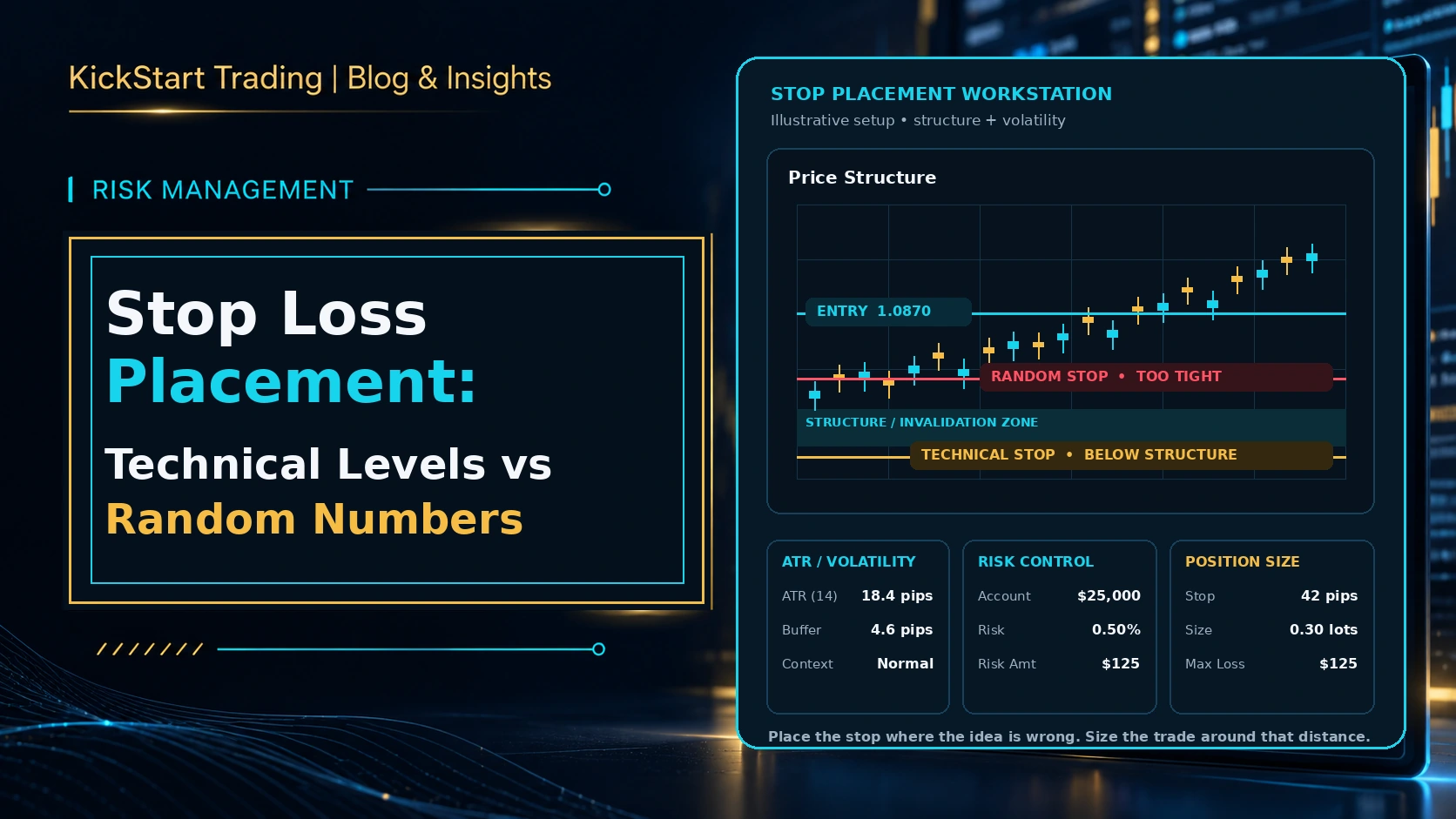
Stop Loss Placement: Technical Levels vs Random Numbers
A stop loss is supposed to answer one question:
Where is this trade idea wrong?
That sounds simple.
But many traders do something very different.
They place stops based on round numbers, fixed pip distances, how much money they are willing to lose, or how uncomfortable they feel watching the position move against them.
Then, when the stop is hit and price later moves in the original direction, they conclude that “stops do not work.”
Usually, the problem is not the existence of the stop.
The problem is where it was placed.
A good stop loss is not an arbitrary pain threshold.
It is part of the structure of the trade.
It should sit at a level where the original reasoning behind the position has been invalidated, while the position size is adjusted so that the financial loss remains acceptable.
That distinction changes everything.
What a stop loss is actually for
A stop loss is a predefined exit point for a losing trade.
Its job is to prevent a small, planned loss from becoming an uncontrolled one.
But a stop loss also has a second purpose:
It defines the point at which the trade thesis is no longer valid.
That is important.
A trader should not think:
“I can afford to lose 20 pips, so my stop goes 20 pips away.”
The trader should think:
“My trade idea is wrong beyond this level. How large can I trade while keeping that distance within my risk limit?”
Those are two very different processes.
The first starts with money and forces the market structure to fit.
The second starts with market structure and uses position sizing to control the money.
The second approach is usually much stronger.
The danger of random stop distances
Random stops often sound disciplined because they use fixed numbers.
A trader may say:
- I always use a 20-pip stop
- I never risk more than 30 points
- I always put my stop $1 below entry
- I use the same stop distance on every trade
That may create consistency in appearance.
But it does not necessarily create consistency in logic.
Markets do not move in fixed units.
A 20-pip stop may be appropriate in one environment and far too tight in another.
A 10-point futures stop may make sense during quiet conditions and be almost meaningless during a volatile session.
The same instrument can behave differently from one day to the next.
A fixed distance ignores that.
Technical invalidation comes first
The most useful way to think about stop placement is through invalidation.
Before entering, ask:
What would price need to do to prove that my setup is no longer valid?
That answer depends on the strategy.
For a long trade, invalidation might occur if price:
- Breaks below a meaningful swing low
- Closes beneath a support level
- Trades through a demand zone
- Fails a breakout and returns into the prior range
- Violates a higher-timeframe structure level
- Moves beyond a volatility threshold built into the strategy
For a short trade, the logic is reversed.
The point is not that every trader should use the same type of stop.
The point is that the stop should be connected to the actual reasoning behind the trade.
Structure-based stops
Structure-based stop placement is one of the most common approaches.
Suppose a trader buys after a higher low forms in an uptrend.
The trade idea depends on that higher low holding.
If price breaks materially below it, the structure has changed.
A stop below that level therefore has a logical purpose.
The stop is not there because 25 pips feels comfortable.
It is there because the technical premise no longer makes sense below the level.
The same reasoning can apply to:
- Swing highs and lows
- Support and resistance
- Supply and demand
- Range boundaries
- Breakout levels
- Trend structure
- Higher-timeframe zones
This creates a direct connection between analysis and risk management.
Why placing the stop exactly on the level can be dangerous
A technically logical stop can still be poorly positioned.
One common mistake is placing the stop exactly on an obvious level.
Markets often trade slightly beyond visible highs, lows, and boundaries before reversing.
That can happen because of:
- Normal volatility
- Liquidity around obvious stops
- Spread
- Fast execution
- Market noise
- News-driven movement
If the setup allows for it, traders may need a buffer beyond the technical level rather than placing the stop directly on it.
The size of that buffer should not be arbitrary either.
It should reflect the instrument and the strategy.
Stop loss versus market noise
A stop can be technically logical and still sit inside normal noise.
This matters especially on lower timeframes.
Imagine an instrument regularly moves 15 to 20 points back and forth during normal rotation.
A stop only five points away may be hit frequently even when the broader setup remains valid.
That does not mean wider stops are always better.
It means stop distance needs to reflect the behaviour of the market.
Volatility matters.
Using volatility to improve stop placement
Volatility-based stops can help traders account for changing market conditions.
One common tool is Average True Range, or ATR.
ATR estimates the typical range of price movement over a selected period.
A trader might use ATR to avoid placing a stop inside normal movement.
For example, if recent average movement has expanded significantly, the trader may decide that the stop needs more room than it did during quieter conditions.
The exact implementation depends on the strategy.
Possible approaches include:
- A fraction of ATR
- One ATR
- A multiple of ATR
- ATR combined with structure
- Volatility bands
- Session-specific range measures
The strongest use of volatility is usually not to replace structure completely, but to add context.
Structure plus volatility is often stronger than either alone
A useful framework is:
Structure tells you where the trade is wrong.
Volatility tells you how much noise may exist around that level.
Suppose a swing low is technically important.
If the market is quiet, a small buffer below it may be enough.
If the market is extremely volatile, that same buffer may be too tight.
This combination can make stop placement more realistic.
Position sizing solves the “wide stop” problem
One reason traders use bad stops is that technically correct stops can feel too wide.
They think:
“If I put my stop there, I will lose too much money.”
The solution is not necessarily to tighten the stop.
The solution may be to reduce the position size.
This is one of the most important relationships in risk management.
If the technical stop needs to be 40 pips away instead of 20, the trader can reduce the position size so the monetary risk stays the same.
For example:
- $100 risk with a 20-pip stop requires one position size
- $100 risk with a 40-pip stop requires roughly half that exposure, assuming pip value is otherwise unchanged
The financial risk stays controlled.
The stop remains technically valid.
That is exactly what the KickStart Position Size Calculator is designed to help calculate.
Do not move the stop just to increase position size
The reverse is also true.
Some traders want to trade a larger position.
So they move the stop closer to entry to make the calculation fit.
That is not precision.
It is risk manipulation.
If the market invalidation level is 30 points away, moving the stop to 15 points does not make the setup better.
It simply increases the chance that normal movement will remove the trader before the thesis has genuinely failed.
The position size should adapt to the stop.
The stop should not be distorted to justify the position size.
Fixed-dollar risk does not define the stop
Another common mistake is beginning with a fixed money amount and translating it directly into stop distance.
For example:
“I only want to lose $100, so I need a 10-point stop.”
That calculation is incomplete.
The $100 defines the maximum financial loss.
It does not define the market level.
The correct sequence is:
- Find the technical invalidation point
- Measure the distance from entry to that point
- Decide the maximum monetary risk
- Calculate the position size that fits both
This sequence keeps technical logic and financial risk connected.
Stop placement and risk-to-reward
Stop distance directly affects the risk-to-reward ratio.
If the stop becomes wider while the target stays the same, the reward multiple becomes smaller.
If the stop becomes tighter while the target stays the same, the reward multiple becomes larger.
This can tempt traders to place stops unnaturally close just to improve the ratio.
That is a mistake.
A visually attractive 1:3 setup is worthless if the stop is sitting somewhere the market is likely to trade through routinely.
The Risk / Reward Calculator is useful for evaluating the relationship, but the numbers only mean something if the stop and target are technically defensible.
The “perfect stop” does not exist
No stop placement guarantees that the market will behave exactly as expected.
Sometimes price will hit the stop by a fraction and reverse.
Sometimes it will move straight through the level.
Sometimes the trade will be invalidated cleanly.
That is trading.
The goal is not to find a stop that never gets hit.
The goal is to define a repeatable invalidation rule that makes sense across a large sample of trades.
One isolated stop-out does not prove the stop was wrong.
The method should be judged over many trades.
Wider stops are not automatically safer
Some traders react to repeated stop-outs by placing stops much farther away.
That creates the opposite problem.
A stop can be so wide that the original trade idea has clearly failed long before the exit is reached.
This increases loss size relative to the opportunity and may damage the overall expectancy of the system.
A stop should give the trade enough room to behave normally.
It should not give a bad trade unlimited room to become worse.
There is a balance.
Tight stops are not automatically more professional
Tight stops often look efficient.
The reward multiple can appear attractive.
The position size can be larger.
But none of that matters if the stop sits inside ordinary market noise.
A tight stop is only good when the strategy and market structure justify it.
Precision comes from context.
Not from small numbers.
Stop loss placement in forex
Forex traders often think in pips.
That makes fixed-distance stops especially tempting.
But different currency pairs have different behaviour.
EUR/USD may behave differently from GBP/JPY.
A stop appropriate during the Asian session may be too tight during the London or New York overlap.
Major news can also dramatically change volatility.
Forex traders should consider:
- Pair volatility
- Session
- Spread
- News
- Swing structure
- Pip value
- Account currency
The KickStart Pip Value Calculator can help translate stop distance into real monetary exposure once the technical stop has been identified.
Stop placement in futures
Futures traders need to think in ticks and points.
A stop that is only a few ticks away may be appropriate for a very specific scalping model.
The same distance may be completely unsuitable for a broader intraday structure setup.
Contract value matters too.
A one-point move in one market does not necessarily equal the same financial exposure in another.
That is why futures traders should combine:
- Technical invalidation
- Tick size
- Tick value
- Contract count
- Volatility
- Session behaviour
The Futures Position Size Calculator helps translate that structure into appropriate contract size.
Stop placement in equities
Equity traders face another set of considerations.
Stocks can gap.
They can move sharply around earnings.
Liquidity can vary significantly.
A stop order may not always execute exactly at the stop price.
That means the planned loss and realised loss may differ.
Equity traders should consider:
- Share price
- Average daily range
- Support and resistance
- Liquidity
- Earnings calendar
- Overnight gap risk
- Position size
A technically valid stop still needs to fit the broader account risk.
Overnight risk changes the meaning of a stop
A stop loss is not a guarantee of an exact exit price.
This becomes especially important when positions are held overnight.
If an instrument gaps beyond the stop, the order may execute at the next available price.
That can create a larger loss than planned.
This is called slippage or gap risk.
Traders holding through:
- Earnings
- Major economic releases
- Weekend closures
- Geopolitical events
- Thin liquidity periods
should understand that a stop can reduce risk but cannot remove all risk.
News can invalidate normal stop assumptions
Major news events can temporarily change market behaviour.
Spreads may widen.
Liquidity may thin.
Price can move rapidly through multiple levels.
A stop placement method that works during normal conditions may behave differently during high-impact releases.
This is why the trading plan should specify whether the strategy operates around major news.
If it does, the trader should test how stops behave under those conditions.
If it does not, avoiding the event may be the better risk-management decision.
Stop losses and funded trading
Funded accounts make stop discipline even more important.
A trader is operating within defined loss limits.
A poorly placed stop can create repeated unnecessary losses.
An excessively wide stop can consume too much of the available drawdown.
An oversized position can turn a routine stop-out into a rule breach.
The trader needs to understand how each stop interacts with:
- Daily loss limits
- Maximum drawdown
- Static or trailing loss rules
- Position size limits
- Account-specific restrictions
A good funded-trading stop is not simply technically valid.
It also fits the risk structure of the account.
A personal stop should sit well inside the firm’s limits
If a funded account allows a large maximum daily loss, that does not mean each trade should use a large portion of it.
The official limit should be treated as an outer wall.
A trader’s own risk per trade and personal daily stop should normally leave significant room inside that boundary.
This is where stop placement, position sizing, and daily risk planning all work together.
The article Daily Loss Limits: Why They Exist and How to Respect Them explores that broader daily-risk framework in more detail.
Never widen the stop because you do not want to lose
One of the most dangerous habits in trading is moving a stop farther away after entry.
The trader originally accepts a certain invalidation point.
Price approaches it.
Then emotion appears.
The trader thinks:
“Maybe it just needs more room.”
So they widen the stop.
Now the original risk plan no longer applies.
The trade may still recover.
That is what makes the behaviour dangerous.
Occasionally being rewarded for breaking the rule teaches the trader to do it again.
Eventually, one trade may not recover.
The loss becomes much larger than planned.
If the original stop was wrong, fix the methodology during review.
Do not improvise after the trade is already losing.
Moving a stop tighter can also be harmful
Traders often assume moving a stop closer is always responsible.
Not necessarily.
Suppose the trader moves the stop to breakeven too early.
The market makes a normal pullback, removes the position, and then continues to the target.
If that happens repeatedly, the management rule may reduce expectancy.
A stop should only move according to a tested management plan.
Examples might include:
- After a defined structure break
- After price reaches a certain R multiple
- Behind a trailing swing
- According to volatility
- After a specific partial-profit rule
The key word is tested.
Stop placement should be backtested
A stop rule should not be based only on what feels logical.
It should be tested.
Compare different stop methodologies across historical samples.
For example:
- Below the prior swing
- Swing plus fixed buffer
- Swing plus ATR buffer
- Fixed ATR multiple
- Candle low or high
- Higher-timeframe invalidation
Then compare:
- Win rate
- Average winner
- Average loser
- Expectancy
- Stop-out frequency
- Maximum drawdown
- Average R
- Behaviour in different volatility regimes
This turns stop placement from opinion into evidence.
Review stopped-out trades properly
When a trade stops out and then reverses, traders often become angry.
But one chart is not enough to change the rule.
Instead, review a meaningful sample.
Ask:
- Was the stop technically valid?
- Was it placed directly on an obvious liquidity level?
- Was the buffer too small?
- Was volatility unusually high?
- Was the entry too early?
- Was the setup weak?
- Did the strategy simply experience a normal losing trade?
Sometimes the stop was genuinely poor.
Sometimes the trade was simply wrong.
The difference matters.
The entry affects the stop relationship
Stop placement cannot be separated completely from entry quality.
A trader who enters late may need a much wider stop to reach the same invalidation point.
That can weaken the reward-to-risk relationship.
A trader who enters too early may place the stop correctly but expose the position to unnecessary movement before confirmation.
This is why good execution combines:
- Setup quality
- Entry timing
- Invalidation
- Position sizing
- Target selection
No single element works alone.
A simple stop-loss framework
A practical pre-trade process could look like this.
Step 1: Define the trade thesis
Why are you entering?
What specific market behaviour supports the idea?
Step 2: Identify invalidation
What price action would prove the idea is wrong?
Mark that level.
Step 3: Add a justified buffer if needed
Consider spread, volatility, normal noise, and the behaviour of the instrument.
Step 4: Measure the stop distance
Calculate the distance from planned entry to stop.
Step 5: Define monetary risk
Decide how much of the account you are willing to lose if the stop is hit.
Step 6: Calculate position size
Use the technical stop distance and monetary risk together.
Step 7: Check the resulting reward profile
Make sure the realistic target still offers an acceptable opportunity.
Step 8: Commit to the stop
Once the trade is entered, do not widen the stop because of emotion.
This process keeps the technical and financial decisions in the correct order.
Signs your stop placement may need work
A trader should review the methodology if they repeatedly experience:
- Stops hit immediately before normal continuation
- Extremely different risk from one trade to another
- Stops based only on fixed pip or point distances
- Stops adjusted after entry without a rule
- Unrealistically tight stops designed to improve R:R
- Very wide stops that survive long after the setup is invalid
- Frequent confusion about why the stop is where it is
- Position sizes chosen before the stop is defined
These are not automatic proof of a bad system.
But they are useful warning signs.
The best stop is not the stop that survives
This is an important mental shift.
Traders sometimes judge stop quality by whether the trade eventually wins.
That is dangerous.
A bad stop can survive and produce a winner.
A good stop can be hit and produce a loss.
The quality of the decision should be judged by the process, not the outcome of one trade.
The question is:
Was the stop placed according to a repeatable, evidence-based rule that properly represented invalidation?
That is what matters.
Accepting the stop is part of trading
A technically valid stop does not remove the emotional discomfort of losing.
The trader still has to accept the result.
This is where risk management becomes psychological.
If the amount lost at the stop feels unbearable, the position may be too large.
If the trader cannot tolerate a normal losing trade, they may begin interfering with execution.
Good position sizing makes it easier to respect the stop.
The article Position Sizing Explained: How Much Should You Risk Per Trade? explains that relationship in detail.
Final thoughts
A stop loss should not be a random number.
It should represent the point where the trade idea no longer deserves capital.
That may be below a swing.
Above resistance.
Beyond a range.
Outside a volatility threshold.
Behind a structural level.
The exact method depends on the strategy.
But the logic should always be clear.
The stop defines invalidation.
Position sizing controls the financial consequence.
Risk-to-reward evaluates whether the opportunity is worth taking.
These pieces belong together.
Do not tighten a stop just to make the ratio look better.
Do not widen it because you cannot accept the loss.
Do not choose a fixed distance simply because it is easy to remember.
Place the stop where the trade is genuinely wrong.
Then size the position so being wrong is survivable.
That is what professional risk management looks like.
To your health, wealth, and happiness, always,
Chris