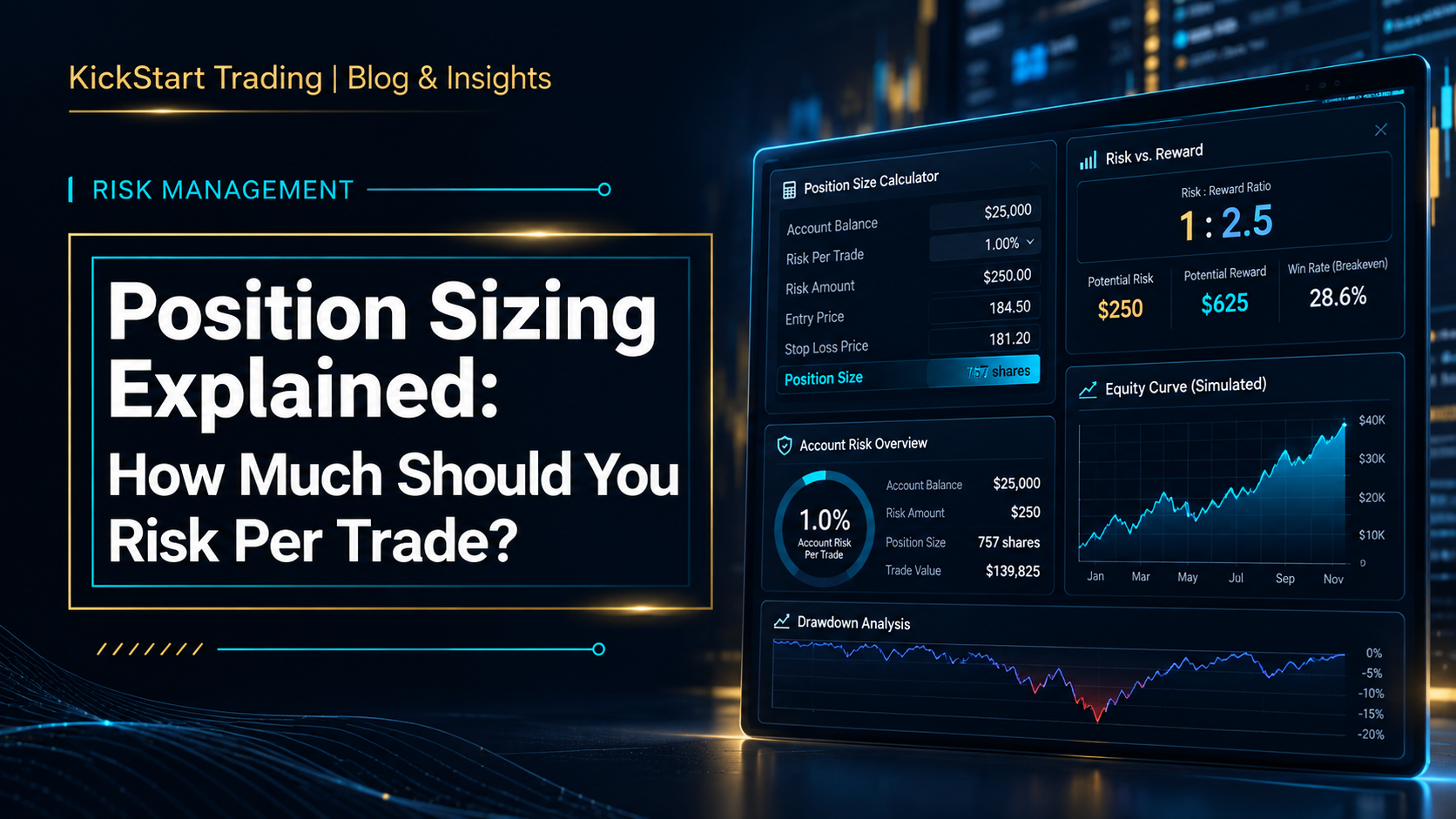
Position Sizing Explained: How Much Should You Risk Per Trade?
Most traders spend a lot of time thinking about entries.
They look for the right setup, the right level, the right confirmation, and the right moment to click buy or sell.
But there is another decision that can matter just as much as the entry itself:
How large should the trade be?
That is the purpose of position sizing.
Position sizing is the process of deciding how much exposure to take on a trade based on the amount of money you are willing to lose if the trade is wrong.
It connects your account size, stop loss, and risk tolerance into one practical decision.
This is important because two traders can take the exact same setup and experience completely different outcomes simply because they used different position sizes.
One trader might lose a controlled 0.5% of the account.
Another might lose 5%.
The market move is identical.
The damage is not.
That is why serious risk management starts before the trade is opened.
What is position sizing?
Position sizing determines how much of an instrument you buy or sell.
Depending on the market, that may mean:
- Lots in forex
- Contracts in futures
- Shares in equities
- Units in other leveraged markets
The correct position size depends on more than account balance alone.
A trader should normally consider:
- Account size
- Maximum acceptable risk on the trade
- Entry price
- Stop loss
- Distance between entry and stop
- Pip, tick, point, or share value
- Currency conversion where relevant
- Commissions and other trading costs
The objective is simple:
If the stop loss is hit, the amount lost should remain within the trader’s planned risk.
This is very different from deciding, “I usually trade one lot,” or, “I always use five contracts.”
Fixed size without reference to stop distance can create wildly inconsistent risk.
Why position size matters so much
Position sizing controls the financial consequence of being wrong.
That matters because losses are unavoidable.
Even a strong trading strategy will produce losing trades.
A trader who sizes positions properly can absorb those losses without putting the account under unnecessary pressure.
A trader who sizes positions badly can turn a completely normal losing trade into a serious account problem.
Consider two traders with $20,000 accounts.
Both take the same setup.
Both enter at the same price.
Both use the same stop loss.
Trader A sizes the position so the maximum planned loss is $100.
Trader B sizes the position so the maximum planned loss is $1,000.
If the stop is hit, Trader A loses 0.5%.
Trader B loses 5%.
After one trade, the difference may already be significant.
After several losing trades, it can become enormous.
Position sizing is therefore not a minor detail.
It is one of the main tools a trader has for controlling account survival.
The basic position sizing process
At its core, position sizing can be broken into three questions:
- How much money am I willing to lose?
- How far away is my stop loss?
- What position size produces that amount of risk?
Suppose a trader has a $10,000 account and decides to risk 1% on a trade.
Their maximum planned loss is:
$10,000 × 1% = $100
Now imagine the trader’s setup requires a 25-pip stop.
The position size must be chosen so that a 25-pip adverse move produces approximately a $100 loss.
The same principle applies to futures contracts, shares, indices, metals, and other instruments.
The exact calculation changes because the unit value changes.
The risk principle does not.
If you want to calculate this quickly, the free KickStart Position Size Calculator can do the sizing work once you know your account size, stop distance, and planned risk.
Position size should follow the stop, not the other way around
One of the biggest mistakes traders make is choosing position size first and then adjusting the stop to make the trade fit.
That reverses the correct process.
The stop loss should normally be placed where the trade idea is invalidated.
Only after that should the trader calculate the correct position size.
For example, imagine a trader sees a valid setup that requires a 40-pip stop.
They usually prefer trading one standard lot.
But one standard lot would risk too much money with a 40-pip stop.
The wrong response is:
“I’ll just use a 15-pip stop instead.”
That may place the stop inside normal market noise and destroy the logic of the setup.
The better response is:
“The setup requires 40 pips, so I need a smaller position.”
The market determines the technical structure.
Risk management determines the position size.
A trader should not distort the structure simply because they want a bigger trade.
How much should you risk per trade?
There is no universal percentage that every trader must use.
You will often hear common figures such as:
- 0.25%
- 0.5%
- 1%
- 2%
But these are guidelines, not laws.
The correct risk level depends on the trader, the account, the strategy, the drawdown tolerance, and the rules being traded under.
A trader operating a funded account with strict daily and maximum loss limits may need to use smaller risk than someone trading personal capital with a wider tolerance.
A trader testing a new strategy may also choose smaller risk.
A trader going through a difficult period may reduce risk further.
What matters is that the number is deliberate.
Risk should not change simply because the trader feels more confident about one setup.
It should be part of the trading plan.
Is 1% risk per trade the right amount?
The 1% rule is popular because it is simple.
Risking 1% means a losing trade costs approximately 1% of the account.
That provides a useful starting point for many traders.
But it is not automatically correct for everyone.
Imagine a funded account with a relatively tight maximum drawdown rule.
A trader risking 1% per trade could lose five trades and already be down approximately 5%.
That may be far too aggressive depending on the account structure.
On the other hand, a trader risking 0.25% would have much more room to absorb normal variance.
This is why risk percentage should be considered in the context of the entire account.
The better question is not:
“Is 1% safe?”
The better question is:
“How does this amount of risk behave across a realistic losing streak?”
That is where position sizing and drawdown management connect.
You can use the KickStart Drawdown Calculator to see what repeated losses at different risk levels can actually do to an account.
Losing streaks change the conversation
Every trader eventually experiences consecutive losses.
The problem is that traders often choose risk based on one trade rather than on a series of trades.
A 2% loss may not sound catastrophic.
But five consecutive 2% losses can create serious pressure.
The trader may start questioning the strategy.
They may reduce discipline.
They may become desperate to recover.
They may increase size.
This is why professional risk thinking considers sequences, not isolated outcomes.
If your normal risk level becomes emotionally or financially difficult after several losses, the position size may be too large.
A good risk level should allow the trader to continue following the plan even when the strategy is going through normal drawdown.
Position sizing and funded accounts
Position sizing becomes even more important when trading funded capital.
Funded accounts often include rules such as:
- Daily loss limits
- Maximum loss limits
- Trailing drawdown
- Static drawdown
- Consistency rules
- Position limits
- Contract limits
The trader cannot ignore these rules.
The position size must fit inside them.
For example, if a funded account allows a 5% maximum loss, risking 2% per trade creates very little room for error.
Two full losses would already consume most of the available drawdown.
Even if the strategy is profitable over time, the account may not survive the short-term variance.
A funded trader should therefore think backwards from the account rules.
Ask:
How many normal losses should this account be able to survive?
Then choose risk accordingly.
This is one of the reasons funded trading requires discipline rather than simply finding good setups.
Daily loss limits should affect your position size
Your daily stop matters too.
Suppose an account has a 5% official daily loss limit.
That does not mean the trader should risk 5% on one trade.
The official rule should be treated as an emergency boundary.
A trader may decide that their personal daily stop is 1.5%.
If they normally risk 0.5% per trade, they have room for three full-risk losses before the personal stop is reached.
That creates structure.
If they risk 1.5% on every trade, one loss ends the day.
Neither approach is automatically wrong, but the trader must understand the consequences.
Position size should fit the daily plan.
The daily plan should fit the account rules.
Everything should connect.
Stop distance changes the position size
This is one of the most important concepts in position sizing.
A wider stop should generally result in a smaller position.
A tighter stop may allow a larger position.
The planned monetary risk can remain the same.
For example:
Trade A has a 20-pip stop.
Trade B has a 40-pip stop.
If the trader wants to risk the same amount on both trades, Trade B should normally use roughly half the exposure of Trade A, assuming the pip value is otherwise equivalent.
This is why traders should not think in terms of one permanent lot size.
A one-lot position might be appropriate for one setup and excessive for another.
The risk should stay consistent even when the stop distance changes.
Do not confuse a tight stop with low risk
A tight stop can allow a larger position.
That does not necessarily make the trade safer.
If the stop is unrealistically tight, the trade may simply be more likely to be stopped out by normal price movement.
This is where technical analysis and risk management must work together.
The stop should make sense structurally.
The position size should then make the financial risk acceptable.
A trader should never tighten a stop just to justify taking more size.
That is not risk management.
It is leverage disguised as precision.
Position sizing in forex
Forex position size is commonly measured in lots.
A standard lot is generally larger than a mini or micro lot, and pip value changes depending on the pair and account currency.
That means forex traders must understand:
- Lot size
- Pip size
- Pip value
- Account currency
- Conversion rate
- Stop distance
A trader may know they want to risk $100, but without knowing the pip value, they still cannot calculate the correct lot size.
The KickStart Pip Value Calculator is useful here because it helps translate movement in pips into actual monetary exposure.
The calculation should never be guessed.
Position sizing in futures
Futures traders size positions using contracts.
The important variables include:
- Tick size
- Tick value
- Point value
- Stop distance
- Number of contracts
- Commissions and fees
This can become particularly important when comparing full-size and micro contracts.
A stop on one futures contract may represent far more monetary risk than the same number of points on another.
That is why futures traders should calculate risk contract by contract.
The Futures Position Size Calculator can help translate planned risk into a whole-contract position.
Position sizing in equities
Equities traders normally think in shares.
The core calculation is straightforward.
If a trader is willing to risk $200 and the difference between entry and stop is $2 per share, then approximately 100 shares would represent $200 of price risk before fees.
But equity traders should also consider position value.
A risk-based calculation might suggest a large number of shares, but that position could consume an uncomfortable amount of account capital.
That is why both risk and account usage matter.
The Equities Position Size Calculator helps show both share size and capital exposure together.
Risk and reward are separate decisions
Position sizing answers:
How much can I lose?
Risk-to-reward analysis asks:
How much might I make relative to that risk?
They work together, but they are not the same calculation.
A trader can size a position perfectly and still take a poor trade.
Likewise, a trade may have an attractive reward target but still be oversized.
Both decisions matter.
Once your position size is correct, the Risk / Reward Calculator can help evaluate the relationship between the stop and target.
The trade should make sense structurally and financially.
Do not increase size because you are “more confident”
Confidence is not a mathematical input.
This is worth remembering.
Traders often change position size based on how good a setup feels.
A normal setup gets 0.5%.
A “really good” setup gets 1%.
A “perfect” setup gets 2%.
The problem is that the trader does not know the outcome in advance.
Every trade contains uncertainty.
If your position sizing framework allows variable risk, the rules for that variation should be defined before the trade appears.
For example, you might have an A-grade and B-grade setup model with clearly documented risk limits.
That is different from increasing size because you feel excited.
Position sizing should reduce emotional decision-making, not create another place for it.
Why oversized trades damage psychology
Oversizing is not only a financial problem.
It changes behaviour.
When the amount at risk feels too large, traders often:
- Move stops
- Close winners too early
- Refuse to accept losses
- Stare at every tick
- Take profits randomly
- Revenge trade after losing
- Become afraid to take the next valid setup
The strategy may not have changed.
The position size changed the trader.
This is one of the clearest signs that risk is too large.
A properly sized trade should still matter.
But it should not create so much emotional pressure that the trader can no longer execute the plan.
Smaller risk can make better execution easier
Reducing risk is sometimes treated as weakness.
It should not be.
Smaller risk can give the trader more room to think clearly.
It can make it easier to let the stop do its job.
It can reduce the urge to interfere with the trade.
It can make a losing streak more manageable.
And it can allow the trader to collect enough real data to understand whether the strategy actually works.
The objective is not to make the largest amount possible on one trade.
The objective is to execute a repeatable process over many trades.
Position sizing helps make that possible.
A simple pre-trade position sizing checklist
Before entering a trade, the trader should be able to answer:
- What is my account balance or equity?
- What percentage or amount am I willing to risk?
- Where is the technically valid stop?
- What is the distance from entry to stop?
- What is the pip, tick, point, or share value?
- What position size keeps the loss within my limit?
- Does this trade fit my daily loss plan?
- Does it fit my maximum drawdown rules?
- Does the resulting position consume too much account capital?
- Have I included commissions or relevant costs?
If those questions cannot be answered, the trade is not fully planned.
Position sizing should be boring
Good position sizing is not exciting.
That is a positive thing.
It should be mechanical.
The trader identifies the setup.
The trader determines invalidation.
The trader calculates the risk.
The trader takes the appropriate size.
There should be very little negotiation.
The more emotional the sizing decision becomes, the more likely the trader is drifting away from the plan.
Consistency is the goal.
The purpose is survival
Position sizing is ultimately about survival.
Trading involves uncertainty.
No trader controls the next market move.
What the trader can control is how much damage one wrong idea is allowed to cause.
That is the power of position sizing.
It allows a trader to be wrong without being destroyed.
It allows losses to remain part of the process rather than becoming emergencies.
It gives the trading edge time to play out.
And in funded trading, it helps keep the trader inside the rules long enough to demonstrate consistency.
Final thoughts
Position sizing is one of the most important skills a trader can learn.
It connects the technical trade idea to the financial reality of the account.
The correct position size is not based on how confident you feel.
It is based on planned risk, stop distance, instrument value, and account structure.
A serious trader decides how much they are prepared to lose before entering the trade.
Then they size the position accordingly.
If the setup requires a wider stop, the size gets smaller.
If the account rules are tighter, the risk may need to come down.
If the position creates too much emotional pressure, it is probably too large.
The goal is not to make every trade big.
The goal is to make every trade survivable.
If you want to calculate your trade size before entering the market, use the free KickStart Position Size Calculator and build the risk decision into your process before the trade begins.
To your health, wealth, and happiness, always,
Chris