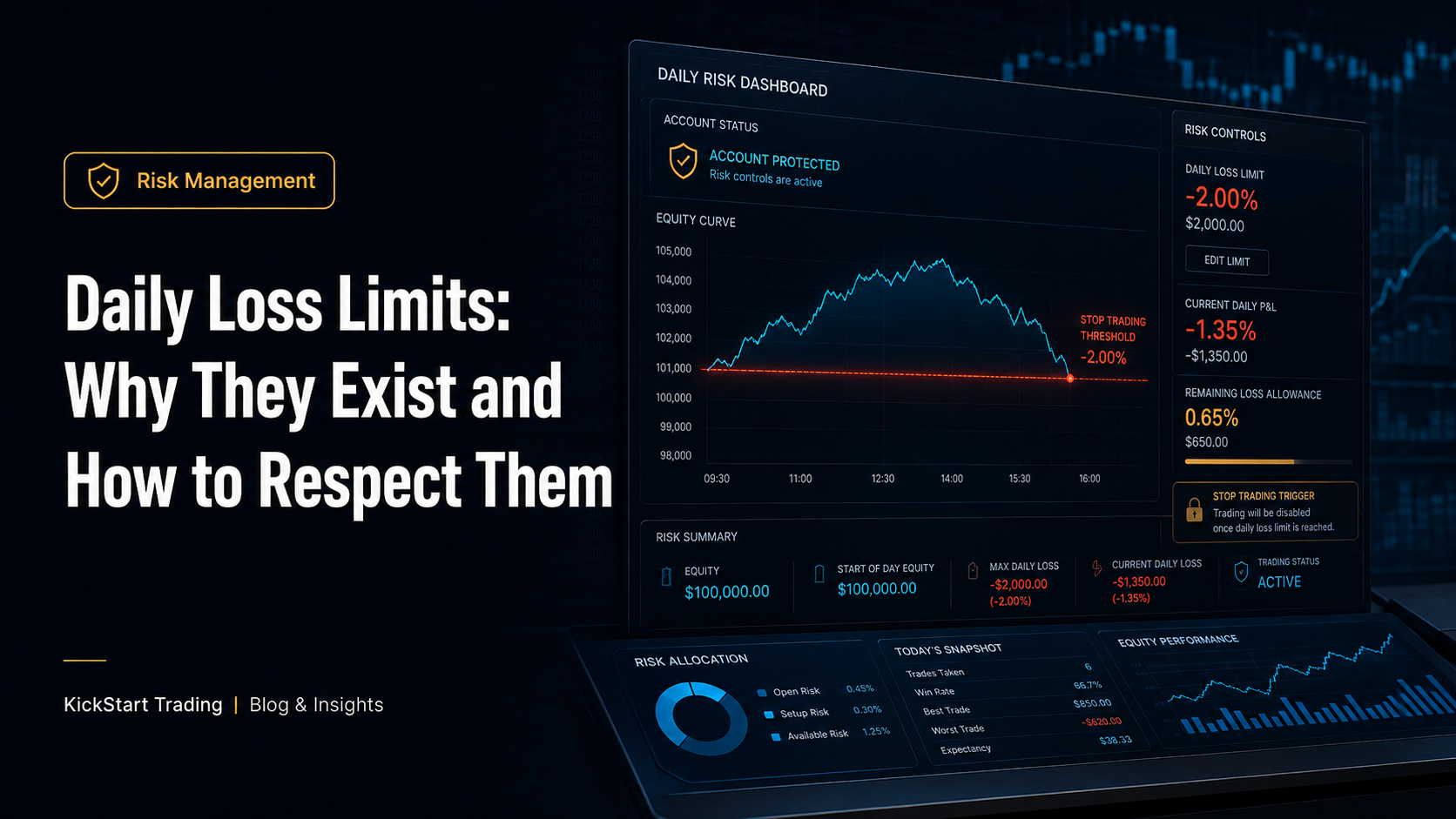
Daily Loss Limits: Why They Exist and How to Respect Them
Daily loss limits are one of the most important rules in trading.
They are also one of the most commonly violated.
Many traders understand daily loss limits in theory. They know the rule is there to protect the account. They know they should stop trading when the limit is close. They know one bad day should not be allowed to destroy weeks of progress.
But knowing the rule is not the same as respecting it.
In funded trading especially, daily loss limits can be the difference between surviving a difficult day and losing the entire account.
That is why traders need to understand not only what daily loss limits are, but why they exist and how to build the discipline to follow them.
What is a daily loss limit?
A daily loss limit is the maximum amount a trader is allowed to lose in a single trading day.
It may be expressed as a percentage of the account or as a fixed monetary amount.
For example, if a $100,000 funded account has a 5% daily loss limit, the trader may not be allowed to lose more than $5,000 in one day, depending on the exact rules of the account.
Some accounts calculate the daily loss limit based on starting balance. Others may calculate it based on equity, balance, or the previous day’s ending value.
That detail matters.
A trader should never assume all daily loss rules are calculated the same way.
Before trading any funded account, the trader must understand exactly how the daily loss limit works.
Why daily loss limits exist
Daily loss limits exist to protect the account from emotional damage.
Every trader can have a losing trade.
Every trader can have a losing day.
But one bad day should not be allowed to become a catastrophic day.
The daily loss limit creates a hard boundary. It tells the trader:
This is the maximum damage allowed today.
That boundary is useful because traders are not always rational under pressure.
After a loss, the temptation to recover can become powerful. The trader may want to win the money back immediately. They may increase risk, take lower-quality setups, or abandon the plan entirely.
The daily loss limit is designed to stop that spiral before it destroys the account.
It exists because trading discipline often breaks when emotion takes over.
Daily loss limits are not the enemy
Some traders see daily loss limits as restrictive.
They feel frustrated because the rule stops them from “getting back in the market” after a bad trade.
But that frustration usually reveals the real issue.
The trader is not upset because the rule exists.
They are upset because the rule is stopping them from acting emotionally.
That is exactly why the rule is there.
A daily loss limit is not designed to punish the trader. It is designed to protect them from the part of themselves that wants to keep trading when they are no longer thinking clearly.
A serious trader learns to respect that protection.
The problem with revenge trading
Revenge trading is one of the biggest reasons traders violate daily loss limits.
It usually starts with one loss.
The trader feels annoyed, embarrassed, or frustrated. They believe the market “should have” moved differently. They want to recover quickly.
So they take another trade.
Then another.
Then another.
The trades become less planned and more emotional. The trader is no longer following a strategy. They are trying to repair how they feel.
That is dangerous.
A daily loss limit is meant to stop the trader before revenge trading becomes account destruction.
The problem is that many traders do not stop when the first warning signs appear.
They keep going until the rule stops them.
By then, the damage is already done.
Why funded traders must take daily limits seriously
In personal trading, breaking your own daily loss limit is damaging.
In funded trading, breaking the account’s daily loss limit can be fatal.
A trader may lose the account immediately if they breach the rule.
This is why funded traders must treat daily loss limits as non-negotiable.
The account does not care why the rule was broken.
It does not care if the trader was “almost right.”
It does not care if the market reversed later.
It does not care if the trader intended to close earlier.
A rule breach is a rule breach.
That may sound harsh, but funded trading requires professional behaviour.
If a trader wants access to capital, they must prove they can protect it.
Know how the daily loss limit is calculated
Before trading, the trader must understand the exact calculation.
This is not optional.
Questions to ask include:
- Is the daily loss limit based on balance or equity?
- Does floating loss count?
- Does floating profit affect the calculation?
- Is the limit based on the starting balance?
- Is it based on the previous day’s closing balance?
- What time does the trading day reset?
- Which timezone is used?
- What happens if the limit is breached by open trades?
- Are commissions included?
- Are swap fees included?
These details can make a major difference.
A trader might think they are safe, but if open losses count toward the daily loss limit, they could be much closer to violation than they realise.
This is especially important for traders using larger position sizes, holding multiple trades, or trading volatile markets.
Build your own personal daily stop
A funded account may have an official daily loss limit, but a smart trader should have a personal daily stop that is smaller than the maximum allowed.
For example, if the account allows a 5% daily loss, the trader might decide to stop at 2% or 2.5%.
That creates a buffer.
The official loss limit should be treated as the emergency wall, not the normal stopping point.
Professional traders do not aim to stop at the maximum allowable damage.
They aim to stop before they get there.
A personal daily stop helps protect the trader from emotional decision-making and gives them room to come back the next day.
Stop after a set number of losses
One practical way to respect daily loss limits is to set a maximum number of losing trades per day.
For example:
- Stop after two full-risk losses
- Stop after three smaller losses
- Stop after one mistake-based loss
- Stop immediately after breaking a rule
This approach is powerful because it prevents the trader from negotiating emotionally.
The decision is made before the trading session begins.
If the rule says stop after two losses, the trader stops after two losses.
No debate.
No bargaining.
No “one more trade.”
The trader can review the market later, but they do not continue trading while emotional.
Reduce risk after losses
Another way to protect the account is to reduce risk after a loss.
Some traders keep risking the same amount after multiple losing trades, even when they are clearly not performing well that day.
That can be dangerous.
A better approach may be:
- Full risk on the first valid setup
- Half risk after one loss
- Stop trading after two losses
- No increased risk after losing trades
The exact rules depend on the trader’s system, but the principle is important.
Losses should make the trader more careful, not more aggressive.
When a trader increases risk after losing, they are often trying to recover emotionally.
That is not risk management.
That is gambling behaviour.
Avoid trading when frustrated
Frustration changes execution.
A frustrated trader sees setups that are not really there. They enter too early. They exit too late. They ignore invalidation. They become impatient.
This is why traders need emotional awareness.
If you feel angry, desperate, rushed, or personally attacked by the market, you are probably not in the right state to continue trading.
A daily loss limit can protect the account, but self-awareness protects the trader before the rule is even reached.
A serious trader learns to step away before the damage becomes serious.
That might mean closing the platform.
Taking a walk.
Writing in a journal.
Reviewing screenshots.
Or simply ending the session.
Walking away is not weakness.
Sometimes it is the most professional decision a trader can make.
The danger of “one more trade”
“One more trade” is one of the most dangerous phrases in trading.
It usually appears when the trader is already emotional.
One more trade to recover.
One more trade to finish green.
One more trade because the setup looks good.
One more trade because the market owes me.
The problem is that “one more trade” often has very little to do with strategy.
It has everything to do with emotion.
Daily loss limits are designed to protect traders from this trap.
If you are near your daily stop, the question should not be, “Can I find one more setup?”
The question should be, “Am I still thinking clearly?”
If the honest answer is no, the session is over.
Daily loss limits protect tomorrow
A daily loss limit does not only protect today’s account balance.
It protects tomorrow’s opportunity.
If a trader loses control today, they may not be able to trade tomorrow.
They may breach the account, damage their confidence, or create emotional pressure that carries into the next session.
Respecting a daily loss limit allows the trader to preserve capital and return with a clearer mind.
That is the whole point.
Trading success is not built in one day.
It is built through repeated disciplined decisions over time.
Protecting tomorrow is part of professional trading.
How to prepare before the session
Before starting a trading session, the trader should know:
- The account balance
- The daily loss limit
- Their personal daily stop
- Their risk per trade
- Their maximum number of trades
- Their planned markets
- Their valid setups
- Their high-impact news risks
- Their stop point if emotion takes over
This preparation should happen before any trade is placed.
Not during the session.
Not after the first loss.
Not when the account is already under pressure.
A trader who starts the day without a clear risk plan is already inviting emotional decision-making.
Daily loss limits and position sizing
Position sizing is directly connected to daily loss limits.
If a trader risks too much per trade, they may reach the daily loss limit after only one or two trades.
That creates pressure.
The trader may become afraid to take valid setups or become desperate after one loss.
A better position size gives the trader room to operate.
For example, a trader risking 0.5% or 1% per trade usually has more flexibility than a trader risking 3% or 4% per trade.
This does not mean every trader must use the exact same risk percentage.
But the trader must understand how their risk per trade interacts with the account’s daily loss limit.
If the position size does not fit the rule structure, the account becomes harder to trade.
Daily loss limits reveal discipline
A trader’s relationship with daily loss limits reveals a lot.
A disciplined trader sees the limit as protection.
An emotional trader sees it as an obstacle.
A professional trader stops before the damage becomes serious.
An impulsive trader keeps going until the platform or rule forces them to stop.
This is why daily loss limits are not just technical rules.
They are behavioural tests.
They test whether the trader can accept a bad day without making it worse.
They test whether the trader can separate discipline from ego.
They test whether the trader can protect the account when they are not getting what they want.
What to do after hitting your personal daily stop
If you hit your personal daily stop, the next step is not to stare at the chart for another three hours.
The next step is to reset.
A useful process might include:
- Close the trading platform
- Save screenshots of the trades
- Write down what happened
- Identify whether the losses were valid or mistake-based
- Review whether the trading plan was followed
- Check emotional state
- Do not trade again that day
This process turns the loss into information.
It also prevents the trader from immediately reacting.
The goal is not to feel good after a losing day.
The goal is to behave professionally after a losing day.
The trader who survives wins
Trading is not about winning every day.
It is about surviving long enough for your edge to play out.
Daily loss limits support that survival.
They stop one bad session from becoming a disaster. They force the trader to respect risk. They create boundaries when emotion wants control.
This is especially important in funded trading, where rule breaches can end the opportunity immediately.
The trader who protects the account gets to come back tomorrow.
The trader who refuses to stop may not.
Final thoughts
Daily loss limits exist for a reason.
They are not there to annoy traders.
They are there to protect the account from emotional decision-making, revenge trading, overexposure, and one bad day becoming catastrophic.
A serious trader does not wait for the official limit to stop them.
A serious trader creates personal rules, respects them, and walks away before the damage becomes too large.
If you want to trade funded capital, you must prove that you can protect capital.
That starts with respecting the daily loss limit.
Not sometimes.
Not only when it feels easy.
Every time.
To your health, wealth, and happiness, always,
Chris