Static vs Trailing Drawdown: The Difference That Really Matters
Drawdown rules can make or break a funded trading account.
Many traders focus on account size, profit targets, payout splits, and discounts.
Those things matter.
But they are not the full picture.
One of the most important things a trader must understand before buying a funded account is how the drawdown works.
More specifically, traders need to understand the difference between static drawdown and trailing drawdown.
This difference can completely change the way an account feels, how much pressure the trader experiences, and how they need to manage risk.
If you do not understand the drawdown structure, you do not fully understand the account.
What is drawdown?
Drawdown is the decline from an account’s highest point to a lower point.
If an account starts at $10,000, grows to $10,800, and then drops to $10,300, the account has experienced a $500 drawdown from its high.
Drawdown is one of the clearest ways to measure risk, account health, and trader discipline.
In funded trading, drawdown is even more important because it is usually tied directly to the account rules.
If the trader breaches the drawdown limit, they may lose the account.
That is why drawdown should never be treated as a small detail.
It is one of the most important rules on the account.
What is static drawdown?
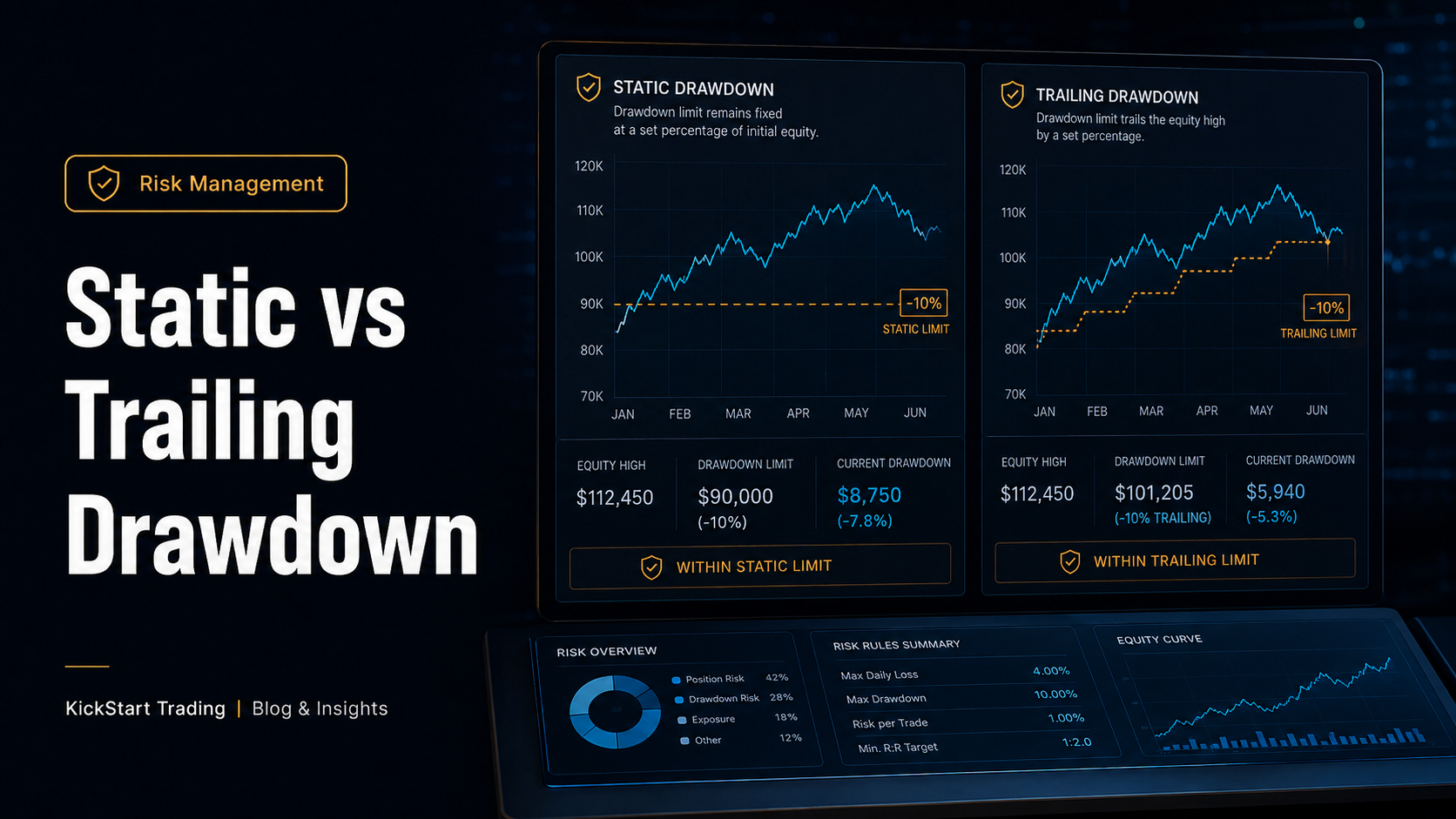
Static drawdown means the loss limit stays fixed.
The drawdown threshold does not continue moving upward every time the account reaches a new high.
For example, if a funded account starts at $100,000 and has a static maximum drawdown of 6%, the maximum loss level may be fixed around $94,000, depending on the exact rules of the account.
If the trader grows the account to $103,000, the drawdown limit does not necessarily move higher with that new peak.
That creates a clearer and more stable risk boundary.
The trader knows where the danger line is.
They can plan around it.
They can calculate risk more comfortably.
This is why many traders prefer static drawdown. It usually feels more predictable.
What is trailing drawdown?
Trailing drawdown moves as the account reaches new highs.
Instead of staying fixed from the starting balance, the drawdown threshold follows the account upward as the trader makes progress.
For example, if an account starts at $100,000 with a trailing drawdown of $6,000, the initial loss limit may be $94,000.
If the account grows to $102,000, the drawdown threshold may move up to $96,000.
If the account grows to $105,000, the threshold may move up again.
The exact calculation depends on the account rules. Some trailing drawdowns are based on balance. Others may be based on equity. Some trail until they reach the starting balance and then lock. Others may work differently.
That is why traders must read the rules carefully.
Trailing drawdown can create more pressure because progress can change the risk boundary.
The trader may be in profit overall, but still at risk if they give back too much from the account high.
Static drawdown usually feels more predictable
The biggest advantage of static drawdown is clarity.
A trader knows the maximum permitted loss level and can plan around it.
That does not make the account easy, but it does make the risk structure easier to understand.
Static drawdown can be especially helpful for traders who prefer a measured approach.
It allows them to think in terms of:
- Account starting balance
- Maximum permitted loss
- Risk per trade
- Number of losses they can absorb
- How much room they have before violating the account
This can reduce emotional pressure because the drawdown line is not constantly moving with every new high.
For traders who are still developing consistency, that clarity can be valuable.
Trailing drawdown can increase pressure
Trailing drawdown is not automatically bad.
Some traders can manage it well.
But it can create a different kind of pressure.
Because the drawdown threshold moves as the account reaches new highs, traders may become more defensive after making profit.
They may start thinking:
What if I give back too much?
What if my open profit increases the drawdown level?
Should I close early?
Should I stop trading?
Should I protect the account instead of following the plan?
Those questions can affect execution.
A trader may start cutting winners too early, avoiding valid setups, or trading emotionally because the account feels more fragile.
That does not mean trailing drawdown should always be avoided.
It means the trader must understand the rule and know how to trade within it.
Balance-based vs equity-based trailing drawdown
One of the most important details is whether trailing drawdown is based on balance or equity.
Balance usually refers to closed trades.
Equity includes open trades.
This distinction matters.
If trailing drawdown is based on equity, then open profit may affect the drawdown calculation before the trade is closed. That can surprise traders who do not understand how the account is being measured.
For example, a trader may be in a winning trade, see the account equity reach a new high, and then later watch the trade pull back. Depending on the rules, that temporary equity high may have moved the trailing drawdown level.
That can create risk even though the trader may feel they did nothing wrong.
This is why traders should never assume all trailing drawdown rules work the same way.
They need to know exactly how the rule is calculated.
Why this matters for funded traders
In personal trading, drawdown rules are usually self-imposed.
In funded trading, drawdown rules are contractual.
That means a trader can lose access to the account if they break them.
This is why funded traders must treat drawdown rules seriously.
Before choosing any account, traders should understand:
- The maximum drawdown
- The daily loss limit
- Whether drawdown is static or trailing
- Whether trailing drawdown is based on balance or equity
- Whether the drawdown locks at a certain level
- How open trades affect the rule
- Whether profits create more breathing room or more pressure
A trader who skips these details is taking unnecessary risk before the first trade is even placed.
Static drawdown and two-step accounts
Many traders associate static drawdown with more traditional evaluation structures, including some 2-Step Funding routes.
A two-step account can sometimes feel more gradual because the trader has more time to prove consistency across phases.
If the drawdown is static, the account may feel easier to plan around because the risk boundary is clear.
This can suit traders who prefer structure, patience, and a more measured challenge.
It does not remove the need for discipline.
But it may reduce some of the emotional friction that comes with a moving drawdown line.
Trailing drawdown and faster routes
Trailing drawdown is often found in account structures that offer a more direct or faster path.
Some traders accept trailing drawdown because they want a quicker route, a simpler evaluation, or access to funding without multiple phases.
That can make sense for the right trader.
But it requires maturity.
A trader using a trailing drawdown account needs to understand how to protect progress without becoming fearful. They need to manage position size carefully, avoid overexposure, and know how much room they really have.
This kind of structure can punish emotional trading quickly.
If the trader pushes too hard early, gives back profit, or misunderstands the drawdown calculation, the account can be lost even if the strategy itself has potential.
Which drawdown structure is better?
Neither static drawdown nor trailing drawdown is automatically better.
The better structure depends on the trader.
Static drawdown may be better for traders who:
- Prefer clear and fixed account boundaries
- Are still developing consistency
- Want more predictable risk planning
- Feel pressured by moving loss limits
- Trade more carefully with defined risk levels
Trailing drawdown may be suitable for traders who:
- Understand the rules clearly
- Have strong emotional discipline
- Can manage open profit responsibly
- Are comfortable with a moving risk boundary
- Want a faster or more direct funding route
The key is self-awareness.
A trader should not choose an account based only on the potential payout.
They should choose the rule structure they can actually trade well.
The emotional side of drawdown
Drawdown is not just about numbers.
It is about psychology.
When traders get close to a drawdown limit, their decision-making can change. They may become fearful, hesitant, impatient, or desperate.
A static drawdown line may feel easier to manage because it is clear.
A trailing drawdown line may feel more stressful because the account’s risk boundary changes as performance changes.
That emotional difference matters.
A trader who understands themselves honestly can choose a funding route that reduces unnecessary pressure.
This does not mean avoiding challenge.
It means choosing the right challenge.
Common mistakes traders make
Many traders make the same mistakes with drawdown rules.
They buy the account before reading the full rules.
They assume all drawdown works the same way.
They ignore whether the drawdown is based on balance or equity.
They risk too much per trade.
They chase the profit target aggressively.
They fail to adjust risk after losses.
They do not know when to stop for the day.
They treat drawdown as something to worry about later.
That is backwards.
Drawdown should be understood before the account is purchased.
Not after the first losing streak.
How to prepare for either structure
Whether a trader chooses static drawdown or trailing drawdown, preparation is essential.
Before trading, the trader should know:
- The account’s exact drawdown limit
- Their risk per trade
- Their maximum number of trades per day
- Their daily stop point
- Their weekly review process
- Their rules after consecutive losses
- Their rules after reaching new account highs
- Their plan for protecting capital without abandoning good trades
This kind of preparation prevents emotional negotiation.
The trader is not trying to invent rules under pressure.
The rules already exist.
Use position sizing properly
Position sizing is one of the strongest tools for managing drawdown.
If the trader risks too much, even a normal losing streak can become dangerous.
A trader risking 3% to 5% per trade on a funded account may have very little room for error.
A trader risking 0.5% to 1% per trade usually has more room to absorb losses, review performance, and continue executing the plan.
This does not mean every trader must risk the exact same amount.
But the principle is clear.
The higher the risk per trade, the faster drawdown can become a serious problem.
This is especially important on accounts with trailing drawdown.
Choose the account you can trade responsibly
A funded account should match the trader’s actual behaviour, not their fantasy version of themselves.
If a trader knows they struggle under pressure, they should be careful with account structures that increase emotional stress.
If a trader knows they cut winners too early, they should understand how trailing drawdown may affect that behaviour.
If a trader knows they overtrade after losses, they need strict daily rules before buying any account.
The best account is not always the biggest account.
It is not always the cheapest account.
It is not always the fastest account.
The best account is the one you can trade responsibly.
Final thoughts
Static drawdown and trailing drawdown are not small technical details.
They shape the entire funded trading experience.
Static drawdown usually gives traders a clearer and more predictable risk boundary.
Trailing drawdown can offer opportunity, but it can also create more pressure if the trader does not understand how it works.
Neither structure guarantees success.
Both require discipline.
Both require preparation.
Both require proper risk management.
At KickStart Trading, we believe traders should understand the rules before chasing the reward. That means studying the account structure, respecting drawdown, managing position size, and choosing the funding pathway that fits the trader’s actual level of development.
A serious trader does not just ask, “How much can I make?”
A serious trader asks, “What risk am I agreeing to manage?”
That question can make all the difference.
To your health, wealth, and happiness, always,
Chris