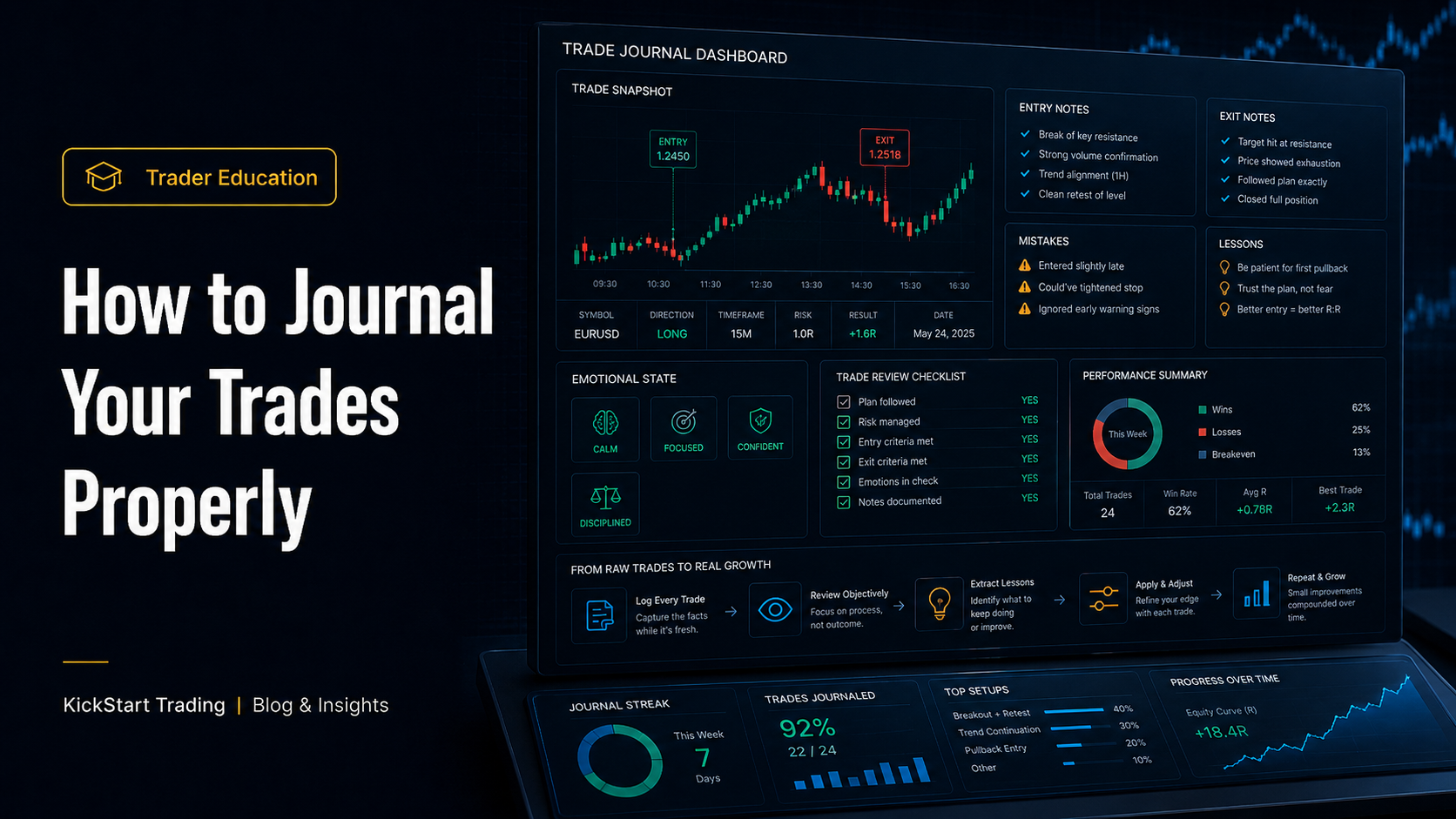
How to Journal Your Trades Properly
A trading journal is one of the most powerful tools a trader can use.
It is also one of the most ignored.
Many traders say they want consistency, but they do not properly track their decisions. They take trades, win or lose, feel good or bad, and then move on without recording what happened.
That makes improvement much harder.
Without a journal, traders rely on memory.
Memory is not reliable.
Especially in trading.
Emotion changes how traders remember decisions. A trader may remember a winning trade as better than it really was. They may remember a losing trade as worse than it really was. They may forget the hesitation, the impulse entry, the moved stop, the missed rule, or the emotional reaction that actually mattered.
A trading journal creates evidence.
And evidence helps traders improve.
What is a trading journal?
A trading journal is a record of trading decisions, trade outcomes, execution quality, emotional state, screenshots, mistakes, and lessons.
It is not just a list of wins and losses.
A basic trade log may record the date, market, entry, exit, profit, and loss.
That is useful.
But a proper trading journal goes deeper.
It helps the trader understand why the trade was taken, whether it followed the plan, how it was managed, and what can be learned from the result.
The purpose of a journal is not simply to collect data.
The purpose is to create better decisions over time.
Why traders avoid journaling
Many traders avoid journaling because it feels boring.
It is not as exciting as finding a setup.
It is not as satisfying as winning a trade.
It requires honesty.
That is often uncomfortable.
A journal can reveal patterns the trader may not want to see.
It may show that the trader overtrades after losses.
It may show that most mistakes happen at a certain time of day.
It may show that the trader does not follow the strategy as consistently as they believed.
It may show that the trader’s biggest losses come from emotional decisions, not strategy failure.
That honesty is exactly why journaling matters.
A trader cannot fix what they refuse to measure.
A journal separates strategy problems from behaviour problems
One of the biggest benefits of journaling is that it helps separate strategy problems from behaviour problems.
Many traders blame the strategy when the real issue is execution.
For example, a trader may say:
This strategy does not work.
But the journal may show something different.
It may show that the trader entered late, moved stops, skipped valid setups, overtraded, closed winners too early, or increased risk after losses.
That is not necessarily a strategy problem.
That is a behaviour problem.
Without a journal, the trader may abandon a good strategy because they never properly identified the real issue.
Record the basic trade details
Every trading journal should include the basic trade details.
These may include:
- Date
- Market
- Direction
- Entry price
- Stop loss
- Take profit
- Exit price
- Position size
- Risk amount
- Result
- R-multiple
- Session
- Timeframe
These details help the trader analyse performance clearly.
They also create a record of what actually happened.
Over time, basic data can reveal useful patterns.
For example, the trader may discover that certain markets, sessions, or setups perform better than others.
That information can help refine the trading plan.
Record the reason for entry
A trading journal should always include the reason for entry.
This is one of the most important sections.
The trader should be able to explain why the trade was taken.
For example:
- Price pulled back into support
- Market structure supported the trade idea
- Fibonacci confluence aligned with a key level
- Candlestick confirmation appeared
- The trend was clear
- The trade matched the plan
- Risk-to-reward was acceptable
If the trader cannot explain the entry clearly, the trade may not have been planned properly.
A vague reason usually indicates a vague setup.
A strong journal entry forces the trader to define the trade idea before or immediately after execution.
Record the invalidation point
Every trade should have an invalidation point.
The invalidation point is where the trade idea is no longer valid.
This should be recorded in the journal.
Not just the stop loss.
The logic behind the stop loss.
For example:
My trade idea is invalid if price breaks below the support area and closes beneath the previous swing low.
That kind of note is useful.
It helps the trader review whether the stop was placed logically or emotionally.
Many traders place stops based on fear, convenience, or the amount they want to lose.
A journal helps identify whether the stop actually matched the trade idea.
Record the risk
Risk should be recorded clearly.
The trader should know:
- How much was risked in money terms
- How much was risked as a percentage
- Whether the risk matched the trading plan
- Whether the risk was increased or reduced
- Whether the risk made sense relative to the account
- Whether the trade threatened daily loss limits or drawdown rules
This is especially important for funded accounts.
A trader may take a technically valid trade but still risk too much for the account structure.
The journal should reveal that.
Risk is not only about the chart.
It is about the account.
Record the emotional state before entry
This is where many traders resist honesty.
But emotional state matters.
Before entering the trade, the trader should record how they felt.
Calm.
Rushed.
Confident.
Frustrated.
Desperate.
Excited.
Bored.
Angry.
Fearful.
That emotional information can become incredibly valuable over time.
A trader may discover that their worst trades happen when they feel rushed.
Or when they are trying to recover from a loss.
Or when they trade out of boredom.
Or when they feel overly confident after a winning streak.
The market does not only test technical skill.
It tests emotional control.
A journal helps the trader see that clearly.
Record whether the trade followed the plan
Every trade should be marked as either plan-based or non-plan-based.
This is more important than whether the trade won or lost.
A winning trade that broke the plan is still a problem.
A losing trade that followed the plan may be acceptable.
This distinction is essential.
If a trader only judges trades by outcome, they may reinforce bad behaviour.
They may think a reckless winner was a good trade.
They may think a disciplined loser was a bad trade.
That creates confusion.
A proper journal should ask:
Did I follow the plan?
That question builds professionalism.
Take screenshots
Screenshots are one of the best parts of a trading journal.
A trader should save screenshots before, during, and after the trade when possible.
Useful screenshots include:
- The setup before entry
- The entry point
- Stop and target placement
- Trade management decisions
- The final result
- Higher-timeframe context
- Any emotional or mistake-based changes
Charts reveal things that written notes may miss.
Later, the trader can review whether the trade looked as good as it felt at the time.
That can be eye-opening.
Many impulsive trades look obvious in hindsight when reviewed calmly.
Record trade management decisions
A journal should include what happened after entry.
Did the trader follow the management plan?
Did they move the stop?
Did they close early?
Did they scale out?
Did they add to the position?
Did they hesitate?
Did they panic?
Did they hold properly?
Did they exit according to plan?
Trade management is where many traders lose discipline.
The entry may be clean, but the management may be emotional.
A journal helps reveal whether the trader’s biggest problem is finding trades or managing them after entry.
Record mistakes clearly
A trader should not hide mistakes from the journal.
The journal is not there to make the trader look good.
It is there to help the trader improve.
Mistakes might include:
- Entered too early
- Chased price
- Ignored the stop plan
- Moved stop loss
- Risked too much
- Took a trade outside the strategy
- Traded during poor market conditions
- Ignored high-impact news
- Revenge traded
- Overtraded
- Closed from fear
- Held from hope
Mistakes should be recorded clearly and calmly.
No drama.
No shame.
Just evidence.
Separate normal losses from mistake-based losses
Not all losses are the same.
A normal loss happens when the trader followed the plan and the trade simply did not work.
That is part of trading.
A mistake-based loss happens when the trader broke the plan.
These should be treated differently.
A normal loss may not require any major change.
A mistake-based loss requires behavioural review.
This distinction prevents emotional overreaction.
A trader should not abandon a strategy because of normal losses.
But they should take repeated mistake-based losses seriously.
The journal helps separate the two.
Review winning trades too
Many traders only review losses.
That is a mistake.
Winning trades should also be reviewed.
A winning trade may have followed the plan perfectly.
Or it may have been lucky.
The trader needs to know the difference.
Review winning trades and ask:
- Did I follow the plan?
- Was the entry valid?
- Was the risk appropriate?
- Did I manage the trade properly?
- Did I exit according to plan?
- Was the win process-based or random?
A reckless win can be dangerous because it may encourage the trader to repeat poor behaviour.
A journal helps prevent that.
Track patterns over time
The real power of journaling comes from reviewing patterns over time.
One trade does not reveal everything.
Ten trades reveal more.
Fifty trades reveal even more.
A trader may begin to see patterns such as:
- Best setups
- Weakest setups
- Best trading sessions
- Worst trading times
- Most common emotional mistakes
- Average risk-to-reward
- Typical losing streak length
- Markets that fit the trader best
- Conditions that should be avoided
This is where journaling becomes strategic.
It helps the trader refine what they do and remove what damages performance.
Use weekly reviews
A trading journal should be reviewed regularly.
A weekly review can be especially useful.
At the end of each week, the trader can ask:
- How many trades did I take?
- How many followed the plan?
- What was my total result?
- What was my average R?
- What mistakes repeated?
- What did I do well?
- What should I stop doing?
- What should I continue doing?
- What is the main focus for next week?
This turns the journal into a development tool.
The trader is not just collecting information.
They are using it.
Use monthly reviews
Monthly reviews help traders see the bigger picture.
A month gives more data than one week.
During a monthly review, the trader can look at:
- Overall performance
- Best setups
- Worst setups
- Risk consistency
- Emotional patterns
- Journal quality
- Rule compliance
- Improvements made
- Weaknesses that remain
This helps prevent short-term thinking.
A bad day does not define the trader.
A good day does not prove mastery.
The bigger pattern matters.
Keep the journal simple enough to use
A journal should be detailed enough to help, but simple enough to maintain.
Some traders create overly complicated journals and then stop using them.
That defeats the purpose.
The best journal is the one the trader will actually use.
Start with the essentials:
- Setup
- Entry
- Stop
- Target
- Risk
- Result
- Emotion
- Mistake
- Lesson
- Screenshot
The journal can become more advanced over time.
Consistency matters more than complexity.
Be honest
A trading journal only works if the trader is honest.
If the trader hides mistakes, edits the story, or avoids emotional notes, the journal becomes less useful.
The journal is not public performance.
It is private truth.
That truth is valuable.
It helps the trader see what is actually happening rather than what they wish was happening.
Honesty can be uncomfortable.
But it is necessary for growth.
Journaling and funded accounts
Journaling is especially important for funded traders.
Funded accounts have rules.
A journal can help traders track whether they are respecting those rules.
It can show:
- Risk per trade
- Daily loss exposure
- Drawdown pressure
- Rule compliance
- Emotional mistakes
- Overtrading
- News-risk decisions
- Consistency problems
This information can help traders protect the account.
A funded trader should not wait until failure to analyse what happened.
They should review constantly.
Turn lessons into rules
The goal of journaling is not only to record mistakes.
It is to turn lessons into rules.
For example:
If the journal shows that the trader loses money after two consecutive losses, the new rule might be:
Stop trading after two losses.
If the journal shows poor decisions during high-impact news, the rule might be:
Do not open new trades 30 minutes before major news.
If the journal shows overtrading after a big win, the rule might be:
Stop trading after reaching the daily goal.
This is how the journal improves behaviour.
Evidence becomes rules.
Rules create structure.
Structure supports consistency.
Final thoughts
A trading journal is not optional for serious traders.
It is one of the clearest ways to understand performance, behaviour, mistakes, and progress.
Without a journal, traders often repeat the same problems without seeing them clearly.
With a journal, they can identify patterns, separate strategy issues from discipline issues, and improve their decision-making over time.
The goal is not to write perfect notes.
The goal is to build self-awareness.
Record the trade.
Record the reason.
Record the risk.
Record the emotion.
Record the mistake.
Record the lesson.
Then review it.
That process can change everything.
To your health, wealth, and happiness, always,
Chris